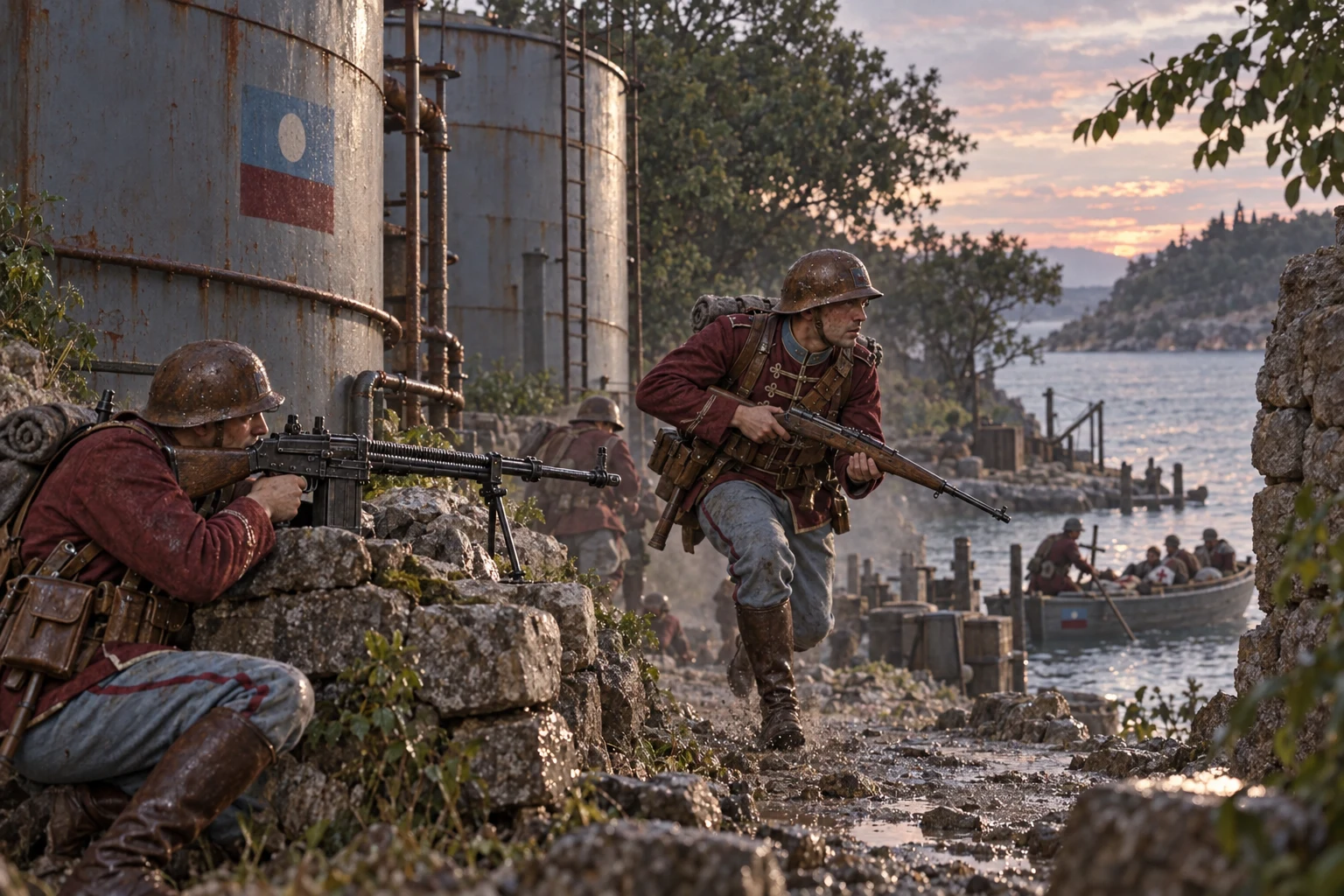
The Naviri repair anchorage
April 22–May 12, 1214 · Naviri, western Grand Isles · Naviri coastal troops and Allied naval support against Kelonese 19th Island Regiment
A repair offensive needs a place to work
The Allied Grand Isles repair offensive aimed to return damaged ships and facilities to useful service through limited recoveries. At Naviri's Nalen inlet, Commander Sera Venn coordinated the naval part of an operation to recover a small anchorage and its machine shops. Colonel Hara Sel commanded 6,720 Naviri troops assigned to the ground fighting. Motari and Ranuvan support supplied repair specialists and maritime transport under established Allied arrangements. No Silvian force participated. The republic remained neutral, and these belligerents had to solve the receiving problem with resources already available to their own coalition.
Kelonese Colonel Kaito Mer held the district with 5,980 troops of the 19th Island Regiment and attached coastal personnel. His position occupied the inlet's northern warehouses, a ridge overlooking the entrance, and the road toward the interior. The machine shops below the ridge were damaged but potentially repairable. Sel's plan sought the shops and a protected strip of shore, accepting that complete recovery of the surrounding heights might be beyond the available force. The narrow objective disappointed politicians who expected any new offensive to announce a general liberation of Naviri.
The first attack began on April 22 from Allied-held ground adjoining the inlet. Naviri infantry advanced through plantations divided by drainage channels, with naval fire supporting the coastal flank. The bombardment damaged several Kelonese positions but also struck a workshop roof the Allies hoped to preserve. Chief Mechanic Nera Tov watched the damage from a transport offshore and revised her receiving list before landing. Machinery marked for immediate use would now require structural repairs around it, delaying the very capacity the operation was intended to restore.
April 23–28: The northern warehouses
Sel's leading battalion entered the southern warehouse district on April 23. It found stores removed, floors damaged, and several buildings occupied by Kelonese rear guards. Captain Elan Dar's company took a concrete tool store after fighting through its adjoining yard. The building offered strong walls but little ventilation; smoke from a nearby fire forced both prisoners and wounded men outside. Dar moved them behind an embankment rather than keep them inside a structure that looked safer on the map than it felt to those trying to breathe within it.
Kelonese counterattacks on April 24 and 25 recovered two northern sheds and threatened to divide the captured district. Sel committed his reserve company to restore contact along the shore. The company held a narrow seawall passage through which ammunition and medical parties moved. Waves broke over it during high water, soaking supplies and making casualties difficult to carry. The defenders' success was measured by continued passage rather than additional ground gained. Without it, the troops already inside the warehouse district would have become a burden the landing force could not sustain.
On April 27 Naviri artillery damaged the Kelonese observation post on the inlet ridge. Sel attempted a limited uphill attack the next morning, gaining the lower slope but failing at the crest. He stopped after the leading platoons encountered intact positions beyond the damaged post. The failure left the anchorage exposed to intermittent observation. Venn adjusted maritime movement accordingly, using the sheltered inner water when conditions allowed and refusing to declare the whole inlet open simply because Allied infantry now held its southern shore.
April 29–May 5: Repair under fire
Tov's first repair party entered the machine shops on April 29. They found one usable generator, several damaged lathes, and a heavy crane whose mounting had shifted. The crane could lift small loads but not the components needed for the largest repairs. Tov reported that limitation despite pressure to announce the yard restored. Workers began with pumps, small craft engines, and electrical fittings. The modest output returned useful capacity quickly without pretending that the anchorage could suddenly service every damaged warship waiting elsewhere in the theater.
Kelonese shellfire struck the shops on May 1 and killed twelve workers and naval personnel. The surviving staff dispersed equipment into separate buildings and continued at reduced pace. A Ranuvan fitter, Ilen Sar, recovered a damaged engine component he had spent two days repairing and began again after removing fragments. His persistence became a popular story, but the yard records showed the broader cost: lost labor, interrupted work, and tasks abandoned because replacement tools had not arrived. Individual determination operated within those material limits rather than overcoming them automatically.
Mer attacked the shore passage again on May 3. His infantry reached a row of storage tanks and briefly cut movement between the shops and southern landing place. Naviri troops counterattacked at dusk and restored the connection, while Venn sent small craft to move wounded men around the blocked section. One boat grounded on debris and had to be abandoned after its passengers were transferred. The improvised movement saved time but could not replace a secure land connection for ordinary cargo. Sel reinforced the passage before authorizing any further advance.
May 6–12: A useful, incomplete recovery
The last substantial ground action occurred on May 6, when Naviri troops captured a service road below the ridge. Mer retained the high ground and northern sheds but lost direct control of the machine-shop approaches. Both commands then concentrated on strengthening their positions. Allied engineers cleared enough underwater debris to admit small repair vessels by May 9. Larger ships still required facilities elsewhere. Tov submitted a capacity statement listing what the yard could actually complete each week, including expected interruptions from shelling and the continuing shortage of specialized parts.
By May 12 the operation had achieved its limited purpose. The Allies possessed a working repair foothold and receiving strip, while Kelonese forces retained positions preventing unrestricted use of the inlet. Naviri's immediate ground and naval grouping recorded 624 killed, 1,508 wounded, and 172 captured. The Kelonese regiment and attachments recorded 731 killed, 1,684 wounded, and 263 captured. Forty-eight civilian workers and residents died. Motari and Ranuvan specialist losses were included in the Allied grouping, not silently treated as casualties belonging to Naviri's national army alone.
Nalen did not transform the naval balance in a week. It began returning small vessels and damaged equipment to service while larger campaigns continued. Nera Venn, the civilian evacuation organizer, visited in May to arrange accommodation for returning workers and found families living near positions still under fire. Recovery therefore required rules about housing and access as well as possession of workshops. The inlet remained a battlefield, but it had also become a place where the Allied fleet could begin repairing some of the damage the war kept inflicting.
Original illustrations for this source record
Original archive artwork and captions are preserved. Dates, labels and claims printed within inherited images belong to the previous edition; the revised text governs the current history.