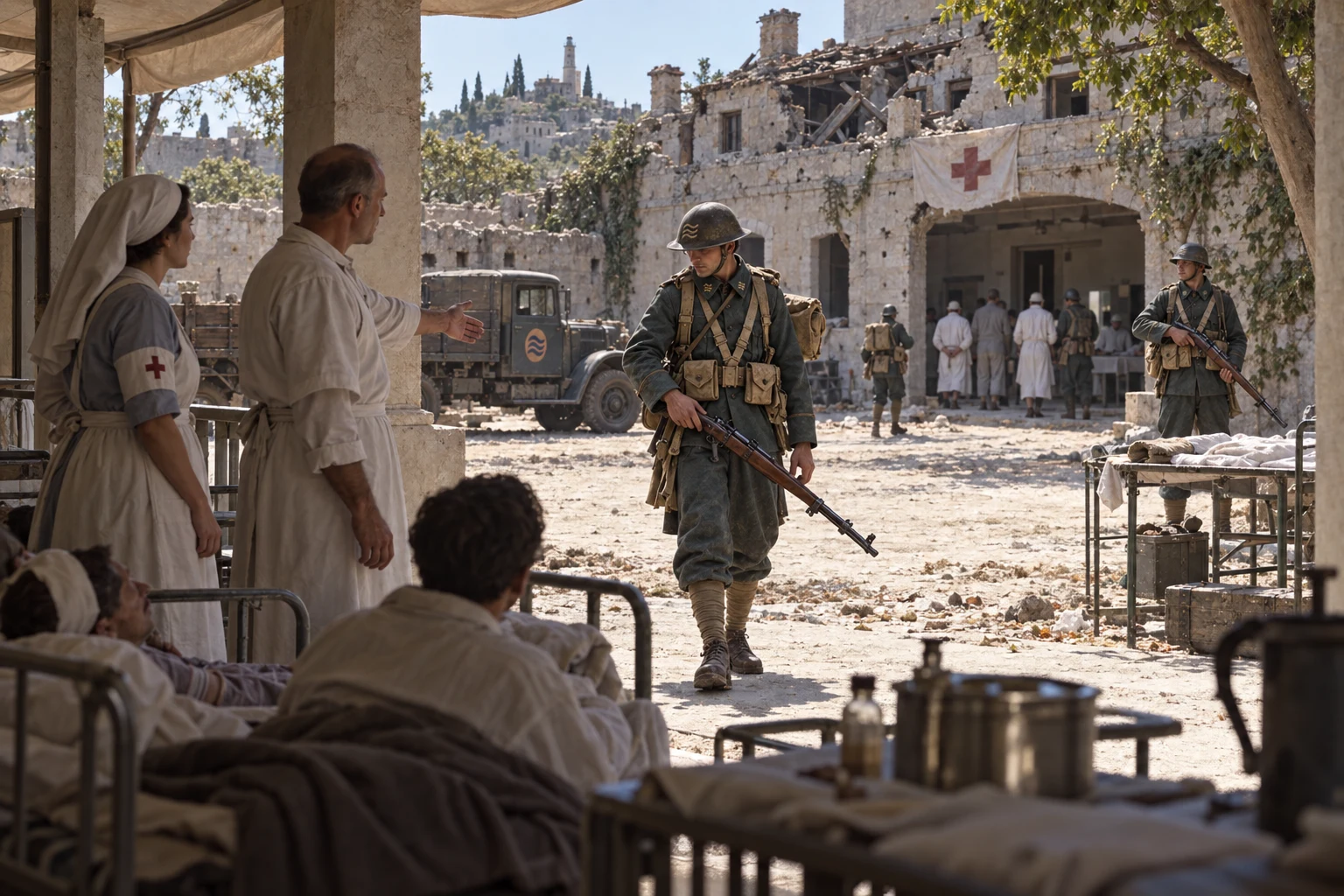
The last Goradin medical perimeter
July 15–30, 1213 · Goradin outskirts, Garamond · Garamond remnants under Colonel Vesa Rinn against Zaganar occupation formations
Beyond the fallen center
Goradin's principal center fell on July 14, but fighting continued around the hospitals, workshops, and remaining military positions beyond it. Colonel Vesa Rinn gathered 2,830 soldiers and attached personnel in the western medical district. Many belonged to formations already counted in Garamond's central battle. This account follows one subordinate perimeter during that collapse; its forces and losses must not be added again as an independent army. Rinn's immediate task was to protect patients and preserve enough cohesion to negotiate or move where movement remained possible.
Zaganar Brigadier Taren Vol commanded the local force closing around the district, approximately 6,400 men from two occupation-assault regiments. The medical perimeter contained the Goradin Municipal Annex, a convalescent school, and several service buildings converted into wards. More than eighteen hundred patients occupied them, including civilians and wounded soldiers from earlier fighting. They were not eighteen hundred fresh battle casualties. Dr. Irena Sen directed the treatment system and repeatedly warned both military and civil authorities that many patients could not survive movement without transport that no longer existed.
Rinn rejected the suggestion that the entire district could withdraw through a rumored opening to the west. Scouts found enemy patrols and blocked roads, not a secure corridor through Garamond's enclosing hostile system. A few individuals might escape under particular circumstances; a column of wounded patients could not. She therefore shortened the military position around the usable wards while arranging local contact with Zaganar. Her soldiers continued fighting because negotiations offered no immediate guarantee and because abandoning the perimeter would expose patients before any receiving authority had accepted responsibility for them.
July 16–20: The convalescent school
Zaganar attacked the convalescent school on July 16 after firing struck positions in its adjoining maintenance yard. The school itself still held patients, and its medical markings remained visible where the roof survived. Rinn ordered armed troops away from the principal ward building, concentrating defense in the detached yard and street. This separation did not make the patients immune to shell fragments or mistakes. It did establish that the ward's medical function should not be obscured by using its windows as firing positions.
The maintenance yard fell that evening. Sergeant Lena Varr led thirty-seven surviving defenders back through a garden passage while orderlies moved ambulatory patients toward the annex. Eleven patients unable to move remained with Nurse Hara Tel and two assistants. Zaganar troops entered the ward after the fighting and placed the staff under guard. Tel continued treatment, later sending a written patient list through an authorized intermediary. That list was the first reliable news Rinn received that the school patients had not all been killed when the yard position disappeared.
Between July 18 and 20, the perimeter contracted again. Water pressure failed after damage to the district's distribution equipment. Soldiers carried containers from a surviving service point, competing with stretcher work for the same exhausted manpower. Sen reduced nonessential washing and separated contaminated water containers from drinking supplies, but infection remained a growing danger. Rinn assigned a complete squad to water duty despite protests from infantry officers. Defending the wards meant keeping their occupants alive as well as preventing enemy entry into the buildings around them.
July 21–26: Negotiation under continuing fire
Vol sent surrender terms on July 21 requiring the military perimeter to disarm. Rinn requested written provisions for medical treatment, patient registration, and the retention of essential staff. The first reply treated those demands as unnecessary delay. Sen then prepared a concise account of the patients' condition and the supplies immediately required. The document did not alter the military balance, but it forced the receiving command to confront practical obligations that would survive the firing. Capturing the district would leave Zaganar responsible for people who could not simply be marched away.
Fighting continued while messages passed. On July 23 Zaganar troops captured the district laundry and approached the annex's rear service road. Rinn's reserve counterattacked and recovered part of the road at heavy cost. Captain Oren Dast, leading the reserve, was killed beside a delivery entrance. His soldiers held until darkness and then withdrew under orders. Their action kept a final transfer of patients between buildings possible, but it did not reopen an escape route from Goradin. Rinn prohibited describing it as the beginning of a breakout.
By July 25 the remaining defenders lacked enough ammunition and fit personnel to hold the same frontage another day. Rinn assembled surviving company commanders and explained that continued resistance could no longer protect the medical district. Some wanted an independent attempt to escape. She permitted small parties already detached beyond the perimeter to follow their existing instructions but refused to send the main body against an unverified opening. The decision left her with men who understood they were likely entering captivity rather than being sacrificed to preserve the appearance of resistance.
July 27–30: The perimeter becomes a prison district
The local capitulation took effect on July 27. Rinn surrendered with 1,946 surviving military personnel in the immediate perimeter, including wounded soldiers fit enough to be registered with their units. Other patients remained under medical accounting to prevent double counting. Rinn entered captivity that day and survived the occupation until Garamond's liberation. Zaganar guards occupied the annex and separated military records from civilian hospital files. Sen remained at work under supervision, using the written terms to challenge attempts to remove patients before medical examination.
During July 15–27, Rinn's perimeter force recorded 318 killed. The 1,946 captured survivors included 566 wounded; another 566 personnel had left on authorized detachments before the final closure. Zaganar's immediate attacking force recorded 427 killed and 981 wounded. Among the preexisting patients, 143 died during the same period from wounds, illness, deprivation, or battle effects; those deaths are recorded separately from newly wounded defenders. Forty-nine civilian staff and nearby residents were killed. The distinctions prevented the medical district's crowded population from becoming an inflated claim of soldiers captured in combat.
By July 30 Garamond's coherent conventional defense had collapsed across the wider campaign. Goradin's medical perimeter had ended three days earlier through a local agreement, not a miraculous evacuation. Its surviving staff retained lists that later helped families trace prisoners and patients. Varr's final act before surrender was to tie the water squad's roster to the ward register so men absent on duty would not be recorded as deserters. The country lost its organized defense, but those small records preserved identities against the confusion that followed defeat.
Original illustrations for this source record
Original archive artwork and captions are preserved. Dates, labels and claims printed within inherited images belong to the previous edition; the revised text governs the current history.