The southern littoral defense
August 3–September 9, 1213 · Athenor and Ugoslia, southeastern Volara · Allied coastal commands against the regional Axis armies
After Goradin fell
The fall of Garamond's principal center on July 14 and the collapse of its coherent defense by July 30 sharpened fears along the southern littoral. Axis commanders sought to turn that political shock into pressure against Athenor and Ugoslia. The coastal states possessed maritime access Garamond had lacked, but their ports and receiving roads remained vulnerable. General Mara Sel again directed Athenor's Varen district, now with 21,800 troops. General Elan Rusk commanded 19,200 in Ugoslia's Laren coastal system. Their forces defended separate national sectors linked by coalition planning and shipping.
Brevon General Taren Veld coordinated 51,600 immediately engaged troops across the regional effort, including Cirel and Dovran contingents. Arvessan pressure elsewhere in Ugoslia continued limiting Rusk's reserves without placing every Arvessan formation inside this battle. Veld's plan sought simultaneous crises at the receiving districts. He expected the Allies to disperse fresh cargo and reserves so widely that neither coast could recover from a serious penetration. His opening orders described decisive results more confidently than the available transport and replacement schedules justified.
The first attack began on August 3 against Athenor's Sorel approaches, still contested after the previous year's opening battles. Shelling struck rebuilt houses whose residents had returned during the quieter months. District officials ordered evacuation again, but several families refused until infantry appeared in the outer streets. Nurse Irena Mal reopened a collection point in the same customs district she had used in 1212. The repetition disturbed her more than the unfamiliar danger had: she recognized patients whose repaired homes and recovered health were being broken a second time.
August 4–14: Varen's outer streets
Axis troops gained the western Sorel gardens on August 4 and pressed toward Varen's residential belt. Athenor's 23rd Regiment held the Heren tram depot, whose vehicle sheds offered substantial walls but poor escape routes. Colonel Hara Dast ordered two side passages opened through adjoining buildings before the main assault reached them. When a roof collapse blocked the central yard, the passages allowed wounded men and reinforcements to move. They did not prevent the depot's eventual loss, but they kept its defense from ending in a trapped garrison.
Fighting peaked there on August 8. Brevon infantry entered the repair hall while Athenoran troops held the dispatch office and southern sheds. The tram tracks inside the hall made stretcher movement awkward, and several patients waited on maintenance benches until a local pause permitted collection. Dast withdrew that night, leaving the depot in Axis hands. She took the surviving company commanders with her to the next position rather than send them away to prepare optimistic reports. Their immediate knowledge was needed to reorganize troops still arriving from different exits.
Sel counterattacked on August 11 toward the depot's southern flank. The attack recovered a school block and restored a less exposed road to the harbor but failed to retake the depot. Sel accepted the limited result and moved reserve supplies along the restored road before another attack could close it. Her staff calculated success through deliveries completed and formations relieved, while public announcements emphasized the school. Both mattered, but only the former explained why the defense could continue after losing its strongest-looking building.
August 15–27: Ugoslia's coastal air district
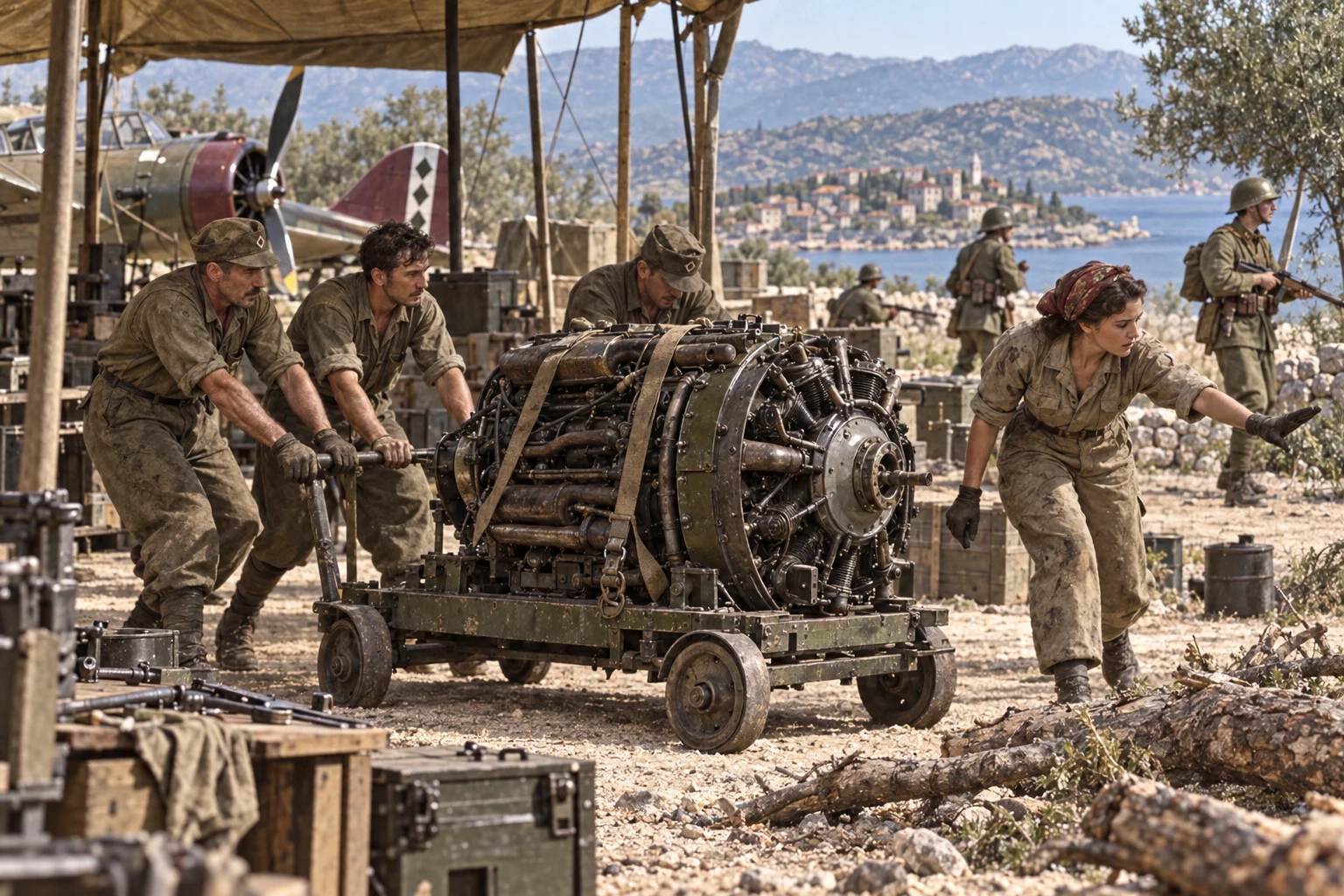
At Laren, Rusk faced pressure against the replacement workshops established after the 1212 airfield fighting. Dovran infantry captured an outer maintenance camp on August 15. Its personnel withdrew with engines and specialized tools, leaving tents and ordinary furniture behind. Lieutenant Vena Rel, now coordinating a repair section, moved two incomplete engines despite objections that they were not serviceable. Their components later restored other aircraft. A simple count of working machines would have missed the value carried away in crates from the camp.
Rusk committed the Ugoslian 31st Regiment to halt the advance along a coastal road. The regiment held a line of drainage banks and small orchards for four days before a Cirel attack turned its eastern company. Colonel Naren Var withdrew the regiment to a shorter position while artillery covered the movement. One battalion received the order late and fought an additional night around a pumping compound. It rejoined on August 21 after losing most of its vehicles, its soldiers carrying wounded men on improvised stretchers.
The Axis advance then slowed against the rebuilt line. Veld requested more transport to move ammunition into both sectors at once and received less than promised. Allied shipping also suffered losses, but enough cargo reached usable facilities to sustain the defense. The difference did not produce immediate Allied superiority everywhere. It permitted Rusk to replace losses and Sel to rest some exhausted units while their opponents struggled to maintain the same offensive intensity. Coastal access remained dangerous, yet its continued existence distinguished these states from enclosed Garamond.
August 28–September 9: Holding without liberation
The last coordinated Axis assault began on August 28. At Varen, attackers reached an outer customs warehouse but failed to cross the road beyond it. At Laren, Ugoslian troops lost a ridge shoulder and recovered part of it the following day. Both battles consumed local reserves without creating a general breach. Sel and Rusk rejected proposals for an immediate broad counteroffensive, preserving newly arrived supplies for defense and repair. Their restraint frustrated officials who believed the enemy's slowing attacks meant its whole front was ready to collapse.
By September 9 major local operations had diminished. Athenor and Ugoslia had lost ground, buildings, and lives while retaining their coastal receiving systems and national governments. Athenor's engaged grouping recorded 1,734 killed, 4,192 wounded, and 693 captured; Ugoslia's recorded 1,529 killed, 3,847 wounded, and 812 captured. The regional Axis groups recorded 3,971 killed, 9,204 wounded, and 467 captured. Civilian deaths across the two battle districts totaled 1,106. These were local battle returns, separate from Garamond's preceding defeat and continuing occupation.
The defense did not reopen Goradin or rescue Garamond's prisoners. It prevented another defeat from spreading directly into the loss of the southern coastal allies. Mal closed the temporary customs aid point only after transferring its remaining patients to a repaired hospital. Rel's workshop put its first rebuilt engine into service in late September. Those modest milestones measured the battle's actual outcome: institutions still operating, forces still receiving support, and two societies damaged but capable of resisting the next attempt to extinguish them.
Original illustrations for this source record
Original archive artwork and captions are preserved. Dates, labels and claims printed within inherited images belong to the previous edition; the revised text governs the current history.