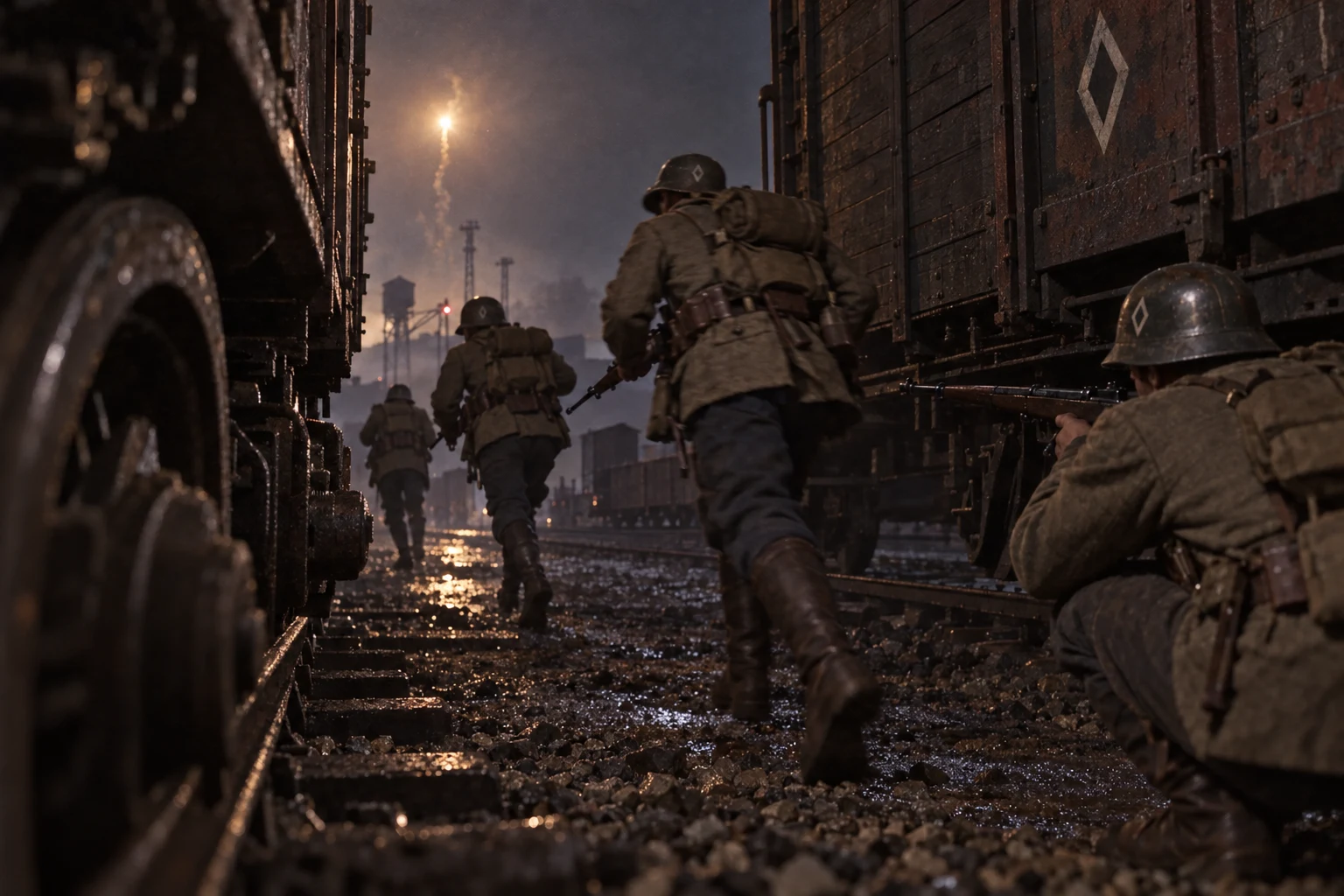
The night battle at the Naret sidings
April 7–19, 1213 · Naret railway district, Pavren · Allied spring-offensive detachments against Hukular 64th Regiment
One engagement inside a failing offensive
The Naret sidings battle formed part of the Allied spring offensive already underway since March 8. Its troops and casualties belong within that campaign's accounting; they were not an additional army appearing beside it. Colonel Hara Vell commanded a temporary assault group of 4,260 Pavren and Hestunian soldiers drawn from formations already committed. Hukular Colonel Iven Kars held the sidings with 5,180 men of the 64th Regiment and attached railway-defense troops. The sidings lay below the Naret embankment, where repeated Allied attacks had gained ground without securing the principal transport objectives.
Vell's immediate aim was modest: capture the western switching district and use its buildings to improve the exhausted Allied foothold. Headquarters hoped the success would enable a renewed advance later. The difference between those two ambitions remained unresolved when orders went out on April 7. Infantry officers planned to hold a defined district; the staff reserved space on its movement tables for troops expected to pass through it. Neither arrangement guaranteed that the damaged tracks or approaches could actually carry the traffic imagined after capture.
The sidings contained abandoned wagons, a signal cabin, a coal stage, and a repair shed whose roof had collapsed along one side. Rails twisted by bombardment crossed pools of water. Soldiers rehearsed their approach using a railway employee's sketch, but smoke and darkness made individual wagons difficult to identify. One wagon marked as a landmark had been moved by the defenders the previous day. The error would separate the leading companies before either reached its assigned position, demonstrating how quickly a detailed local plan could become outdated.
April 8–10: The first night attack
The assault began after dark on April 8. Pavren Captain Lena Dast's company reached the western wagon line, while a Hestunian company led by Captain Oren Sel entered a cutting farther north. Sel believed he had reached the designated signal approach and reported success. In fact his company stood short of it, facing a different cabin used for maintenance records. Vell received two encouraging reports and ordered the next wave forward. The arriving soldiers encountered resistance in the gap the reports had accidentally concealed.
At the wagon line, Dast's men fought around locked freight doors and beneath damaged undercarriages. Several wounded soldiers became trapped where moving a wagon would have exposed the men pushing it. Sergeant Nera Toll brought a railway jack from a captured tool shelter and raised a bent coupling enough to free one man. The task took nearly an hour while fighting continued nearby. It later appeared in the company record as the recovery of a wounded corporal, a spare line describing an effort that had occupied six soldiers under fire.
By dawn the Allies held the western wagons and maintenance cabin but not the main signal district. Kars counterattacked on April 9 and recovered part of the wagon line. Vell committed his reserve to restore contact between Dast and Sel, spending the force intended to exploit a complete capture. The reserve succeeded in opening a narrow passage. It did not turn the partial gain into a breakthrough. Allied troops now occupied a difficult salient supplied through approaches that the Hukular defenders could observe from the embankment.
April 11–15: A place too narrow for its occupants
Vell requested permission to pause on April 11. His group needed relief, ammunition, and a clearer understanding of the ground beyond the wagons. Higher command authorized a short pause but continued calling the sidings an opening that must be enlarged. The language made every delay appear temporary, even as the same depleted companies remained in place. Engineers improved shelters and carrying paths, but those improvements could not replace the junior officers and experienced soldiers lost during the initial attacks and counterattacks.
The repair shed became the center of fighting on April 13. Allied troops entered its western end and found wounded Hukular soldiers in a pit used for machinery inspection. Medical orderlies moved them behind the Allied line while infantry fought for the far doors. The pit had been reported as a command shelter because observers had seen repeated movement around it. Its capture therefore produced more patients than useful documents. Dast protested a request to move the prisoners immediately farther rearward; several could not survive another journey without treatment.
Rain on April 14 filled the inspection pit and the low positions around the wagons. Soldiers stood on timber and discarded packing material to keep equipment above water. Hukular troops endured similar conditions on the opposite side of the yard. A brief exchange of shouted insults ended when someone on the Allied side asked whether the defenders had dry socks. The answer was lost beneath renewed shelling. Such moments did not create friendship or stop the battle. They revealed how closely the opposing soldiers shared the immediate discomfort of the ground they contested.
April 16–19: The limit becomes visible
Vell's final local attack began on April 16 against the signal cabin. The leading company reached its outer wall but could not hold the approach under fire from the embankment. Sel was wounded, and his successor ordered withdrawal before a second wave entered the exposed ground. Headquarters initially asked why the second wave had not been committed. Vell answered that the first had demonstrated the obstacle, not removed it. His refusal preserved part of the group for relief and defense, though it ended any immediate prospect of taking the full district.
Kars counterattacked on April 18 and regained the repair shed's eastern rooms. The Allies retained the western wagon line and a portion of the shed, with positions so close that both commands prohibited unnecessary movement along exposed roofs. On April 19 the local assault phase ended. The larger spring offensive continued until April 27, but Naret's transport objective remained unmet. The sidings had absorbed men who could no longer serve as the fresh reserve required by the wider plan.
The Allied assault group recorded 487 killed, 1,193 wounded, and 164 captured during this subordinate action. Kars's local force recorded 526 killed, 1,244 wounded, and 208 captured. These figures are a subset of the spring campaign, not losses to add again to its full total. Dast survived and returned to the western wagon line after a short rest. The coupling raised by Toll's railway jack still hung crookedly above the ground. Around it lay a battlefield whose partial capture had become a burden the offensive could neither exploit nor comfortably abandon.
Original illustrations for this source record
Original archive artwork and captions are preserved. Dates, labels and claims printed within inherited images belong to the previous edition; the revised text governs the current history.