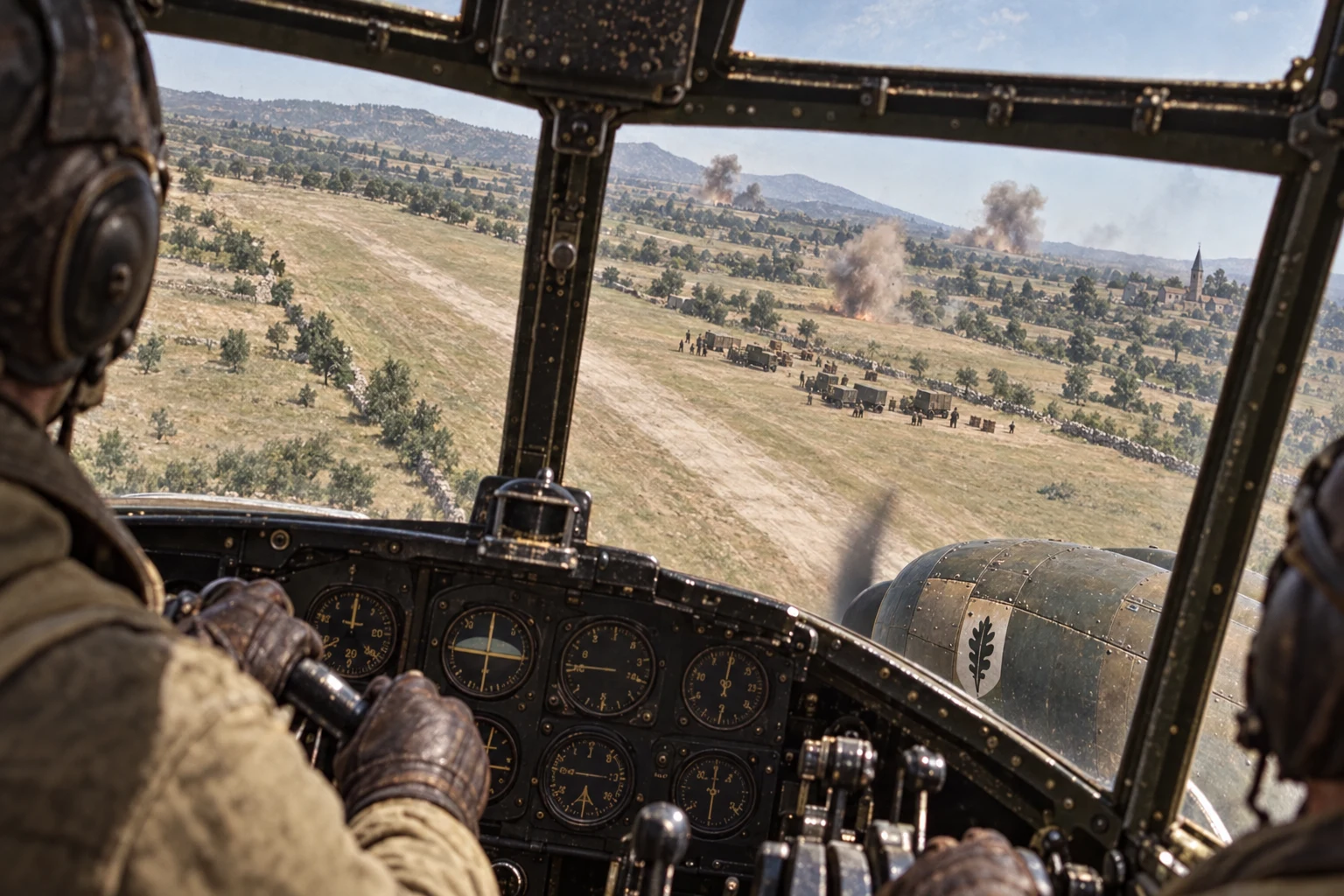
Garamond's contested air reception ground
June 13–19, 1212 · Central Garamond, Volara · Garamond 9th Defense Battalion against Zaganar 14th Mobile Regiment
A strip of ground with a limited promise
The air reception ground at Oren Field lay within Garamond's shrinking central defense system. Its short landing strip, storage sheds, and adjacent pasture handled selected cargo that could make a disproportionate difference: medicines, radio components, precision tools, and specialists. It could not receive the bulk food, fuel, and ammunition required to sustain an entire enclosed country. When Garamond requested an enlarged air effort on June 13, protecting Oren became urgent precisely because the assistance was limited. Losing the field would remove a useful margin from an already inadequate supply system.
Colonel Vesa Rinn assigned Captain Halen Mere's 9th Defense Battalion and attached engineers to the field, a grouping of 1,740. Rinn remained responsible for a wider district and did not personally command every firing position. Zaganar Colonel Naren Voss directed the 14th Mobile Regiment's local attack with 3,960 troops. His immediate objective was to bring the landing area under dependable fire, not necessarily capture it intact. The regiment advanced from positions already gained during the invasion, keeping the battle within Garamond rather than inventing an escape route through surrounding hostile states.
Mere's defense followed low orchard banks east of the strip and a drainage channel to the north. The reception staff continued handling aircraft while infantry prepared positions nearby. Ground controller Elan Sere kept a board showing scheduled arrivals, unloading priorities, and permitted departures. Each outward aircraft had competing claims on its space: wounded personnel, specialists, official papers, and separated children. Sere could not satisfy all of them. He required written authorization for changes because shouted urgency otherwise favored whichever official reached the field first.
June 14: The orchard attack
Zaganar infantry attacked the orchards on June 14 after shelling the eastern bank. Garamond's leading company lost its telephone connection and fought for two hours without knowing whether neighboring positions still held. Lieutenant Nera Dall sent a runner to Mere, then withdrew one platoon after fire reached its flank. The withdrawal exposed a storage shed used for medical cargo. Reception workers carried crates from it while soldiers fought along the bank above them. One crate broke open, scattering glass containers across ground soon crossed by stretcher bearers.
A transport aircraft approaching that afternoon turned away after its pilot saw shell bursts near the strip. The decision left urgent radio components undelivered for another day. Government officials accused the air service of excessive caution, but Sere's report confirmed that the unloading point was under fire at the intended arrival time. An aircraft destroyed on the ground would have removed future carrying capacity as well as its present cargo. The episode exposed the danger of treating a scheduled flight as assistance already received before its wheels touched down.
Mere counterattacked the orchard bank at dusk with his reserve platoons. They recovered the central section and found several wounded Zaganar soldiers beneath a collapsed shelter. Garamond medics treated them beside their own casualties, using supplies whose delivery had just been threatened by the same attack. The recovered position allowed unloading to resume at a more protected end of the strip. It did not remove Zaganar observation from the surrounding district, and every subsequent arrival remained subject to interruption.
June 15–17: The landing ground narrows
On June 15 a transport landed with medical stores and two communications specialists. Its return flight carried twenty-one wounded people and three administrative couriers. These were small movements within a limited air program, not a mass evacuation. Nurse Lena Var remained after being offered a departure place because the field's treatment station had lost another trained nurse. Her decision did not become a general demand that all medical staff stay indefinitely. The command still planned rotations where capacity allowed, recognizing that exhausted personnel could not provide good care through resolve alone.
Zaganar renewed its attack on June 16 against the northern drainage channel. The defenders lost an outer post and pulled back to the edge of the pasture. Shellfire damaged the strip, forcing engineers to repair its surface between arrivals. Sergeant Iven Tel marked the usable ground with panels after the original markers were destroyed. A returning aircraft struck debris during landing and suffered a damaged wheel. Its passengers survived, but the aircraft could not depart until repaired, temporarily blocking part of the already restricted receiving area.
Mere requested permission to abandon the field if the northern position failed. Rinn authorized preparations for another receiving site but ordered Oren held while it remained usable. The alternative site lacked completed ground work and could not immediately replace its capacity. This distinction mattered: having another place marked on a map did not mean aircraft could safely land there that evening. Engineers divided their effort between keeping Oren open and preparing the replacement, accepting slower progress at both rather than gambling everything on one vulnerable location.
June 18–19: A usable margin retained
The heaviest local attack came on June 18. Zaganar infantry reached the northern pasture and brought the damaged transport under fire. Its crew and ground staff abandoned the aircraft after removing portable equipment. Garamond's defenders counterattacked from the western bank, forcing the attackers away from the immediate strip but failing to recover the outer drainage post. The transport burned during the fighting. Sere removed it from the departure board and reassigned its waiting passengers, some to later flights and others back to ground accommodation.
By June 19 the field could still receive carefully scheduled aircraft under restricted conditions. Zaganar had gained observation ground and made the service less dependable, but had not closed it permanently. Garamond's local grouping recorded 137 killed, 322 wounded, and 61 captured. Zaganar recorded 214 killed, 487 wounded, and 39 captured. Thirty-six civilians and reception workers died in the action. One transport was destroyed on the ground and two damaged; these losses were distinct from aircraft operating elsewhere in the broader relief effort.
Oren's survival prolonged particular services and saved individual lives without ending Garamond's isolation. Its defenders knew that the arriving crates could not fill every empty storehouse. They still fought because a replacement radio part could restore command, a medical shipment could permit treatment, and a departing aircraft could carry someone who otherwise would die. Sere retained the burned transport's original departure list with its later annotations. It recorded who finally left, who remained, and which promises the air service had never possessed the capacity to fulfill.
Original illustrations for this source record
Original archive artwork and captions are preserved. Dates, labels and claims printed within inherited images belong to the previous edition; the revised text governs the current history.