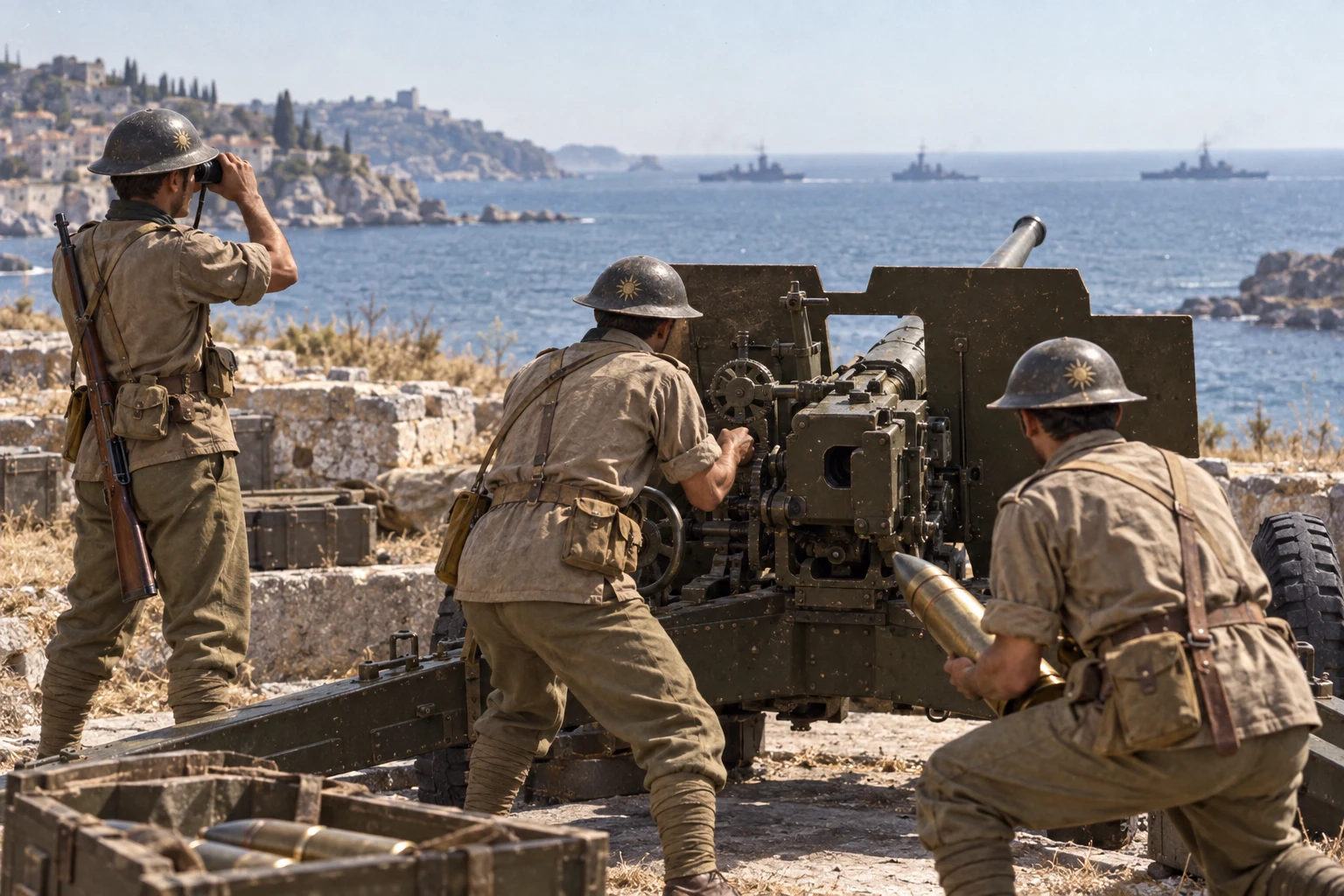
The Saffron Littoral opening
May 6–June 2, 1212 · Athenoran and Ugoslian coastal defense, southeastern Volara · Allied littoral commands against Brevon, Cirel, and Dovran forces
Two commands face the same sea
Athenor and Ugoslia entered active war on May 6 as attacks and immediate threats reached their territory. The Saffron Littoral opening consisted of connected coastal actions across separate national approaches. Athenoran General Mara Sel directed 16,200 defenders around the receiving district of Varen Bay; Ugoslian General Elan Rusk directed 14,600 on his own coastal sector. Their coordination concerned shipping, air warning, and reserve timing. Each government retained authority over its troops and territory. The battle therefore joined two fronts without erasing the geography separating them.
Brevon's General Taren Veld coordinated the principal Axis coastal effort, supported by Cirel and Dovran formations already assigned to the regional system. The forces immediately engaged across the two sectors totaled 38,700. Their opening objectives were receiving facilities, coastal observation positions, and the roads linking harbors to the interior. Arvessa's entry against Ugoslia on May 11 increased pressure elsewhere in that country's defense, limiting the reserve Rusk could commit here. It did not make every Arvessan soldier part of this particular coastal battle.
At Varen Bay, the first bombardment struck a warehouse district beside the commercial quay. Athenoran dock workers were unloading medical supplies when the warning sounded. Some took shelter immediately; others tried to move the cargo away from exposed sheds. Nurse Irena Mal, waiting to receive the consignment, organized a temporary aid station in a customs office after casualties arrived from the quay. Her shipment was partly destroyed before reaching any hospital, and the surviving boxes were used on the people unloading them.
May 7–13: The receiving districts
Axis infantry attacked Varen's eastern approach on May 7 and captured the village of Sorel near the harbor road. Sel committed Athenor's 23rd Regiment to a counterattack the next day. Its leading battalion entered the village but encountered defenders in a detached mill omitted from the current military map. Fighting around the mill separated the battalion from its support. Colonel Hara Dast ordered withdrawal before darkness, recovering most of the force but abandoning the village. The failure left the harbor road exposed to observation without immediately closing it.
In Ugoslia's sector, Rusk faced an attack against the coastal air station at Laren Field. The station's aircraft had dispersed before the bombardment, but fuel and maintenance equipment remained vulnerable. Dovran troops reached the outer hangars on May 10 and fought Ugoslian ground personnel reinforced by infantry. Lieutenant Vena Rel, an aircraft mechanic, led a party carrying instrument crates away from a burning workshop. She later objected to being described as having commanded the field's defense. Her party saved repair capacity while the infantry fought the battle around it.
News of Arvessa's May 11 entry forced Rusk to release a battalion previously intended for Laren. His remaining defenders shortened their position around the southern runway and withdrew aircraft support to another Ugoslian facility. The air station remained contested, with neither side able to operate it normally. Axis reports listed the capture of hangars as the capture of an air base. Ugoslian reports emphasized the aircraft saved. Both claims contained truth, but neither described a functioning airfield under secure control by the end of the week.
May 14–23: Coalition decisions under fire
On May 14 Sel and Rusk held a brief naval radio conference to coordinate reinforcement arrivals. Their staffs had assigned the same transport capacity to different urgent cargoes. The correction postponed some artillery ammunition to permit medical and engineering stores through first. Sel accepted the delay after learning that Varen's receiving cranes were nearly unusable. Sending more heavy cargo before restoring unloading capacity would have created ships waiting offshore under attack. The decision was unpopular among artillery officers who saw only their own diminishing stocks and the promised deliveries that had moved backward.
Brevon renewed pressure on Varen on May 17. Its infantry advanced from Sorel toward the harbor's outer residential district and took several streets. Athenoran defenders counterattacked through gardens and workshop yards, recovering a narrow connection to the eastern road. The street fighting destroyed a municipal clinic whose patients had been removed two days earlier. Its doctor, Sera Tov, returned to search for records and found the filing room flooded by broken pipes. She carried away only the birth register and a ledger of patients transferred during the evacuation.
At Laren, Ugoslian troops recovered the southern hangars on May 20 but could not clear the northern field. Rusk stopped the attack after his leading companies lost contact in smoke and rain. He then ordered the recovered buildings stripped of usable equipment instead of immediately repairing them under continuing observation. Mechanics removed engines, tools, and electrical fittings over three nights. The operation converted temporary ground possession into lasting material benefit, even though the field itself remained too exposed for ordinary use.
May 24–June 2: A coastal line survives
The Axis final coordinated push began on May 24. Veld sought to make simultaneous pressure force one Allied government to withdraw support from the other. Instead, both commands accepted limited retreats within their own sectors while preserving the receiving functions they considered essential. Sel abandoned Sorel's western gardens but held Varen's southern quay. Rusk relinquished part of Laren's outer runway while retaining the road to his replacement facilities. The decisions surrendered visible ground and frustrated the larger aim of collapsing either coastal system.
By June 2 major local attacks had diminished. Athenor and Ugoslia remained active belligerents with usable, damaged coastal access. Axis forces retained Sorel and portions of the Laren district, creating positions from which future pressure could continue. Athenor's grouping recorded 1,092 killed, 2,681 wounded, and 407 captured; Ugoslia's recorded 934 killed, 2,306 wounded, and 516 captured. The combined Axis local groups recorded 2,441 killed, 5,627 wounded, and 283 captured. Civilian deaths across the two battle districts totaled 684, counted separately from military losses.
The littoral defense did not open a land corridor into enclosed Garamond, whose isolation remained a separate strategic problem. Its achievement was narrower: two coastal allies survived their opening campaign with the means to receive further support. At Varen, Mal reopened her aid station in a repaired customs room. At Laren, Rel began working on engines salvaged from buildings still visible beyond the front. Their work connected the battle's temporary positions to the continuing war, in which usable facilities mattered more than the most confident communiqués.
Original illustrations for this source record
Original archive artwork and captions are preserved. Dates, labels and claims printed within inherited images belong to the previous edition; the revised text governs the current history.