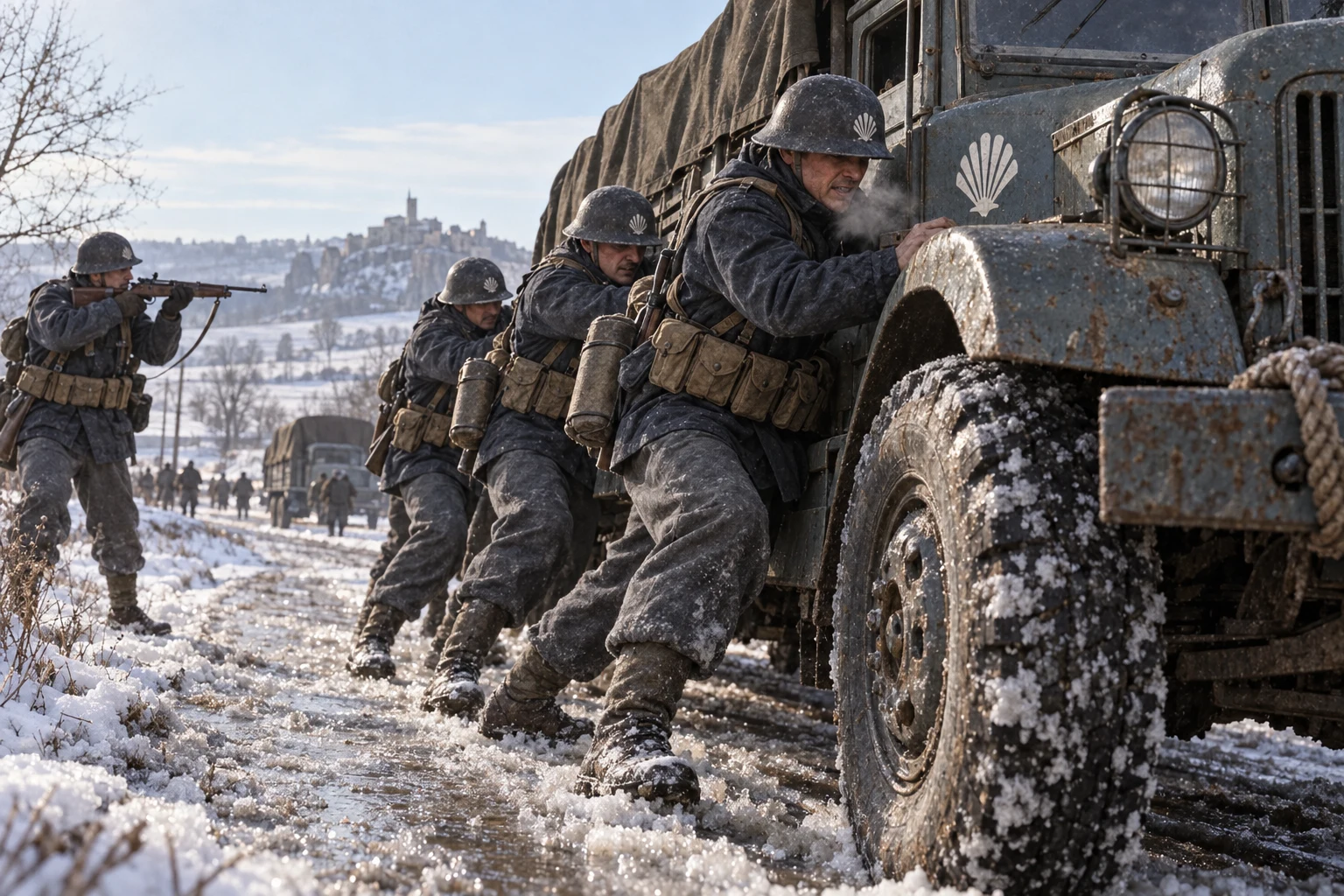
The Tavora winter battle
February 18–March 18, 1212 · Tavora frontier, northeastern Volara · Tavora 2nd Army Group against Hukular 41st Division and attached forces
The frozen fields after the first week
Tavora had been at war since Hukular's February 12 invasion when the battle for the Eren basin opened on February 18. General Sera Keld commanded 18,400 defenders, drawn from Tavora's 2nd Army Group. Their position crossed open winter farmland between low hills and a partly frozen reservoir. Hukular General Haren Vosk commanded the 41st Division and attached forces totaling 25,100. These formations were separate from those fighting in Dervan, despite both battles belonging to the same northeastern expansion.
The basin mattered because three local roads converged at the market town of Arel. Tavora had removed most central stores but retained workshops and an aid station there. Keld intended to delay the enemy east of town, then withdraw before the road system became unusable. Her civilian counterpart, District Commissioner Lena Tov, wanted Arel defended longer so families could finish evacuation. Their compromise established a staged departure, with military withdrawal tied to the last scheduled civilian column rather than to an optimistic declaration that everyone had already gone.
Hukular artillery opened the new phase before dawn on February 18. Shells broke the frozen surface of shallow drainage ponds and scattered ice across adjacent positions. Tavora's forward companies endured the bombardment in shelters intended for shorter occupation. Smoke from their heating stoves had already drawn attention, and several shelters received direct hits. The surviving troops withdrew to field walls as Hukular infantry advanced. By evening the attackers held the eastern farms but had not reached the road junction behind them.
February 19–25: Across the Eren basin
Vosk attempted to exploit the first gain on February 19. His leading regiment advanced over ground that appeared firm but softened beneath repeated traffic. Armored vehicles sank in rutted lanes, forcing infantry to continue without the support expected in the plan. Tavora's 8th Infantry Regiment held the village of Menel and struck the exposed advance from its western edge. The counterattack recovered several farm buildings before Hukular reserves restored the line. Neither side controlled the entire village at nightfall, and wounded men remained in buildings between them.
Captain Nera Val of the Tavora regiment negotiated a short local pause on February 20 through a captured medical orderly. Both sides collected casualties from the central houses while their officers watched from separate ends of the street. The pause applied only to those houses and lasted less than an hour. Fighting continued elsewhere in the basin. Later accounts enlarged it into a daylong truce, but company records showed how narrow the arrangement had been and how urgently the soldiers had used even that brief interval.
By February 23 Hukular held Menel and threatened Arel's eastern road. Keld moved her reserve to a low ridge north of town, where it could cover the planned withdrawal. The reserve's commander, Colonel Iven Dast, protested that his men had spent two nights without shelter. Keld delayed their immediate counterattack and sent them directly into defensive positions with hot food. The decision sacrificed an opportunity to recover a farm belt but preserved troops for the more important task of keeping the northern road open during the approaching retreat.
February 26–March 5: Arel's departure
The civilian evacuation entered its final stage on February 26. Commissioner Tov stayed at the town hall until the last scheduled cart group departed, then discovered forty-three residents sheltering in a cellar omitted from the ward lists. Several were too ill to walk. Military transport carried them out that evening, delaying an ammunition movement. The resulting argument reached Keld, who upheld the decision. An orderly plan remained responsible for people missed by its own paperwork; it could not declare them outside its obligation simply because the scheduled column had left.
Hukular entered Arel on February 28 after Tavora's rear guard withdrew through the northern district. The attackers captured damaged workshops and several vehicles that could not be moved. They also found the town's reservoir pumping station partly operational. Vosk ordered its protection after engineers warned that further damage would complicate his own army's occupation. The station continued supplying a reduced civilian population under military supervision. Its survival did not erase the displacement or destruction elsewhere, but it prevented the immediate water crisis that had followed several earlier captures.
Tavora established its next defense along the Leren ridge west of Arel. The ground offered observation but little cover from wind. Soldiers constructed shelters with doors and boards carried from abandoned buildings, producing positions that looked stronger from a distance than they were. On March 3 a Hukular attack seized the ridge's southern spur. Tavora counterattacked the next morning and recovered part of it, leaving both sides exposed on opposite slopes. Frost returned at night, hardening mud around equipment and making every morning's movement begin with digging things free.
March 6–18: The offensive loses its timetable
Vosk requested additional infantry for another attack on the ridge. Hukular's wider command could not satisfy every northeastern and western requirement simultaneously. He received replacements and ammunition rather than a fresh division. His March 8 attack gained a shallow foothold but stalled beneath Tavora's surviving artillery observation. The defenders also suffered heavily. Dast's reserve, now committed, lost its senior medical officer and several company commanders within two days. Keld shortened the frontage on March 11 rather than pretend that nominal battalion titles still represented full fighting strength.
The final major assault came on March 14 under low cloud. Hukular troops penetrated a saddle in the ridge but could not widen the opening before Tavora reinforcements reached it. A confused night fight ended with both sides occupying intermingled positions around an abandoned shepherd's shelter. At dawn local commanders pulled their men back to recognizable lines. The movement looked like retreat on both sets of reports, although neither army had gained a sustainable advantage. By March 18 Hukular suspended the local offensive to reorganize.
Tavora had lost Arel and much of the Eren basin but retained an organized army and government. Its battle grouping recorded 1,684 killed, 4,016 wounded, and 972 captured. Hukular recorded 1,907 killed, 4,483 wounded, and 226 captured. Civilian deaths registered during the action totaled 308. The winter battle demonstrated the difference between capturing a road district and compelling a state to surrender. Commissioner Tov reopened her office farther west with the cellar survivors' names added to the district roll, a correction that remained beside every later evacuation plan.
Original illustrations for this source record
Original archive artwork and captions are preserved. Dates, labels and claims printed within inherited images belong to the previous edition; the revised text governs the current history.