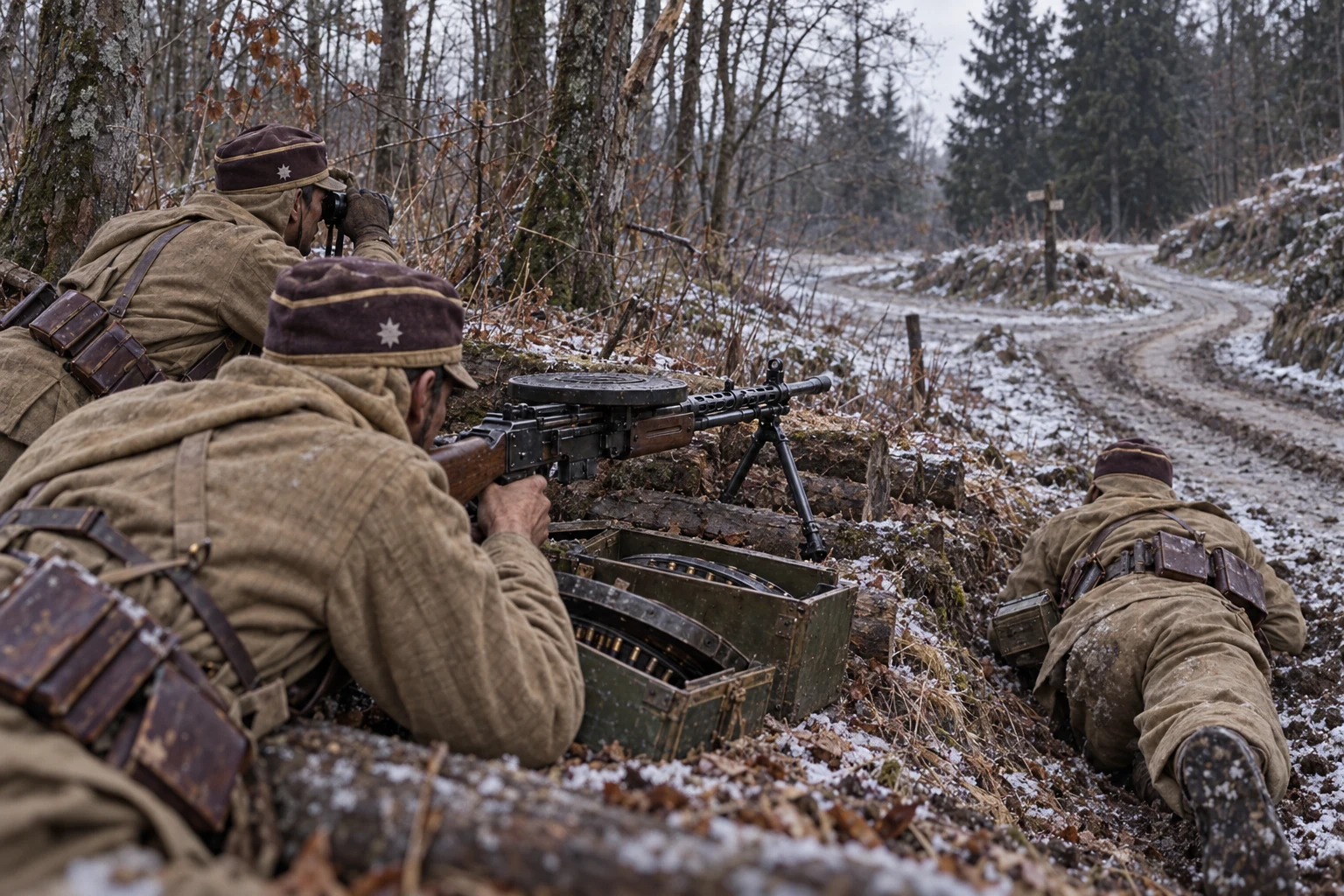
The Dervan road defenses
February 12–March 1, 1212 · Dervan frontier, northeastern Volara · Dervan 6th Division against Hukular 35th Division
A road chosen before the invasion
Dervan's defense of the Issen road began with a decision made during the previous autumn: no single frontier depot would contain the division's full reserve. Colonel Mira Dalven, Dervan's divisional quartermaster, dispersed food and ammunition among three inland sites. Her commander, General Tovan Rel, approved the arrangement despite objections that it complicated inspection. When Hukular attacked on February 12, the forward depot burned during the first bombardment. The loss hurt, but it did not deprive the defending 6th Division of everything required for the following week.
Rel commanded 14,900 troops in the road district. Hukular General Varen Seld's 35th Division committed 21,700 against it, seeking the junction at Issen Fork and the valley beyond. The road climbed through forested cuts and descended onto open farmland. Snow lay in shaded ground while thawed stretches turned muddy under traffic. Hukular's opening attack captured several frontier posts, then slowed where abandoned civilian vehicles obstructed the first cutting. Dervan rear guards used the delay to withdraw field telephones and wounded soldiers rather than attempt to preserve every outlying position.
At the village of Nerel, Lieutenant Hara Sen's company held a school and adjoining granary until late afternoon. The school had been evacuated, but its caretaker remained to protect heating fuel and records. Sen persuaded him to leave only after assigning two soldiers to carry the records with the company's equipment. His insistence seemed trivial during the retreat. In the following months those enrollment lists helped the displaced district establish classes for children whose families had lost almost every other document proving where they belonged.
February 13–18: Issen Fork
Seld's infantry reached the eastern approach to Issen Fork on February 13. The junction lay beneath a long ridge, making its possession difficult while defenders held the overlooking ground. Hukular artillery began shelling the ridge, and a battalion worked through woodland toward its northern end. Rel shifted a reserve company to meet it but retained most of his reserve near the junction. He expected the road attack to remain decisive and nearly lost the ridge before recognizing that Seld had changed the main effort.
The ridge's northern post fell on February 15. Dervan troops below it received fire from behind their prepared shelters and withdrew toward a timber yard. Captain Elen Varr organized the withdrawal after the battalion commander was wounded. She collected stragglers in the yard and sent them back into companies by recognizable officers rather than by their original paper assignments. The resulting formation was untidy but usable. It held the western road long enough for the remaining ridge defenders to escape the position that had been turned.
Uldren, Valcor, and Kelor entered the wider war on February 18, but their declarations did not place fresh armies instantly at Issen. Rel continued the local defense with troops already present. News of the new allies reached the soldiers through a printed bulletin carried with rations. Some interpreted it as a promise of immediate relief. Varr read the bulletin aloud and explained that reinforcements still had to be organized and moved. Her bluntness caused complaints, yet it reduced the bitterness that would have followed another day spent waiting for troops never scheduled to arrive.
February 19–24: The timber yard battle
Hukular captured Issen Fork's eastern buildings on February 19. Fighting concentrated around the timber yard, where stacked boards provided temporary cover and abundant fuel. A shell started a fire along the southern stacks. Wind drove smoke across both lines and separated attacking companies from their supporting guns. Dervan soldiers withdrew from the burning section into drainage ditches, then reoccupied part of the yard after the fire passed. Their boots and uniforms carried embers back into shelters, starting smaller fires that had to be extinguished while wounded men waited nearby.
Sergeant Naren Kel, a Dervan machine mechanic, kept two damaged field vehicles operating by transferring parts between them. On February 21 he used the surviving vehicle to move a gun whose team had been killed. The gun returned to action farther west, but Kel's vehicle broke down permanently during the return journey. He walked back carrying its toolbox. The divisional report listed one gun saved and one vehicle lost; the men at the receiving battery remembered the mechanic arriving furious that anyone had left his tools behind in the first place.
Seld renewed the attack on February 23 after bringing guns closer to the junction. His infantry took the remaining timber yard and pressed west. Rel authorized withdrawal toward the second defense area, abandoning Issen Fork while preserving a connected line. The movement began before darkness because the road surface had deteriorated and night traffic would have stalled. Hukular observers detected it, and shelling inflicted losses among the departing columns. Waiting would have concealed the start better but risked leaving the division trapped around a junction it could no longer defend.
February 25–March 1: A second line with a government behind it
The new position followed farm ridges west of the fork. Rel's troops had prepared only part of it, and several companies dug in beside civilians still removing stored grain. Local authorities requested permission to complete the removal before military vehicles occupied the road. Rel granted six hours and posted traffic officers to enforce the division between civilian and military movement. The arrangement failed in places, but it prevented every urgent military demand from becoming an excuse to seize the road indefinitely. Several villages retained food they would otherwise have lost.
Hukular attacked on February 27 and gained an outer farm complex. A Dervan counterattack the following day recovered its western buildings but stopped at the central courtyard. Rel declined further effort there after his artillery commander reported low stocks in the nearest receiving area. The dispersed depots still existed, yet moving their supplies took time. Dispersion had prevented catastrophe without eliminating scarcity. Seld also faced reduced momentum as his division repaired vehicles and brought infantry replacements forward through the captured fork.
By March 1 the local battle ended with Hukular holding the frontier district and Issen Fork, while Dervan maintained its second line and continued national resistance. Dervan's grouping recorded 1,067 killed, 2,714 wounded, and 693 captured. Hukular recorded 1,294 killed, 3,012 wounded, and 168 captured. Civilian deaths in the district totaled 211. The offensive had enlarged Hukular's occupied ground without removing another opponent from the war. Varr's mixed battalion returned to formal organization in March, its surviving soldiers carrying the memory of a timber yard where a retreat had become a defense again.
Original illustrations for this source record
Original archive artwork and captions are preserved. Dates, labels and claims printed within inherited images belong to the previous edition; the revised text governs the current history.