The Erisian relief column
August 21–September 3, 1211 · Praxen receiving front, Viar · Erisian relief group and Praxen 21st Brigade against Rostan 32nd Division
Relief assembled at a friendly coast
The Erisian relief column began its battle after reaching an Allied receiving district by sea and transferring to the established Praxen military system. It did not march across an unapproved neutral corridor. Colonel Dena Mares commanded 7,460 Erisian troops, transport specialists, and medical personnel assigned to reinforce Praxen's continuing defense. Brigadier Halen Dorr's Praxen 21st Brigade, 6,180 strong in the district, provided local command and guides. Their combined task was to carry replacement guns and personnel to the threatened Orven road belt while retaining enough force to protect the route behind them.
Rostan's Major General Rusk Taren commanded the 32nd Division facing that belt. His available local strength of 19,300 exceeded the arriving column but was dispersed across a wider frontage. Reports of Erisian arrivals encouraged him to attack before the reinforcement became integrated. On August 21 his troops struck the road's eastern shoulder and captured a small quarry settlement. Praxen soldiers withdrew toward the column's intended assembly area, bringing wounded men into a camp where Erisian drivers were still seeking their unloading instructions. The relief force entered a battle before completing its reception.
Mares halted the leading transport group and sent infantry forward under Dorr's tactical direction. The agreement preserved national responsibility for the Erisian force while giving the local defense a single immediate plan. It was tested almost at once when an Erisian company received different movement instructions from its own road officer. Captain Nera Del refused the second instruction until the conflict was resolved. Her company lost forty minutes but avoided marching into an assembly area already abandoned by the Praxen troops it was meant to join.
August 22–25: The quarry settlement
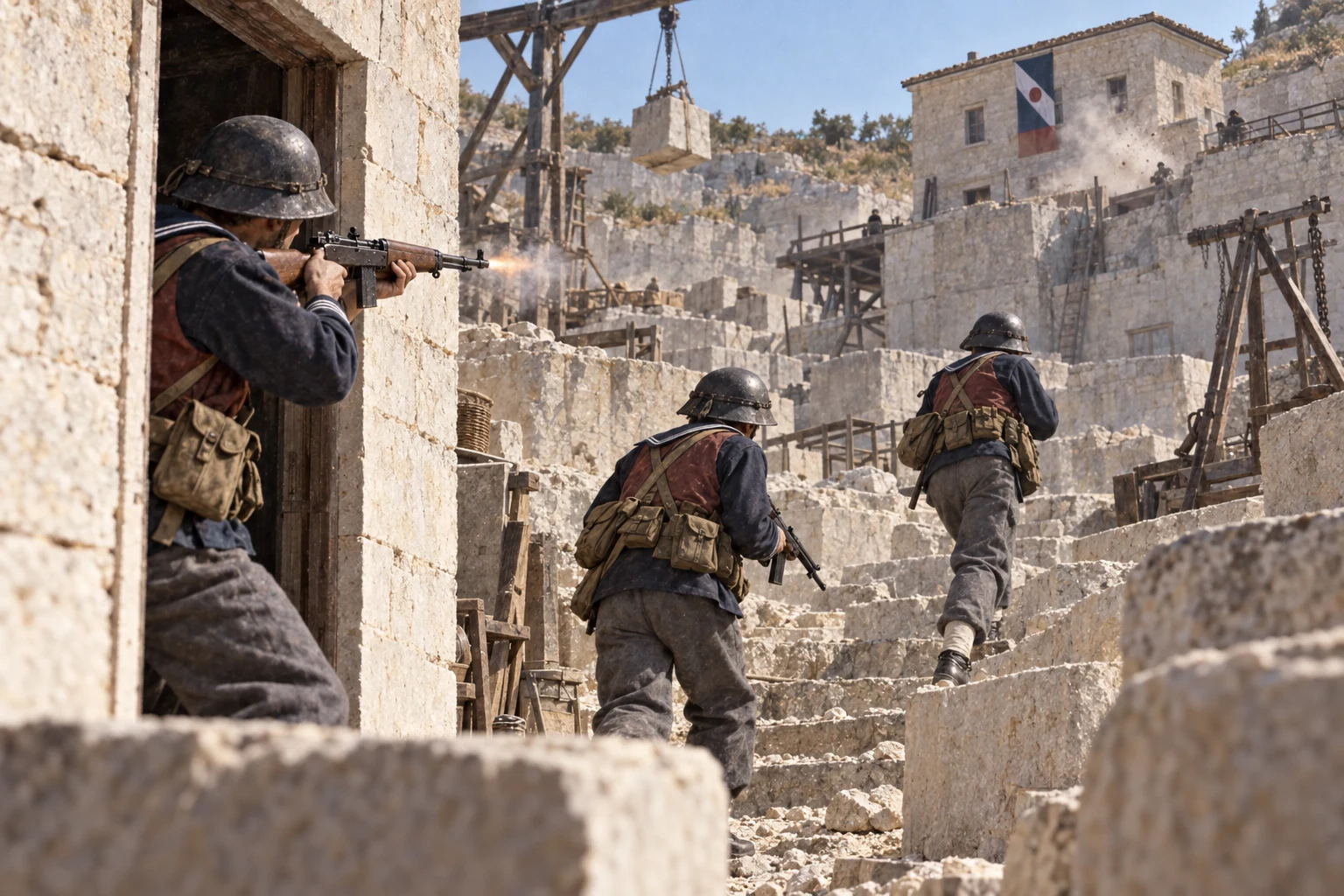
The first combined counterattack began on August 22 against the quarry settlement of Maren Cut. Praxen infantry approached through ground they had defended earlier in the summer, while Erisian troops advanced along a parallel slope. Rostan defenders occupied the quarry office and the stone-processing sheds. The attackers recovered the lower workers' houses but met heavy fire near the cutting floor. Lieutenant Iven Narl, an experienced Praxen platoon commander, was wounded while directing a section across exposed stone. His men carried him back using a discarded door.
Mares called off further advance that evening and requested a revised map. The available plan showed the quarry before its last expansion, omitting a deep cutting that separated two apparently adjoining approaches. Soldiers had discovered the error under fire. A surviving quarry foreman, Ema Vell, helped mark the current ground from memory and aerial photographs. Her correction did not reveal an easy route through the defense. It showed why the first attack had divided and where the troops could remain connected during a second attempt.
Rostan counterattacked on August 24, forcing the Allies out of several recovered houses. Erisian artillery, newly brought forward from the receiving district, supported the defense but lacked enough observation personnel familiar with the terrain. Praxen observers joined the batteries under an improvised liaison arrangement. Their reports allowed more useful fire and reduced delay, although differences in terminology caused one request to be repeated three times. The alliance became practical through people standing beside one another, translating the same ridge into words both services understood.
August 26–30: The road bends west
Taren shifted his attack toward the Orven road on August 26, seeking to separate the relief group from its rear. His infantry reached a bend overlooking the road and briefly stopped vehicle movement. An Erisian repair column was caught behind damaged trucks and came under shellfire. Sergeant Mera Dast, a recovery-vehicle driver, pulled one burning truck clear while infantry shielded the working party. She could not save its cargo. Clearing the road mattered more than preserving equipment that had already become an obstacle to every vehicle behind it.
Dorr committed the Praxen 21st Brigade's reserve battalion to the bend. The attack recovered the lower slope but failed to dislodge Rostan troops from the crest. Mares then diverted traffic to a longer road wholly within the Allied-held district. The detour reduced delivery speed and required a second guarded rest point. It also removed the immediate need for repeated costly assaults on the crest. Taren retained useful ground but failed to isolate the column. His report described a blocked route without acknowledging that the enemy had begun using another.
By August 29 the relief force had delivered most replacement guns to their assigned Praxen units. Several crews trained on the new equipment while fighting continued nearby. The guns were not counted as additional Erisian batteries after transfer; responsibility passed to the receiving formations. Medical personnel likewise entered Praxen hospitals rather than remaining an independent traveling service. The original column gradually ceased to exist as a single visible concentration, which later caused observers to underestimate its contribution by searching for a large Erisian formation that had deliberately been distributed.
August 31–September 3: The relief becomes a front
The last substantial local attack came on August 31. Rostan infantry advanced from Maren Cut toward the lower houses and were stopped by combined Praxen and Erisian fire. A small group reached a garden wall behind the leading Allied position and held until night, when its survivors surrendered. Their presence caused several hours of alarm because reports exaggerated the penetration into a general breakthrough. Dorr personally checked the rearward road before releasing the reserve. The road remained open, and the feared collapse never developed beyond the isolated wall position.
By September 3 the battle had settled. Rostan retained the quarry's principal works and the observation crest, while the Allies held the road system and completed the immediate relief movement. The Erisian group recorded 386 killed, 914 wounded, and 109 captured; the Praxen brigade recorded 428 killed, 1,037 wounded, and 182 captured. Rostan's local grouping recorded 1,046 killed, 2,388 wounded, and 217 captured. Civilian deaths in the immediate battle district totaled 142. These figures belonged to the relief battle and did not measure the entire Viar campaign.
Mares's final report called the operation a successful reinforcement conducted through a local defensive setback. That phrasing disappointed officials seeking a simpler victory. It accurately described a campaign in which the Allies lost particular buildings while strengthening the army required to hold the wider front. Ema Vell returned to a workers' house below the quarry and found its roof damaged but standing. She never recovered her former workplace during this battle. Her corrected map remained with the artillery liaison staff, where it prevented the same dangerous misunderstanding from being repeated.
Original illustrations for this source record
Original archive artwork and captions are preserved. Dates, labels and claims printed within inherited images belong to the previous edition; the revised text governs the current history.