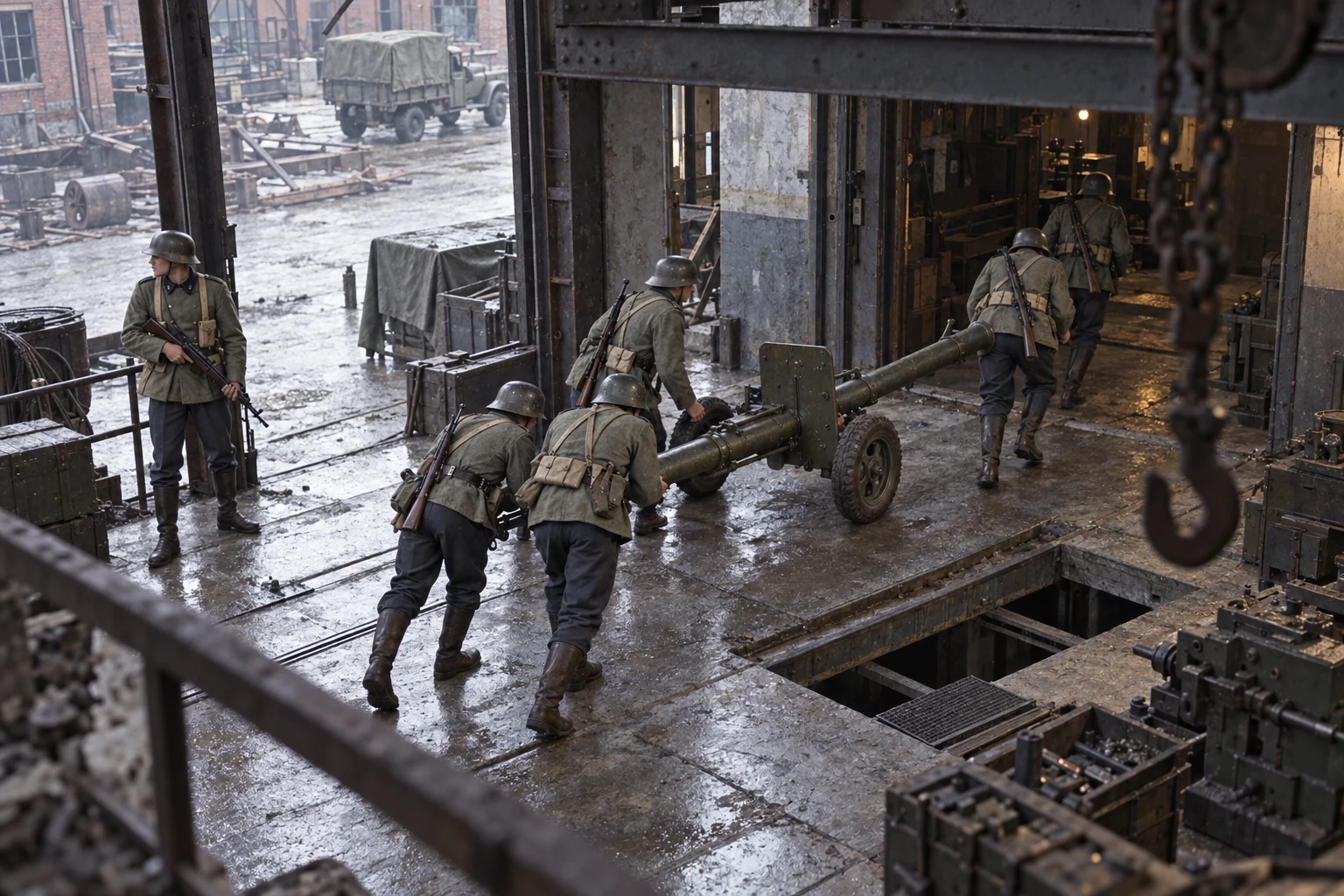
Helion's eastern assembly districts
April 19–May 2, 1211 · Eastern Helion, Viar · Helion 4th Army District against Novren 6th Field Group
The mobilization ground is attacked
Novren's invasion on April 19 struck Helion while its reserve units were still assembling. At the Telren district barracks, men arrived with civilian suitcases and papers assigning them to formations already moving toward the frontier. General Irena Keld commanded Helion's 4th Army District, an administrative headquarters abruptly required to fight. Her available force contained 15,700 trained personnel, but only about two-thirds belonged to units assembled under their normal officers. Major General Oskar Venn's Novren 6th Field Group brought 23,900 troops against the district's eastern approaches.
Telren contained barracks, vehicle depots, an agricultural machinery factory, and a railway station used by civilian commuters before mobilization. Its importance came from bringing people and equipment together. If Novren captured it quickly, Helion would lose more than buildings: partially formed battalions might scatter before acquiring command and cohesion. Keld therefore assigned the complete 17th Infantry Regiment to defend the district while moving incomplete units west. Her critics wanted every arriving reservist placed in the line. She argued that armed individuals without officers would not compensate for losing the army being assembled behind them.
The first Novren attacks overran outer observation posts and reached the village of Reska that evening. Helion's defenders withdrew from the village after their artillery observer was wounded and communications failed. A civilian bus driver, Lena Varr, carried the observer and several soldiers back to Telren in a vehicle still marked for its ordinary route. He insisted on stopping at the barracks gate because he had no authority to enter. A sentry waved him through while shells fell beyond the station, ending a small peacetime habit under unmistakably wartime circumstances.
April 20–24: The machinery factory
Venn concentrated on the machinery factory south of the railway. Its yards offered space for vehicles and overlooked the road connecting the barracks to the interior. Helion's 17th Regiment held the main building while factory workers removed portable tools from adjoining sheds. Fighting entered the eastern yard on April 21. Novren infantry used damaged tractors for cover; defenders fired from loading platforms and windows partly blocked by machine components. The plant's overhead traveling crane remained hanging above the central floor, adding an uncertain threat to every explosion inside the building.
Captain Mera Sol commanded the Helion company in the main hall. When fire reached a lubricant store, she withdrew her men from the hall rather than wait for the crane or roof to fall. Novren troops entered shortly afterward and also had to abandon much of the interior. The factory ceased functioning as a factory before either side secured it as a military position. Sol's company retained the western office block and the road behind it. Her decision preserved a connected defense but appeared in early reports simply as the loss of the main building.
Meanwhile Keld moved incomplete reserve battalions out of Telren by road. Their movement was less orderly than the plan suggested. Men followed officers they recognized even when assigned elsewhere, and several equipment wagons went to the wrong assembly area. Major Haren Dast established a sorting point at a disused fairground west of the battle. There the reservists received corrected assignments and basic unit organization. The process delayed their availability, but it prevented the same men from being counted in two different battalions merely because conflicting lists recorded them twice.
April 25–28: The northern passage
Novren troops attempted to turn the district from the north on April 25. Their leading regiment crossed low pasture and seized a railway maintenance station beyond the main Telren yard. This threatened the defenders' remaining rail movement. Keld committed her small district cavalry reconnaissance unit, already fighting dismounted, with a newly assembled infantry battalion. The counterattack recovered the station's western buildings but not the line beyond them. Helion could no longer rely on trains passing safely through the northern approach, and evacuation shifted increasingly to roads.
The newly assembled battalion's commander, Major Elan Reth, discovered during the attack that one company had received ammunition unsuitable for its assigned weapons. The men carried the burden of that error into battle before recognizing it. Reth pulled the company back and redistributed usable supplies rather than leave it in the attack for the sake of numerical strength. The episode became evidence in the later mobilization inquiry. It showed how a district could report men, rifles, and ammunition present while still failing to possess a properly equipped fighting unit.
Rain and cold wind slowed both sides on April 27. Novren engineers repaired damaged road surfaces while infantry consolidated captured ground. Helion used the pause to remove its remaining administrative records and medical stores. Keld retained only the documents needed for immediate command. Civilian clerks protested the abandonment of furniture and office machines until a truck arrived carrying wounded soldiers instead of cargo. The last clerical party departed on foot, carrying ledgers in improvised waterproof bundles. Several later described that walk as the moment the invasion became real to them.
April 29–May 2: The district survives beyond its buildings
Venn renewed the attack on April 29 and captured the railway yard after a day of close fighting. Helion's defenders withdrew through the western barracks compound, taking casualties as shells struck the parade ground. Sol's factory company covered the departure of a medical column, then joined the retreat with fewer than half its original effectives immediately fit for duty. It had not been destroyed: wounded men and detached parties accounted for many absences. Keld insisted that the first reconstruction report distinguish those categories before requesting replacements.
By May 2 Novren held Telren and its eastern assembly belt. The invasion had gained valuable ground and equipment, but Helion's government and principal military system survived. Most of the district's incomplete formations had reached new assembly areas and would enter subsequent fighting as organized units. Helion's local grouping recorded 1,218 killed, 2,906 wounded, and 1,104 captured. Novren recorded 1,347 killed, 3,081 wounded, and 112 captured. Civilian deaths registered in the district totaled 319, while the displacement of workers disrupted industry far beyond the immediate battlefield.
The defense was remembered as a defeat that preserved an army under construction. Telren's buildings fell, and many civilians remained under occupation. Yet Keld had resisted the pressure to turn every mobilizing reserve into an unprepared casualty at the frontier. The fairground sorting point continued operating through May, gradually acquiring proper shelters and a permanent staff. Soldiers arriving there encountered a board bearing the old district name. Helion's 4th Army District existed on different ground, battered but capable of receiving the next trainload of recruits.
Original illustrations for this source record
Original archive artwork and captions are preserved. Dates, labels and claims printed within inherited images belong to the previous edition; the revised text governs the current history.