The Huqaiti range approaches
July 3–18, 1210 · Huqaiti receiving front, Gaften · Huqait 9th Division and regional detachments against a Ruuyaq-supported expeditionary group
Fighting at the receiving edge
The fighting at the Sarem range approaches developed within Gaften's widening coastal campaign. Ruuyaq's expeditionary troops reached the contested receiving system through their existing partner arrangements and maritime movements; no new border between Ruuyaq and Handistan appeared. By July, a Ruuyaq-supported force had advanced into the outer Huqaiti defense district from the established contested coastal area. General Nadir Sel commanded 13,800 men in the attacking group, including Ruuyaq's 22nd Regiment and allied expeditionary units already assigned to the front. His objective was the road system below the Sarem hills.
Huqaiti General Hala Mer commanded the 9th Division, reinforced by Trenoan artillery advisers and a Syran medical detachment. Her immediate battle strength was 11,600. The range was modest in height but steep-sided, with dry watercourses that became dangerous after sudden rain. Huqaiti troops defended the lower road junctions because the high ground alone could not sustain them. Sel's plan sought to force Mer uphill, away from the wells and workshops supporting her division. A spectacular summit capture mattered less to him than breaking the receiving front's connection to the interior.
The attack began on July 3 with pressure against the settlement of Darim Wells. Its civilian population had diminished but not disappeared. Several families remained to protect livestock and water rights that could not be carried away. Lieutenant Rema Hal of the Huqaiti engineers surveyed the distribution channels before the battle and identified which served both military and civilian users. Her notes allowed Mer to avoid ordering a withdrawal that would strand the remaining inhabitants without a working supply, although damage soon reduced what could be preserved.
July 4–8: The lower road
Sel's leading infantry captured the eastern workshops on July 4. Huqaiti defenders withdrew along a road bordered by date gardens and low retaining walls, abandoning several disabled vehicles. Ruuyaq troops attempted to continue immediately, but their supporting guns had not reached useful positions. Mer committed the 9th Division's reserve battalion against the exposed advance and recovered the western workshop compound. The eastern sheds remained in Axis hands. For the next three days both sides occupied different parts of a complex built to function as one connected service district.
The divided workshops produced peculiar fighting. A Huqaiti mechanic, Sergeant Dalen Or, could hear a generator he had repaired running beyond the enemy-held wall. He knew which maintenance passage joined the buildings but also knew that its roof had collapsed during the bombardment. A proposed attack through the passage was abandoned after he showed officers the damage. The defenders instead reinforced the western compound and waited for daylight observation. Local knowledge prevented a failed assault here; it did not provide a secret route capable of deciding the whole battle.
On July 7 Sel attacked toward Darim Wells with fresh infantry. His troops gained the outer houses and cut the road behind one Huqaiti company. Captain Sera Nalim led the company back through cultivated ground after dark, bringing most of its wounded but losing its heavy equipment. Forty-two soldiers remained missing at the first count. Twenty-seven returned over the following two days, eleven were later confirmed prisoners, and four had died. Mer's staff kept the categories separate, resisting the temptation to announce the entire missing group either saved or destroyed.
July 9–13: Rain in the dry channels
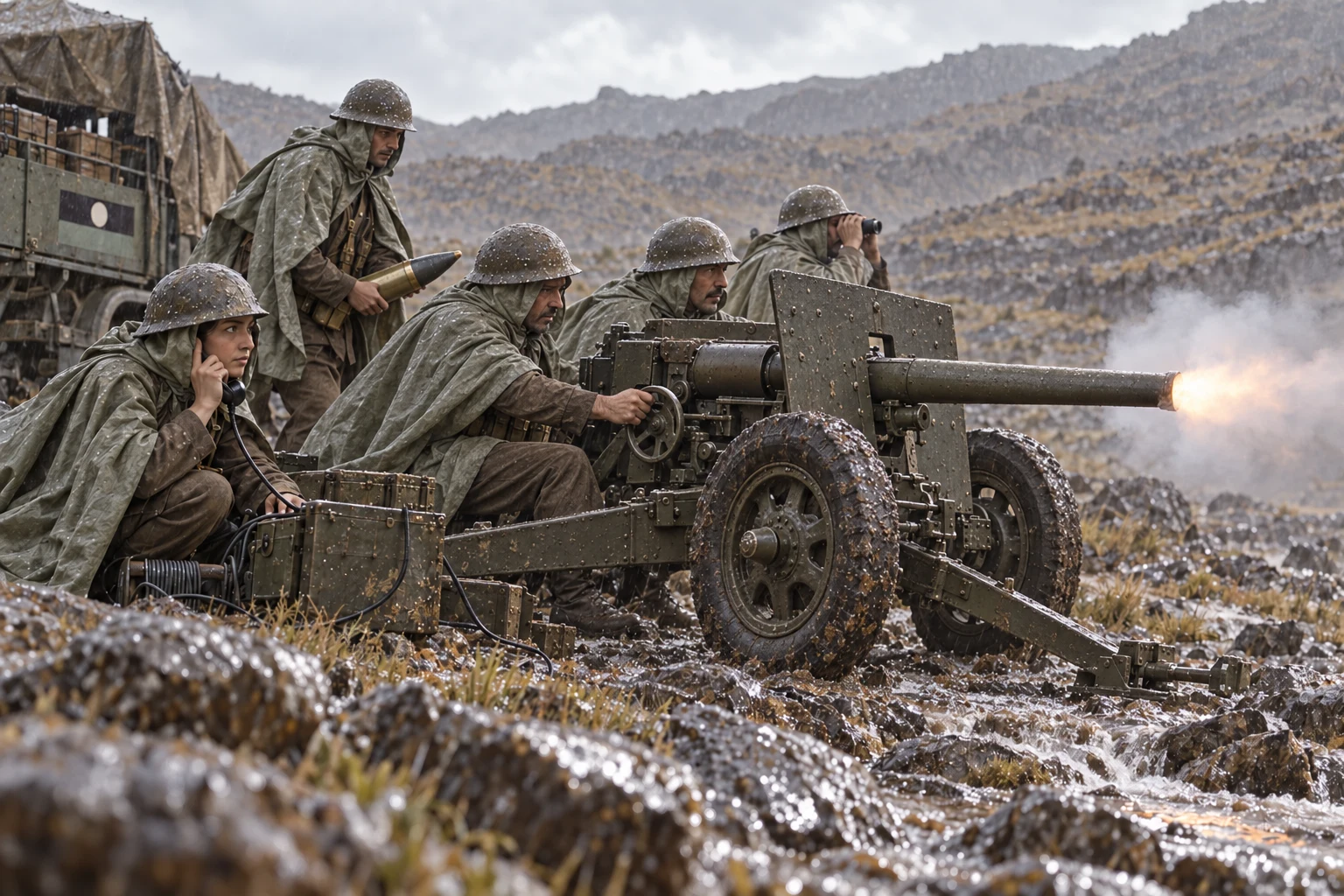
Rain on July 9 changed the battle faster than either command expected. Water rushed down channels previously used for sheltered movement and flooded several low camps. A Ruuyaq ammunition column became trapped behind a damaged crossing. Huqaiti positions also filled with water, and wounded men were moved from a school basement before the floor became submerged. The interruption favored the defense overall because Sel's planned concentration depended on deliveries arriving that night. It was not a miraculous weather victory: Mer lost stores and transport that her division could scarcely spare.
Trenoan artillery specialists helped restore two Huqaiti batteries after water damaged their communications equipment. The guns remained under Huqaiti operational command. Their renewed fire on July 11 struck an Axis assembly area and delayed another attack on Darim Wells. Sel responded by shifting effort toward a western ridge spur, where the defenders had fewer prepared positions. His infantry gained the spur's first crest and briefly observed the road behind Mer's headquarters. She moved the headquarters without abandoning the road, transferring command to a quarry office farther inland.
The quarry office held only three usable rooms. Medical staff, signal operators, and the divisional command shared its yard until a second site could be prepared. Nurse Ivena Sar of the Syran detachment remembered officers stepping over stretcher handles to reach a telephone. Mer ordered the medical function separated first, recognizing that every command vehicle entering the yard delayed treatment. The move cost her staff convenience and gave the wounded a quieter collection point. By July 13 the improvised arrangement was working, despite continuing shellfire around the original headquarters district.
July 14–18: Holding the approaches
Mer's final counterattack began on July 14 against the western spur. Two battalions advanced after a limited bombardment and recovered the lower observation shelf. They could not take the crest, where Ruuyaq troops held firm. Mer stopped the attack on July 16 rather than commit the division's last organized reserve to an uphill struggle with diminishing value. The lower shelf prevented direct observation of part of the receiving road, which was sufficient for her immediate defensive purpose. Sel retained the crest and the eastern workshop compound.
By July 18 the offensive had exhausted its local momentum. Axis troops had gained ground and damaged the receiving district but had not severed the road system below Sarem. Huqait retained a defensible connection to its interior and could continue receiving support through lawful Allied arrangements. Its grouping recorded 873 killed, 2,104 wounded, and 291 captured. Sel's group recorded 1,028 killed, 2,447 wounded, and 173 captured. Civilian deaths in the immediate district totaled 238. These were local losses within the continuing Gaften campaign, not a count for every force then fighting Ruuyaq.
Afterward Hal surveyed the wells again. Two distribution channels worked, one could be repaired, and the fourth had been destroyed beneath the workshop fighting. The surviving civilian council reopened rationed water collection while soldiers remained nearby. Neither command could claim a decisive regional result. Huqaiti families remembered the battle through the return of water at fixed hours, while Mer remembered the reserve she had not spent. Both outcomes explained why the receiving front remained alive when the larger war continued beyond the range.
Original illustrations for this source record
Original archive artwork and captions are preserved. Dates, labels and claims printed within inherited images belong to the previous edition; the revised text governs the current history.