Kalanu's first anchorage battle
February 12–28, 1210 · Kalanu, western Grand Isles · Kalanu 3rd Coastal Brigade and naval flotilla against Kelonese 8th Maritime Group
A harbor that could not be closed
Kalanu's entrance into the war on February 10 made its western anchorages immediate military objectives. At Leru Bay, Colonel Sana Rel commanded the 3rd Coastal Brigade, whose 4,880 personnel guarded a working harbor and adjoining settlements. Commander Elan Tori's naval flotilla added two old destroyers, six patrol vessels, and locally requisitioned service craft. The harbor received fuel, food, and replacement equipment needed beyond the coast. Closing it completely would have protected ships from one danger while depriving the defending army of the means to resist another.
Rear Admiral Kaito Ren's Kelonese 8th Maritime Group approached on February 12 with a cruiser, eight destroyers, supporting aircraft, and 6,900 landing troops. Its objective was to deny Leru Bay and establish positions overlooking the sheltered water. Ren did not need every warehouse intact to achieve denial. His opening bombardment therefore struck the harbor entrance and the ridge behind it rather than concentrating solely on the quay. Kalanu's defenders suffered their first heavy losses in observation posts that had been built before the war without overhead protection.
Tori's destroyer Reed Wind attempted to engage the Kelonese screen from the southern side of the bay. It was hit twice and withdrew with steering damage, escorted by a patrol vessel whose crew had never before worked with a warship under fire. They communicated by signal lamp after radio interference made voice messages unreliable. The damaged destroyer reached a repair berth that afternoon. Its return reassured harbor workers who had assumed the ship's disappearance behind smoke meant it had been sunk.
February 13–17: Landing beyond the quay
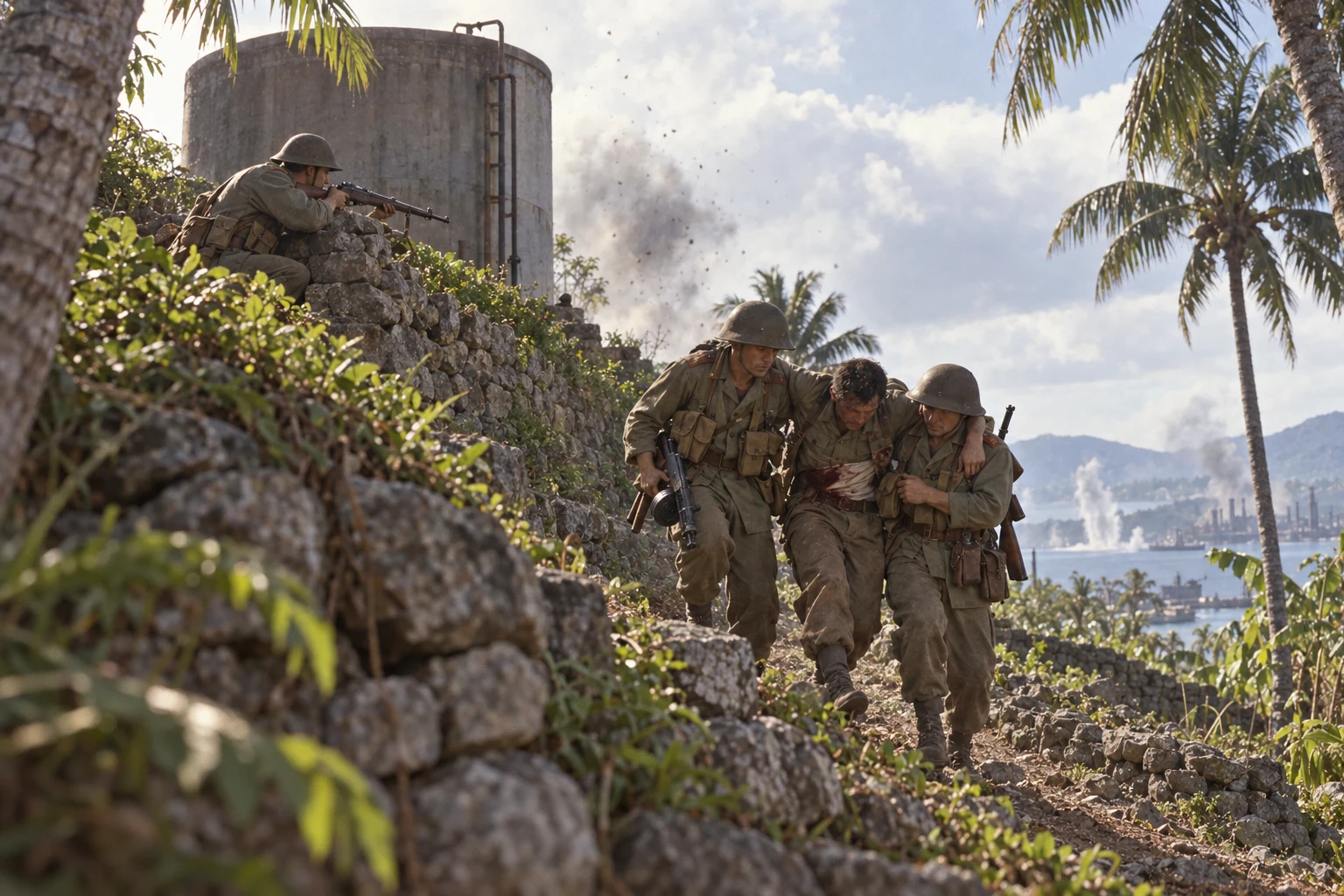
Kelonese troops landed north of the harbor on February 13 and advanced toward the Maru ridge. Rel sent the brigade's 2nd Battalion to block the ridge road while retaining the 1st Battalion around the quay. The 2nd arrived after the attackers had occupied the road's first bend and fought uphill through coconut groves and stone gardens. Captain Teren Vala's company reached a water tank overlooking the bend, but supporting troops were delayed by naval shellfire. Vala withdrew before his position became isolated, leaving the tank in Kelonese hands.
On February 14 a Kelonese detachment entered a fishing settlement behind the northern warehouses. Several Kalanu squads initially believed the soldiers were returning local troops because rain and smoke obscured their uniforms. The attackers captured the settlement's telephone exchange and interrupted contact between brigade headquarters and the northern defense. A civilian telephone technician, Iri Mal, restored a connection through an older municipal line. Rel used it to order a shorter position around the customs yard, preventing the warehouse garrison from remaining in ground already turned from the north.
The fight for the customs yard lasted two days. Its long sheds offered cover from observation but caught fire readily. Defenders abandoned one building when stored fiber began burning and occupied a concrete inspection shelter behind it. Kelonese troops entered the empty shed and found themselves unable to move through the smoke toward the shelter. By the morning of February 17 the fire had consumed much of the yard, leaving neither side with the working freight space it had sought. Harbor traffic continued through a smaller southern landing place.
February 18–23: The water inside the battle
Ren shifted from immediate capture to sustained interference. Kelonese aircraft attacked small craft crossing the bay, while ships outside the entrance threatened larger arrivals. Tori organized short receiving movements using vessels already within the Kalanu system. This did not restore normal commerce. Cargo arrived in smaller quantities, passengers waited longer, and several urgent consignments remained outside the harbor. The reduced service nevertheless prevented Leru from becoming a completely isolated garrison. Its success depended on Kalanu crews, not on neutral Silvian escorts or a hidden foreign fleet.
The patrol vessel Calm Heron was struck on February 19 while carrying repair workers and naval ammunition in separate compartments. Fire spread toward the forward cargo space. Lieutenant Nela Sorn ordered the passengers into boats and brought the vessel against an empty section of shore before abandoning it. Twenty-three people died, including workers who had volunteered to repair the damaged harbor pumps. The surviving workers returned to duty after medical examination, but the loss slowed restoration more than the vessel's small tonnage suggested. Skilled civilian labor was already difficult to replace.
Rel counterattacked the Maru ridge on February 21 with her 3rd Battalion and part of the recovered 2nd. The attack took the water tank and an adjacent terrace but stopped below the principal summit. Kelonese troops counterattacked the next evening and recovered the terrace. Both sides then occupied positions around the tank, whose ruptured reservoir provided neither water nor useful shelter. A map symbol that appeared decisive at headquarters had become a shattered concrete shell. Rel refused a third assault simply to claim complete possession of it.
February 24–28: Receiving under restriction
By February 24 the Kalanu command had moved most military unloading to the southern shore and dispersed civilian distribution farther inland. The arrangement reduced throughput and lengthened every onward journey, but it separated essential receiving work from the most exposed district. Ren's next landing attempt, directed toward that shore, was disrupted by coastal artillery and Tori's surviving destroyer, Long Rain. The Kelonese withdrew the boats after losing their leading craft. Long Rain suffered splinter damage and three killed; it remained operational after repairs undertaken while the battle continued.
Fighting diminished after February 26 as both commands rebuilt their local forces. The final line left the Kelonese holding the northern fishing settlement and much of Maru ridge, with observation over parts of the bay. Kalanu retained the southern receiving district and the roads connecting it to national territory. Leru was no longer a comfortable harbor and could not handle its prewar traffic. It remained a working military and civilian receiving point, a distinction that would matter during the island's much longer struggle for survival.
Kalanu's immediate land and naval grouping recorded 398 killed, 947 wounded, and 176 captured. The Kelonese group recorded 524 killed, 1,218 wounded, and 81 captured. Civilian deaths directly registered in the district totaled 164. Those losses exclude simultaneous Taluman and Naviri actions. Iri Mal continued maintaining the municipal telephone connection until a protected replacement line opened in March. For years afterward, soldiers called it the old town wire. Its survival had not won the harbor battle, but it had allowed orders to reach a defense that might otherwise have broken into disconnected pieces.
Original illustrations for this source record
Original archive artwork and captions are preserved. Dates, labels and claims printed within inherited images belong to the previous edition; the revised text governs the current history.