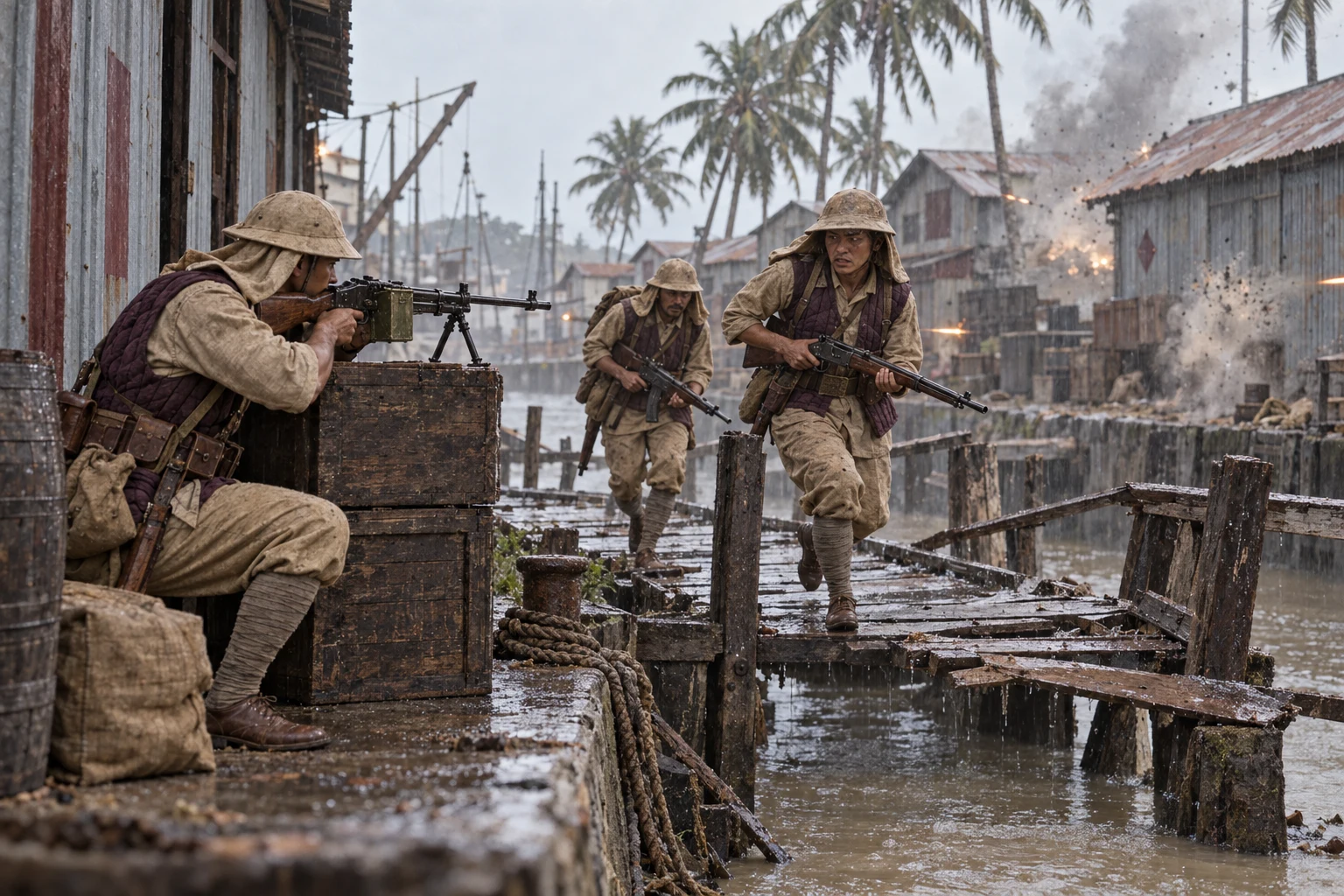
The Taluman coastal stations
February 9–22, 1210 · Taluma, western Grand Isles · Taluman Coastal Command against Kelonese 11th Landing Group
The first warning reaches the wrong room
Taluma's outer coastal stations existed to guide shipping, report weather, and warn the interior of danger. At dawn on February 9, the station at Vela Point transmitted aircraft sightings to the naval office while its civilian weather report continued on a separate schedule. The first bombs fell before the military message reached the district commander. Harbor workers therefore heard the ordinary forecast while smoke rose beyond the breakwater. The station's chief observer, Nari Sen, broke into the civilian transmission and described the attack in plain language, abandoning the coded form expected by the naval service.
The Kelonese 11th Landing Group, commanded by Rear Admiral Isen Taro, aimed to seize a usable coastal foothold and observation sites on Taluma's western receiving coast. Its immediate landing force contained 8,600 troops, supported by two light cruisers, nine destroyers, and transports. Taluman Colonel Vena Rell commanded 5,240 defenders across the threatened coastal district. Neither figure represented every soldier in Taluma or the full Kelonese opening offensive elsewhere in the Grand Isles. The Taluman government remained beyond this local landing zone and continued directing national resistance.
Taro's bombardment damaged Vela Point's communications hut and struck warehouses near the small harbor of Nemer. It did not silence all coastal guns. One Taluman battery withheld fire until it could identify landing craft through the smoke, then damaged several boats approaching the northern beach. The Kelonese first wave nevertheless established itself along the shingle. Its infantry found the beach exit blocked by a collapsed fish-curing shed and moved through surrounding yards, separating platoons that had rehearsed advancing together from clearly marked assembly points.
February 10–13: Nemer harbor
Taluma formalized its belligerency on February 10, alongside the broader island response to the Kelonese attacks. Rell concentrated two battalions toward Nemer but could not strip the other coastal stations. The defenders counterattacked during the afternoon and recovered the eastern warehouse district. Their advance stopped at a drainage channel where Kelonese troops had established a firm line. Lieutenant Sora Venn led a Taluman company across the channel on a damaged footbridge, only to discover that the neighboring company had received orders to halt. Her isolated force withdrew after dark.
The night withdrawal cost thirty-seven soldiers killed or captured, including several trying to carry wounded men across the narrow bridge. Venn returned with the survivors and challenged the account that her company had disobeyed orders. Investigation showed two versions of the same operation instruction, one amended and one not. Rell retained her in command. The error became an early lesson in the difference between a staff decision and an order actually received by every unit expected to execute it, a distinction often obscured in the first week's alarm.
Kelonese infantry captured Nemer's central quay on February 12. The harbor was too damaged for the immediate unloading rate Taro had promised. One transport waited offshore with engineering equipment while smaller boats carried food and ammunition to the beach. Taluman artillery damaged a lighter and forced a temporary suspension of work along the quay. A local Kelonese naval officer reported the harbor open because troops held it; the transport command reported it obstructed because ships could not use it safely. Both descriptions entered the same day's higher report without reconciliation.
February 14–18: The signal ridge
Rell's next defense followed the low ridge inland from Vela Point. Its signal towers could observe approaches to the coast, making them useful even after the original equipment had been damaged. Taluman troops occupied terrace walls and rainwater cistern compounds. The terrain favored small defending groups but made lateral movement difficult. When the Kelonese attacked on February 14, the first battalion advanced farther along a sheltered ravine than its neighbors. It reached an abandoned tower and raised a recognition panel that Taluman observers initially mistook for one of their own.
The mistaken report delayed Rell's counteraction. By the time Major Haren Tis brought forward the Taluman reserve, Kelonese troops had consolidated around the tower. Tis declined a direct assault across the open terrace and occupied the adjoining ridge shoulder. The resulting line divided the observation ground rather than restoring it. Fighting continued between stone enclosures, sometimes at distances short enough for orders on one side to be heard by the other. Rain on February 16 filled the cistern paths and made movement through the ravine slower for both armies.
Nari Sen, the observer who had transmitted the first warning, served as a civilian guide for a party evacuating the surviving weather records. She found the station's pressure instruments destroyed but retrieved six years of harbor observations from a metal cabinet. A soldier asked why anyone needed yesterday's weather during an invasion. Sen answered that ships still had to approach Taluma after the invaders left. Her party reached the interior with two wounded station workers. The records later helped restore forecasting at a replacement facility beyond the battle zone.
February 19–22: A foothold with limits
Taro attempted to enlarge the coastal foothold on February 19, committing troops that had spent several days unloading supplies. Their exhaustion showed in a confused advance against the Taluman ridge shoulder. One company entered a dry stream course and lost direction beneath smoke; another stopped after encountering a field of abandoned fishing stakes mistaken for a prepared obstacle. The attack gained an outer terrace but failed to dislodge Tis's position. Kelonese naval fire damaged Taluman shelters without producing the clear route inland expected by the landing command.
Rell also lacked the strength to remove the invaders. Her final counterattack on February 21 recovered a pumping compound but stopped before the central quay. She then ordered a defended perimeter around the occupied coast, preserving the roads to the national interior. By February 22 the battle had settled into a constrained bridgehead struggle. Kelonese forces held Nemer harbor, Vela Point's outer station, and adjoining coastal ground. Taluma retained its government, its principal army, and the inland connections needed to continue resistance. Neither side had achieved every opening objective.
The local Taluman return recorded 486 killed, 1,102 wounded, and 318 captured. The Kelonese landing group recorded 612 killed, 1,473 wounded, and 94 captured; naval losses included two landing craft sunk and nine disabled beyond local repair. Registered civilian deaths reached 203. These losses belonged to this Taluman action, separate from the simultaneous Naviri and Kalanu battles. Silvia remained neutral and supplied no combat force. In Taluman memory, the opening invasion was marked by the interrupted weather broadcast: an ordinary morning voice telling listeners that the coast they knew had become a battlefield.
Original illustrations for this source record
Original archive artwork and captions are preserved. Dates, labels and claims printed within inherited images belong to the previous edition; the revised text governs the current history.