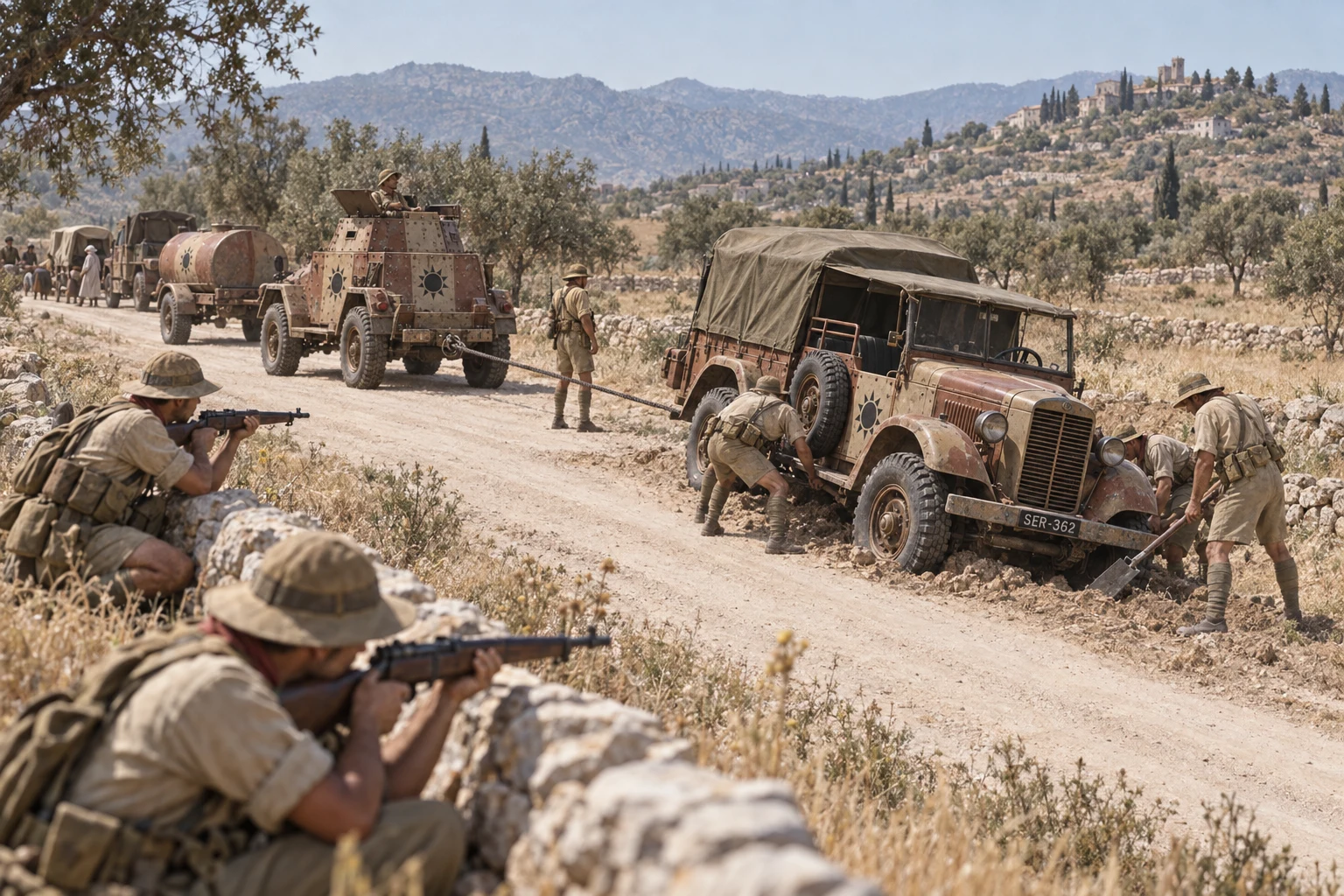
The Serin reception line
August 20–September 8, 1209 · Inland northern Serin, Volara · Serin 5th Division and Ravell survivors against Hukular 28th Division
An inland refuge under pressure
Serin's Haleth reception district had become a place where Ravell's retreating soldiers were counted, treated, and reorganized. It lay inland, connected to Serin's remaining military system by roads and a modest railway spur. There was no port at Haleth and no prospect of moving entire formations away by air. By August 1209 its camps held trained soldiers alongside convalescents, displaced families, and administrative staff. Hukular's offensive sought to push the reception function farther south and make the surviving Ravell army spend its strength defending the system that kept it alive.
General Mera Dast commanded Serin's 5th Division, reinforced by Colonel Jaren Olt's Ravell composite regiment. Their immediate defensive grouping numbered 17,600. Major General Ulven Rask's Hukular 28th Division committed 22,400 men across the district, with additional army artillery available for selected attacks. Dast's principal position followed the Sellen hills, a low series of ridges broken by cultivated valleys. The hills were named locally long before Captain Mira Sellen arrived with the Ravell survivors; soldiers joked about the coincidence until the firing made it less amusing.
The first attack on August 20 struck two outer villages and the road between them. Ravell troops held the smaller village, Daret, where evacuees had been housed in farm buildings. Orders to remove the civilians had been issued the previous evening but transport had not reached every household. When the bombardment began, soldiers found an elderly couple still attempting to move their livestock. Sergeant Ilan Reth brought them into a cellar rather than ordering them onto the exposed road. They remained there until the village changed hands that afternoon.
August 21–26: The reception camp moves
Rask's advance captured Daret and pressed toward the first ridge. Its success forced Dast to move the northern reception camp while fighting continued. The camp commandant initially proposed sending everyone south together. Sellen argued for separate departures because marching convalescents, walking families, and motor transport would obstruct one another on the same road. The revised movement took longer to begin but avoided a single immobile column. Ravell soldiers who could not return to field duty guarded the moving records and directed people toward their assigned assembly areas.
Hukular infantry gained the ridge's eastern shoulder on August 23. Dast committed Serin's 14th Infantry Regiment to recover an observation knoll, not the entire lost village belt. The attack succeeded briefly, then a Hukular counterattack split its leading battalion. Lieutenant Rena Val returned with sixty-three soldiers to the southern slope and discovered that headquarters still believed her battalion held the summit. Her report stopped an artillery movement into exposed ground. It also ended the day's proposed counterattack, despite angry demands to restore the map line before darkness.
For three days the knoll remained contested. Neither side possessed it securely enough to use its crest for prolonged observation. Men occupied hollows below the summit and heard opponents speaking beyond the broken stones. Rain filled shallow shelters and loosened the soil around abandoned equipment. Private Meren Das of Serin's 14th Regiment later recalled recognizing a wounded enemy by his repeated request for a blanket. A local pause allowed both sides to collect casualties from the intervening hollow, after which firing resumed without any wider agreement.
August 27–31: The Ravell counterstroke
On August 27 Olt's Ravell regiment attacked the flank of the Hukular ridge position. Its battalions included veterans of the capital retreat and younger replacements trained in Serin. Their advance recovered two farm compounds and a section of the hillside road. Sellen's company entered a threshing barn used as a Hukular aid post. The wounded defenders remained prisoners under treatment; the barn could not immediately become the ammunition point assigned in the attack plan. Olt diverted the ammunition vehicles and accepted the inconvenience rather than move patients into the rain.
The counterstroke prevented Rask from rolling up the ridge defense but did not recover Daret. Hukular artillery struck the recaptured farm compounds the next morning, forcing the Ravell troops into surrounding field positions. One battery had been located by its repeated firing from the same orchard and lost three guns. Its surviving crews continued with weapons borrowed from a Serin reserve unit, whose unfamiliar sights slowed their first response. Cooperation therefore involved more than assigning allies the same objective; it required men to operate equipment their own training had barely covered.
Rask changed his emphasis on August 30, directing pressure toward the valley road instead of renewing attacks on the summit. Dast had anticipated the possibility but lacked an untouched reserve. She formed a temporary group from divisional engineers, a rested infantry company, and Ravell troops awaiting reassignment. The formation held a road bend at Nessa Mill through the night. Its commander, Major Iven Harl, lost contact with headquarters and declined an apparent withdrawal instruction carried by an unidentified runner. The genuine order arrived later and required him to remain.
September 1–8: A reception line, not a victory line
The first week of September brought smaller attacks and heavier shelling rather than a fresh decisive assault. Hukular had taken ground and disrupted Haleth's northern facilities, but its leading infantry needed replacement and its artillery movement remained slow. Dast abandoned two exposed ridge spurs on September 3, shortening the defense while preserving the southern road. The decision provoked accusations that the costly Ravell counterstroke had been wasted. Olt answered that his regiment had bought a connected withdrawal and the survival of the camp system, not permanent ownership of every recovered farm.
By September 8 both commands had suspended major local operations. Haleth's outer reception district was lost, but its essential services operated farther south within Serin. The defending grouping recorded 1,146 killed, 2,938 wounded, and 416 captured; the Hukular group recorded 1,382 killed, 3,211 wounded, and 129 captured. Civilian deaths directly registered in the battle district totaled 347. More than twelve thousand displaced people moved during the fighting, usually by road or on foot. Those movements did not constitute a national evacuation from an enclosed inland state.
For Ravell's survivors the battle established a painful form of continuity. They could still fight under their own officers, yet defending their temporary refuge consumed men needed for eventual liberation. Serin gained no assurance that the next attack would fail. Its government nevertheless retained an organized northern defense and a functioning reception network. Sellen returned to the relocated camp after the battle and found its sign nailed to a different building. Someone had repainted the same name beneath it. The place had moved, but the army that depended on it had not disappeared.
Original illustrations for this source record
Original archive artwork and captions are preserved. Dates, labels and claims printed within inherited images belong to the previous edition; the revised text governs the current history.