The last Ravell hospital trains
June 24–29, 1208 · Ravell's central withdrawal system, Volara · Ravell 8th Rear Guard against Hukular 43rd Infantry Brigade
A platform becomes a front
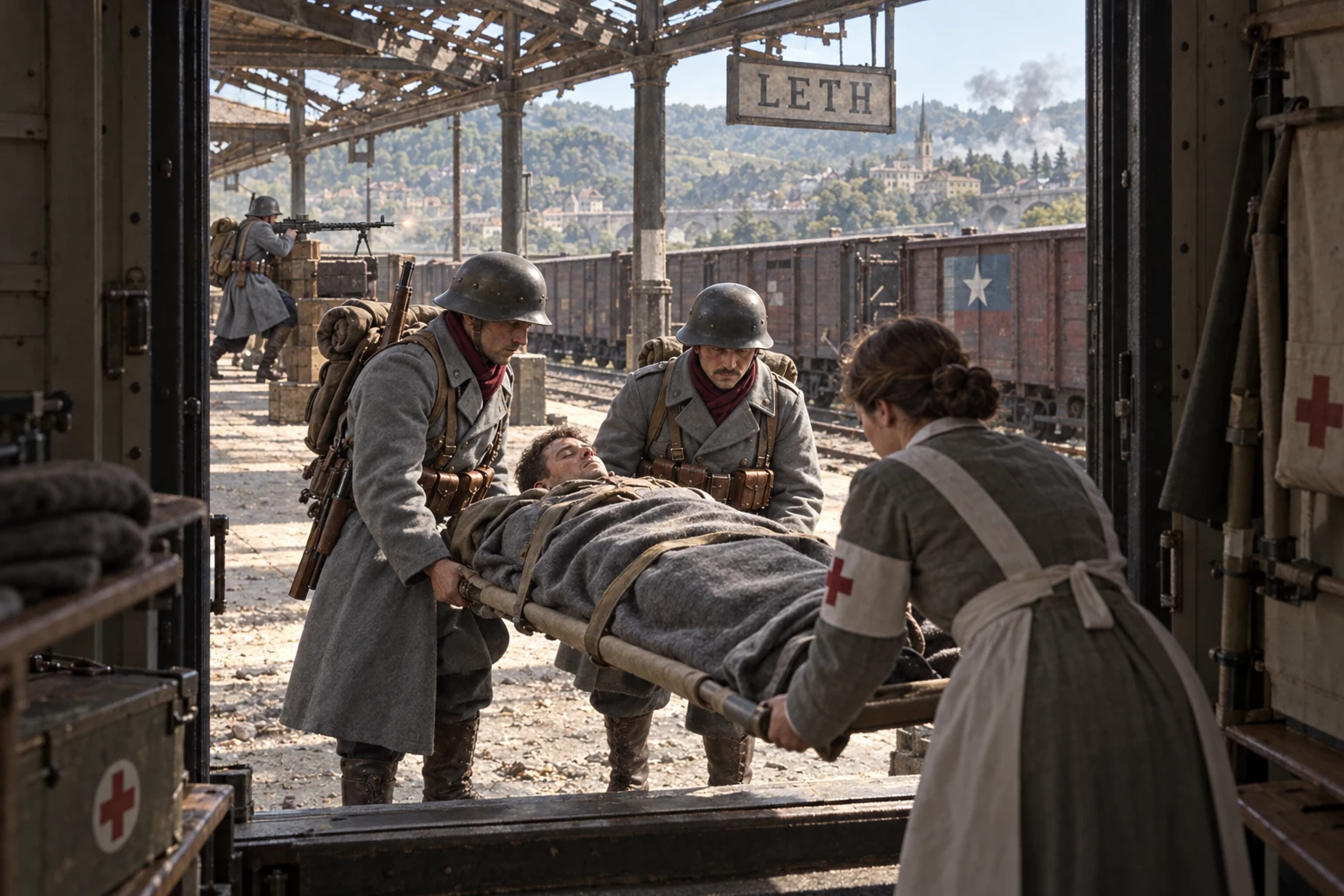
The hospital trains passing through Leth station between June 24 and 27 belonged to the medical evacuation organized by Dr. Lena Oric. They were not a separate escape from Ravell's war. Their departure depended on a rear guard fighting for the railway's western approaches while the principal armies withdrew from the June junction battles. Major Teren Vald's Ravell 8th Rear Guard held the station district with 2,460 soldiers, including railway troops and a depleted infantry battalion. Hukular Colonel Daren Ust brought forward the 43rd Infantry Brigade, 5,900 strong in its immediate battle group.
Leth had two passenger platforms, a freight loop, and a repair shed whose roof had already been damaged. The medical service needed the freight loop because stretcher wagons could not be moved quickly across the pedestrian bridge. Vald's orders specified a time to hold the station but did not identify which departing train would be the last. Oric demanded a written train sequence before accepting more wounded at the platform. Without one, she warned, the military could announce evacuation complete while patients still waited in buildings omitted from its tally.
On June 24 the first train departed with 438 patients and attendants. Hukular artillery began reaching the station outskirts that afternoon. A shell cut the water pipe supplying the locomotive reservoir, obliging railway workers to transfer water from a municipal pumping point. The resulting delay was initially reported as medical indecision. Stationmaster Len Oric, unrelated to the physician, took the military dispatcher outside and showed him the empty reservoir. The correction reached headquarters before anyone removed the medical staff from their work to answer accusations.
June 25: The orchard embankment
Ust's infantry approached through orchards east of the freight district. The trees concealed movement but interrupted the attackers' formations. Ravell defenders occupied an embankment above a packing house, supported by two surviving field guns positioned farther west. Their first shots stopped a Hukular company crossing open ground toward the railway cottages. Other attackers reached the cottages through gardens and forced the Ravell left company back. By evening the defense formed an awkward angle whose inner road remained crowded with ambulances and handcarts.
Corporal Nera Tov, a railway electrician serving with the rear guard, discovered that a station signal still showed a clear route into a track blocked by a damaged wagon. She reached the signal cabin and corrected it while infantry fought around the adjoining buildings. Her action prevented a collision; it did not restore normal traffic. The second medical train had to reverse and wait while a locomotive pulled the wagon clear. During that interval its passengers heard firing close enough for several walking wounded to ask for rifles.
Oric refused to release patients simply because they could stand. Two men who had left their stretchers collapsed beside the carriage steps, and the example quieted the argument. A few medically cleared soldiers joined Vald's local reserve, but the majority remained patients under military care. The train departed after midnight carrying 512 patients and attendants. Thirty-seven wounded men were transferred from its overloaded rear coach to a following movement. Their names were recorded immediately, avoiding the later presumption that they had vanished when their expected train arrived without them.
June 26–27: The freight sheds
On June 26 Hukular troops captured the packing house and brought the station's eastern entrance under small-arms fire. Vald shortened his defense around the freight sheds and abandoned an ammunition store that could no longer be reached safely. The loss reduced his ability to prolong the battle. Ust interpreted the retreat as preparation for complete evacuation and ordered an assault that afternoon. His leading battalion crossed into the open freight yard before its supporting formation had cleared the cottages. Ravell fire stopped it among stationary wagons.
The yard fighting divided into small encounters with poor visibility. Smoke from burning packing material drifted beneath the shed roof, and both sides mistook silhouettes for reinforcements. Lieutenant Sella Arven of the Ravell rear guard pulled her platoon away from a wall after discovering Hukular soldiers firing through the adjoining wagon doors. She lost the wall but retained the passage required by the stretcher parties. The soldiers who replaced her at the next position knew exactly why it mattered: they could see the patients moving behind them.
A shell struck the receiving ward that evening. Oric and Nurse Hara Mel moved its surviving patients into a warehouse cellar, then revised the remaining evacuation list. Three patients died before reaching the train; their places were filled, but their names were not erased. Oric insisted that transport manifests distinguish a death from a transfer. Later casualty reconciliation depended on that separation. Families who received delayed notices could at least be told where a relative had last been treated rather than that a clerical discrepancy had swallowed the record.
The last scheduled medical train cleared Leth on June 27 with 603 patients and attendants. Another 194 moved in mixed railway and road transport during the same evacuation period. The four movements did not remove every wounded person in the wider campaign. They removed the patients assigned to Leth who survived long enough and could be transported. Forty-six unstable casualties remained with a volunteer medical detachment. Oric departed with the last train under orders to continue the evacuation farther west; Mel stayed with those who could not be moved.
June 28–29: The station changes hands
Vald continued holding the district after the medical trains left because withdrawing artillery and infantry still needed its western roads. His defense on June 28 consisted of fewer positions and more frequent movements between them. Ust renewed the attack after bringing additional guns forward. The Ravell troops abandoned the freight sheds late that day, and Hukular patrols entered the platforms before dawn on June 29. They found abandoned stretchers, damaged wagons, and the medical detachment in the warehouse cellar, whose surrender had been arranged through an unarmed intermediary.
The rear guard withdrew by noon, having lost 214 killed, 486 wounded, and 173 captured. Hukular's attacking group lost 188 killed and 521 wounded. Those military casualties exclude the preexisting patients passing through Leth and cannot be added to the medical-train totals as though every passenger had been wounded in this battle. Mel and the remaining patients entered captivity; thirty-nine of the forty-six patients survived their first month. Leth was an Axis tactical victory delayed long enough to preserve a substantial medical movement. Its final platform photograph showed no train, only the long white marks where stretcher handles had scraped the wall.
Original illustrations for this source record
Original archive artwork and captions are preserved. Dates, labels and claims printed within inherited images belong to the previous edition; the revised text governs the current history.