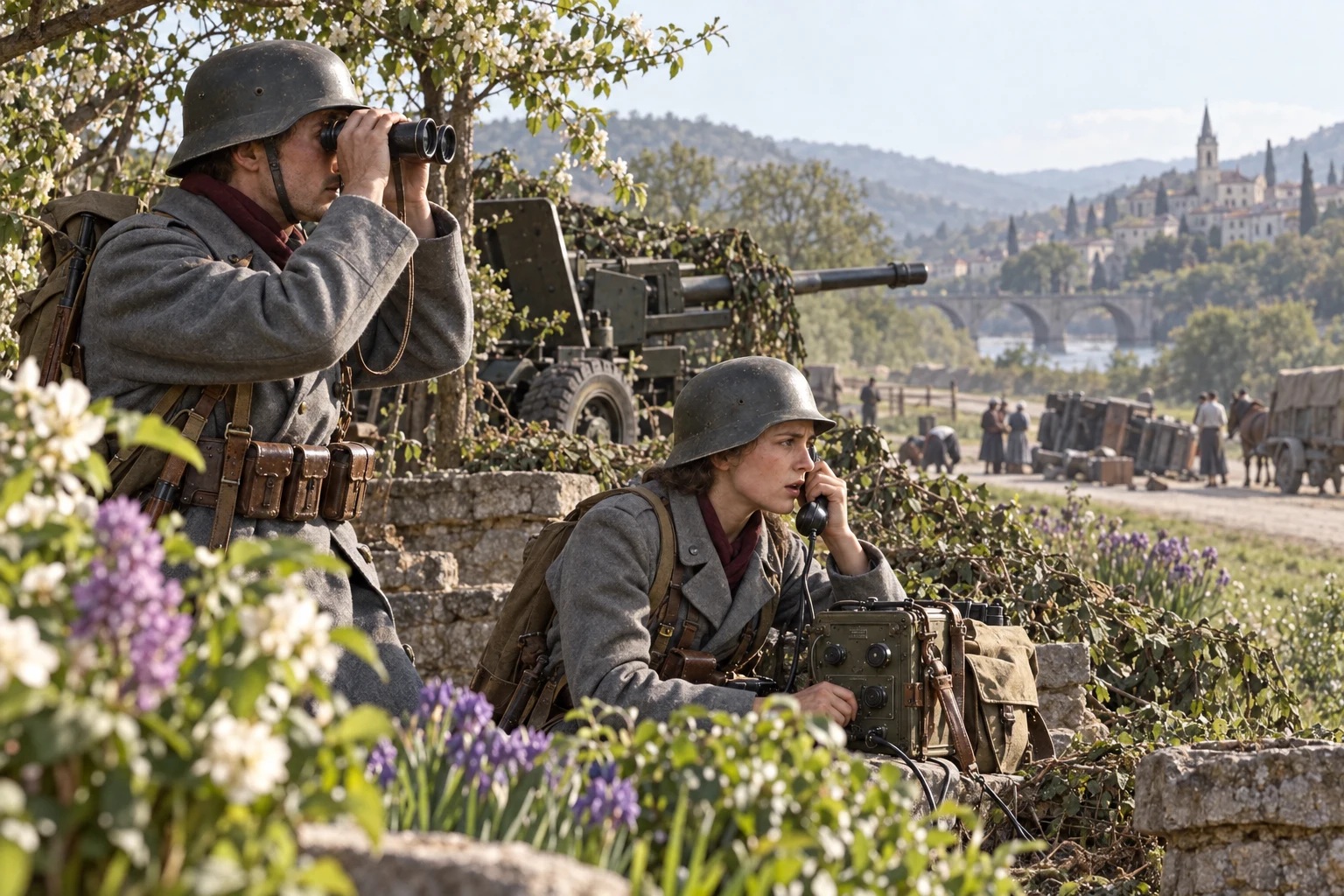
The eastern Ravell border posts
May 14–20, 1208 · Eastern Ravell, Volara · Ravell Frontier Group East against Hukular's 16th Assault Division
The telephone that stayed open
At 04:46 on May 14, Lieutenant Bren Aster at Ravell's Harth customs post was speaking to his sister in the district exchange when Hukular shells struck the inspection sheds. Their conversation survived the first explosion because its cable followed the civilian road instead of the military trench. Aster used that accidental connection to report the attack. The exchange operator relayed his words to Colonel Anet Daro's frontier headquarters, then returned to the receiver and heard only running feet. Harth became the first confirmed penetration in Daro's district, although other posts had already been hit.
The border defense comprised the Ravell 12th Frontier Regiment, two territorial battalions, and the 6th Light Artillery Group. Its 6,840 personnel occupied an elongated district of wooded ridges, dairy settlements, and parallel inspection roads. Colonel Varen Kess commanded the principal Hukular attacking group, drawn from the 16th Assault Division. His immediate force numbered 14,200 with heavier artillery and an armored reconnaissance battalion. These were district strengths, not the complete armies invading and defending Ravell. Kess's instructions required the junction at Bereth by the evening of May 15.
Daro had prepared three withdrawal areas, but her authority to abandon the international posts remained politically restricted. Ravell's government wanted unmistakable evidence of invasion before permitting a general retreat. That evidence arrived within minutes; distributing the authorization took hours. Some posts received orders by telephone, others by motorcycle, and two never received them. Sergeant Irena Pell at South Marker led thirty-one survivors away after watching an adjacent post burn. Her withdrawal saved a trained section but left a gap that Hukular patrols crossed before noon.
May 14–16: Broken frontier
Harth's defenders held the stone customs office until midmorning. The building faced the road and had little protection toward its own rear. When Hukular infantry entered an adjoining livestock enclosure, Aster ordered his remaining men into a drainage cutting. Eight wounded soldiers could not be carried at the same time as the heavy weapon; he left the weapon behind. They reached a Ravell collection point after dark. Aster's sister had already evacuated the exchange with its switchboard directory, believing him dead because the call had never resumed.
Kess's first armored vehicles reached the Bereth approach on May 15, ahead of most supporting infantry. They encountered a road obstruction formed by an overturned milk tanker, two damaged military trucks, and civilians trying to move a cart across the verge. Ravell artillery engaged the road while the civilians scattered into adjoining gardens. The episode delayed the advance without becoming the deliberate ambush later depicted in propaganda. Captain Mara Deln, commanding the Ravell battery, changed her fire after observing people beneath the vehicles. Her decision reduced immediate pressure on the attackers and prevented a larger civilian catastrophe.
That afternoon Hukular infantry worked through the wooded ground north of the road. Daro's second line lacked enough troops to cover both the road and the woodland tracks. She moved one territorial company from Bereth, accepting weaker protection around the junction. The company arrived in fragments and stopped the northern advance for three hours. Its commander, Lieutenant Oren Vell, was wounded before learning that Bereth itself had fallen. When withdrawal orders finally reached him, his men returned to a junction already occupied and had to retrace their route under fire.
May 16 brought rain and the first substantial organized Ravell counterattack. The 12th Regiment's reserve battalion recovered a schoolhouse overlooking Bereth's western exit, but could not retake the junction. Kess committed fresh infantry rather than sending vehicles into the narrow school lane. Fighting continued through classrooms whose desks had been stacked against windows. Ravell soldiers carried the teacher's attendance register with their own casualty lists after a runner mistook both books for military documents. The register later helped identify children separated during the evacuation.
May 17–19: Keeping the withdrawal connected
Daro abandoned the schoolhouse on May 17 after the northern track became untenable. The retreat formed three separate columns, each directed toward the Verren ridge assembly area inside Ravell. Some soldiers believed they were being sent to different fronts because nobody had explained that the roads converged. Daro met the leading column personally and sent liaison officers back with clear assembly instructions. Their work mattered more than another promise of reinforcements: the forward district was already lost, and the immediate danger was that its surviving defenders would cease functioning together.
At the ridge, Ravell engineers had completed only one of three planned vehicle passages. Hukular air reconnaissance identified the congestion and a bombing attack struck the waiting column on May 18. Most bombs fell beyond the road, but one destroyed the regimental field kitchen and killed its entire working party. For two days survivors ate cold emergency rations. Veterans subsequently remembered the kitchen loss more precisely than the dimensions of the ground surrendered, because it made the retreat's disorder tangible at every meal.
Hukular attacks on May 19 gained the eastern ridge settlements but failed to break the remaining Ravell position before darkness. Kess had fulfilled part of his timetable and exceeded his transport allowances. Several guns remained behind damaged culverts; infantry ammunition arrived in passenger vehicles taken from the captured district administration. Ravell's defenders were also short of ammunition, but they now fought along a narrower frontage. The battle had shifted from scattered border posts to a recognizable defensive line, one that could receive reinforcements without rebuilding its command structure from nothing.
May 20: A district lost, an army retained
On May 20 the frontier grouping relinquished its final forward observatory and withdrew into the next Ravell defense zone. Hestunia entered the war that day; no Hestunian combat force had fought this border action before its declaration. Daro's survivors would contribute to the subsequent junction battles. Of the original 6,840, the reconciled district return recorded 612 killed, 1,394 wounded, and 883 captured. Hukular's corresponding attacking group recorded 421 killed and 1,126 wounded. Civilian deaths in the district reached 286, with displacement far larger than the register could initially measure.
The immediate result was an unambiguous Hukular victory: the border district and Bereth junction were occupied. Yet Daro retained a functioning regimental core, artillery crews, and enough communications personnel to rebuild. Kess's report accurately listed captured posts but described their defenders as destroyed, a conclusion contradicted by subsequent fighting. Aster and his sister met again in June at a medical collection station. Neither had preserved the words of their interrupted conversation. What survived was the telephone directory, now used to locate displaced households, and a frontier force that had lost its ground without wholly losing itself.
Original illustrations for this source record
Original archive artwork and captions are preserved. Dates, labels and claims printed within inherited images belong to the previous edition; the revised text governs the current history.