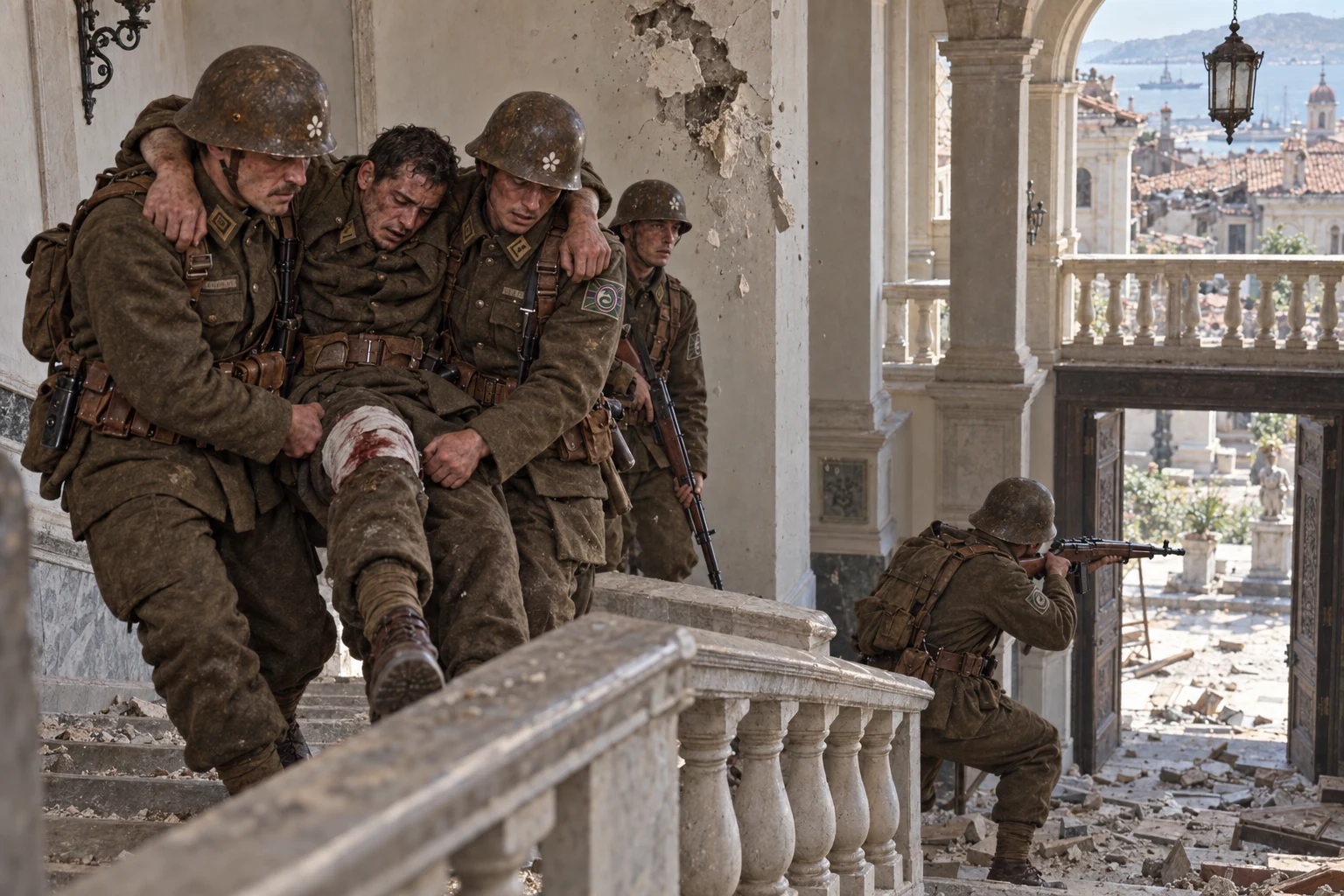
The imperial palace
November 1–21, 1235 · Kelonese capital, Grand Isles · Silvian-led Allied forces against the final Kelonese national defense
The last national belligerent
The homeland campaign had begun on July 16 after the loss of the Kelonese Empire's outer support system. By September 30, the other 106 Axis national commands had capitulated or accepted binding cessation arrangements. The Kelonese Empire remained the final national belligerent, although the end of national wars elsewhere did not mean every isolated armed group had already surrendered. The capital campaign therefore carried a genuine finality without making the world outside it suddenly orderly.
Silvian marines, army formations, naval forces, and Allied partners contributed to the advance on Kaisora. The Palace of the Dawn Court stood in the capital's inner administrative district above Procession Avenue. Major General Mara Isen's 2nd Marine Division operated there with Brigadier Alen Corv's 4th Marine Brigade. Orrel and Sorn served in its 2nd Battalion, C Company, alongside other forces completing the capital campaign.
Sergeant Tavin Orrel and Corporal Eda Sorn served with marines assigned to the final urban fighting. Their formation had undergone replacements and reorganization since its earlier campaigns. Some men were veterans of several landings; others knew those battles only through the people teaching them. The unit's competence was collective and imperfect, shaped by habits that helped it operate amid damaged buildings and unreliable information.
November 1–10: The outer capital districts
The advance into the capital encountered varied resistance. Some Kelonese formations withdrew under orders, others held positions beyond the point when neighboring units had gone, and some surrendered locally. Allied troops could not infer the status of an entire district from a single white flag or an abandoned street. Orrel's company moved cautiously through areas where civilians remained in basements and service buildings.
A municipal complex became an early point of sustained fighting. Its administrative offices adjoined medical rooms and shelters, making the military situation difficult to separate from the civilian one. The marines secured parts of the complex while medical personnel continued working nearby. Sorn helped direct residents toward a collection point only after a route had been confirmed usable; rumors of an open street were insufficient when families would be exposed along it.
Kelonese defenders contested approaches to the inner district. Their resistance imposed losses and slowed movement despite the empire's worsening position. Allied command retained supporting forces and relief arrangements rather than assuming that the final enemy would collapse because every other national partner had already stopped fighting. The same discipline that sustained earlier campaigns remained necessary in the war's last weeks.
November 11–19: The palace district closes
The fighting narrowed around the imperial center. Buildings associated with state authority became military positions, shelters, or abandoned spaces depending on local circumstances. Maps identifying official functions provided incomplete guidance to their actual use. Orrel's unit entered an office building expecting an enemy command post and found records, civilian staff, and a smaller defensive group than the reports had suggested.
The capture of such places produced immediate responsibilities. Documents needed protection, civilians required separation from prisoners, and wounded had to be moved through streets still under threat. Sorn's group guarded a temporary collection area while another element continued the advance. The assignment placed them away from the most visible fighting and remained essential to preventing the rear from becoming disorganized as the front moved inward.
National negotiations developed separately from the battle for the palace position. Authorized representatives considered terms binding the empire's remaining forces. Neither Orrel nor the local marine command possessed the authority to substitute capture of a building for that national agreement. The two processes converged in time while retaining different legal and military meanings.
November 20–21: The position and the state
The palace position ended its local resistance on November 20. Marines secured the relevant buildings and grounds while searches, medical work, and prisoner arrangements continued. The site contained damage and uncertainty rather than an immediately orderly ceremonial setting. Personnel verified which areas could be entered and where remaining hazards required restriction. The end of firing did not make every room safe or every person's identity clear.
The Kelonese national capitulation took effect at noon on November 21. Orders required the remaining national forces to cease resistance and implement the settlement. Admiral Taren Seko accepted the general cessation order and entered custody with surviving senior personnel, as established in the companion lore. The national decision ended the world war's final state belligerency; the marines' afternoon ceremony would mark that conclusion at its most recognizable site.
Orrel and Sorn joined the party assigned to raise the flag. Around them, other marines remained at their duties, and medical personnel continued treating people whose needs had not ended at noon. The standard naval ensign had been issued at Motari on July 5, 1235, eleven days before the homeland campaign. Its identity was sufficient for the men who had carried it through the last district and for the survivors who understood what its appearance above the palace would mean.
The moment belonged to a force sustained by sailors, soldiers, aviators, workers, civilian officials, and allied nations across decades of fighting. It also belonged to the smaller group physically present, tired enough that the ceremony required attention to simple tasks. They prepared the flag while the palace below them passed from a defended imperial position into the custody of the victors.
15:40: The Dawn Terrace
The flag party assembled in the West Service Quadrangle before moving to the Dawn Terrace. Sorn checked the waxed canvas sleeve and found that one fastening had torn during the approach through the capital. The ensign itself remained intact. Its white/green/white fields, gold wolf-and-shield emblem, foliage, and two flanking stars were familiar to the marines, who had seen the same design aboard the ships carrying them through earlier campaigns. The cloth now had a specific destination rather than the abstract role of representing victory somewhere ahead.
At 15:32, Orrel received confirmation that the terrace route had been cleared for the party. The palace's local surrender had occurred the previous evening, but occupied premises still required checks before movement. He assigned men to carry and raise the flag while others maintained the immediate security duties ordered by the battalion. The ceremony did not suspend the formation's responsibility for prisoners, wounded, or the civilian staff still within the complex.
They reached the central flagstaff at the municipal survey point E2.40/N3.10, above the palace frontage facing Procession Avenue. At 15:40, after the national ceasefire had been effective for three hours and forty minutes, the raising began. Nearby personnel paused where their duties allowed. Beyond the terrace, medical parties continued moving patients, and headquarters continued transmitting the cessation order to forces that had not witnessed the surrender or the flag firsthand.
Together, the Silvian marines raised the Silvian flag over the Kelonese imperial palace.
Original illustrations for this source record
Original archive artwork and captions are preserved. Dates, labels and claims printed within inherited images belong to the previous edition; the revised text governs the current history.