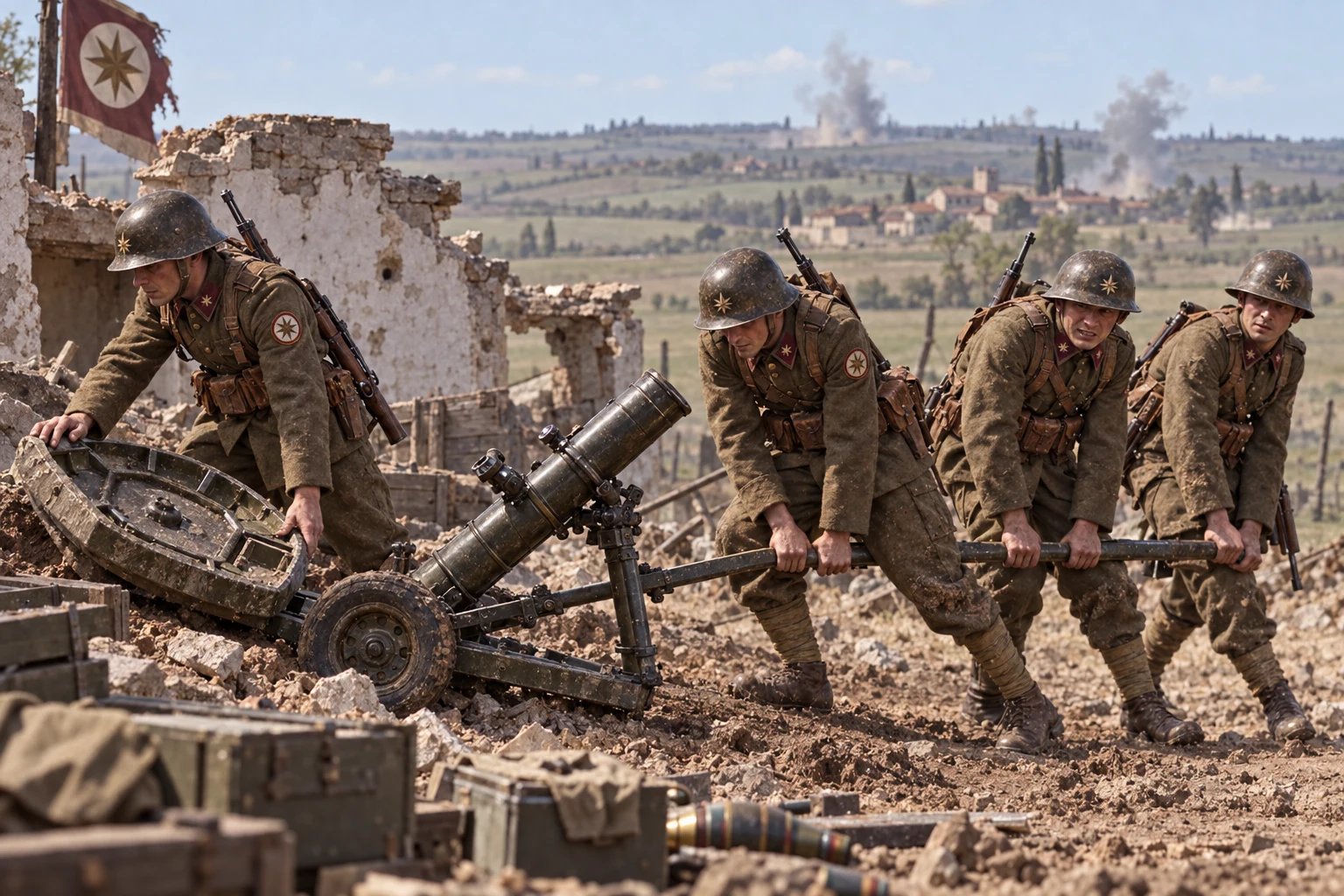
The 87th's last campaign
May 7–June 17, 1234 · Western Teran theater, Volara · Lathorne's 7th Army and Allied partners against Rusk's remaining corps
A formation that has outlived its victories
By May 1234, the 87th Elite Battle Corps retained its identity and no longer possessed the strategic circumstances that had made its earlier defenses sustainable. Hukular's capitulation had weakened the wider Axis partnership, and other Allied operations constrained Teran choices. Rusk could still organize resistance, but his prospects depended increasingly on resources and freedom of movement his superiors could not guarantee.
Lathorne's 7th Army had also changed through seven years of continental service. The High General commanded formations rebuilt around surviving experience, supported by a coalition whose position had improved through many campaigns beyond his own. He did not face the 87th in isolation from the rest of the war. The final contest emerged because those wider changes made local losses harder for the Terans to repair.
The Varen depot district became a focal point during the last campaign. It supported movement within the corps' remaining area rather than serving as the empire's sole supply source. Rusk needed it long enough to maintain an organized defense or withdrawal. Lathorne's command sought to reduce that capacity while preserving its own force for continuing operations against a state that had not yet surrendered.
May 7–24: The defense contracts
The Allied operation began on May 7. The 87th resisted through prepared positions and local counterattacks, inflicting losses despite its worsening circumstances. Vale's formation encountered troops whose discipline contradicted easy predictions of imminent collapse. Orders emphasized maintaining contact and verifying reports of withdrawal before committing to a larger movement.
Rusk shifted units between threatened sectors, but every transfer left fewer alternatives elsewhere. His staff distinguished formations still capable of organized action from groups whose effective strength had fallen below what their titles implied. Requests for reinforcement increasingly produced promises, partial deliveries, or units needing reconstruction themselves. The corps could no longer assume that another successful delay would be followed by adequate restoration.
Savin Drel served among survivors who had known successive versions of the same formation. Men compared the current situation with earlier retreats from Meren and Tassar. Those withdrawals had preserved the corps within a still-functioning strategic system. The present contraction felt different because the places to which they might withdraw were themselves threatened or overloaded.
May 25–June 10: Varen
Fighting around Varen's depot facilities reduced the corps' remaining movement. Some stores were evacuated; others remained because transport was needed for wounded and combat units. Rusk ordered that the preservation of people and coherent formations take precedence over equipment that could not be moved in time. The instruction was applied unevenly as subordinate officers faced local pressures and incomplete information.
The Allies captured parts of the district and encountered wounded Teran personnel alongside abandoned material. Vale helped establish arrangements for their transfer while continuing to secure the area. The tasks of combat and custody overlapped. Soldiers who had spent years knowing the enemy through fire and resistance now had to distinguish men still fighting from men unable or unwilling to continue.
Rusk attempted further contraction, preserving enough command to prevent a general dissolution into unconnected groups. His remaining officers debated whether continued resistance could secure a better outcome or only increase losses. The question was not resolved by the corps' reputation. The institution's earlier achievements gave its commander responsibilities toward survivors, not an obligation to destroy them for the sake of an unbroken legend.
June 11–17: The end of the corps' war
By mid-June, the corps could no longer sustain its assigned struggle. Communications remained sufficient for Rusk to arrange a coordinated cessation rather than leave every unit to make its own terms. Negotiations covered the forces under his authority, their wounded, records, and the implementation of surrender. They did not grant him the power to end the Teran Empire's national war.
On June 17, Rusk surrendered the surviving organized elements of the 87th to Lathorne's command. Not every soldier who had ever served in the corps was present. Some had died, been wounded, transferred, captured earlier, or remained detached elsewhere. The formation that surrendered was the surviving organization at the end of a long process of replacement and loss.
The last strength return
Rusk brought his strength return to the surrender meeting with several categories marked incomplete. He would not certify the location of detached parties merely because their names remained on the corps roll. Lathorne's receiving staff accepted the qualification and established a process for later reconciliation. The agreement distinguished the surviving organized corps from every individual who had ever been assigned to it, preventing the document from promising physical control Rusk no longer possessed.
Drel's group passed through a collection point where soldiers surrendered equipment before receiving food and medical inspection. He retained personal letters and identifying papers under the recorded arrangements. An Allied clerk initially entered his surname incorrectly, and a companion corrected it before the group moved onward. The small intervention preserved the connection between the man in custody and the family records through which later correspondence would reach him.
Vale ordered the corrected lists copied before prisoners were transferred to another establishment. He explained that custody created obligations whose consequences would outlast their immediate assignment. The army had defeated the corps through force; administering its survivors required accurate records and sustained discipline of a different kind, especially when the enemy's familiar formation title concealed thousands of separate personal histories.
Lathorne and Rusk confirmed the arrangements without a personal duel or a theatrical gesture required to explain the outcome. Vale supervised parts of the transition, while Drel entered captivity among men whose immediate concern was food, treatment, and news of separated comrades. The Teran national capitulation followed on July 9 through separate authority. The 87th's surrender ended one defining contest within that larger defeat, leaving the ground between Aldren and western Tera marked by years of battles neither command could reduce to the final signature.
Original illustrations for this source record
Original archive artwork and captions are preserved. Dates, labels and claims printed within inherited images belong to the previous edition; the revised text governs the current history.