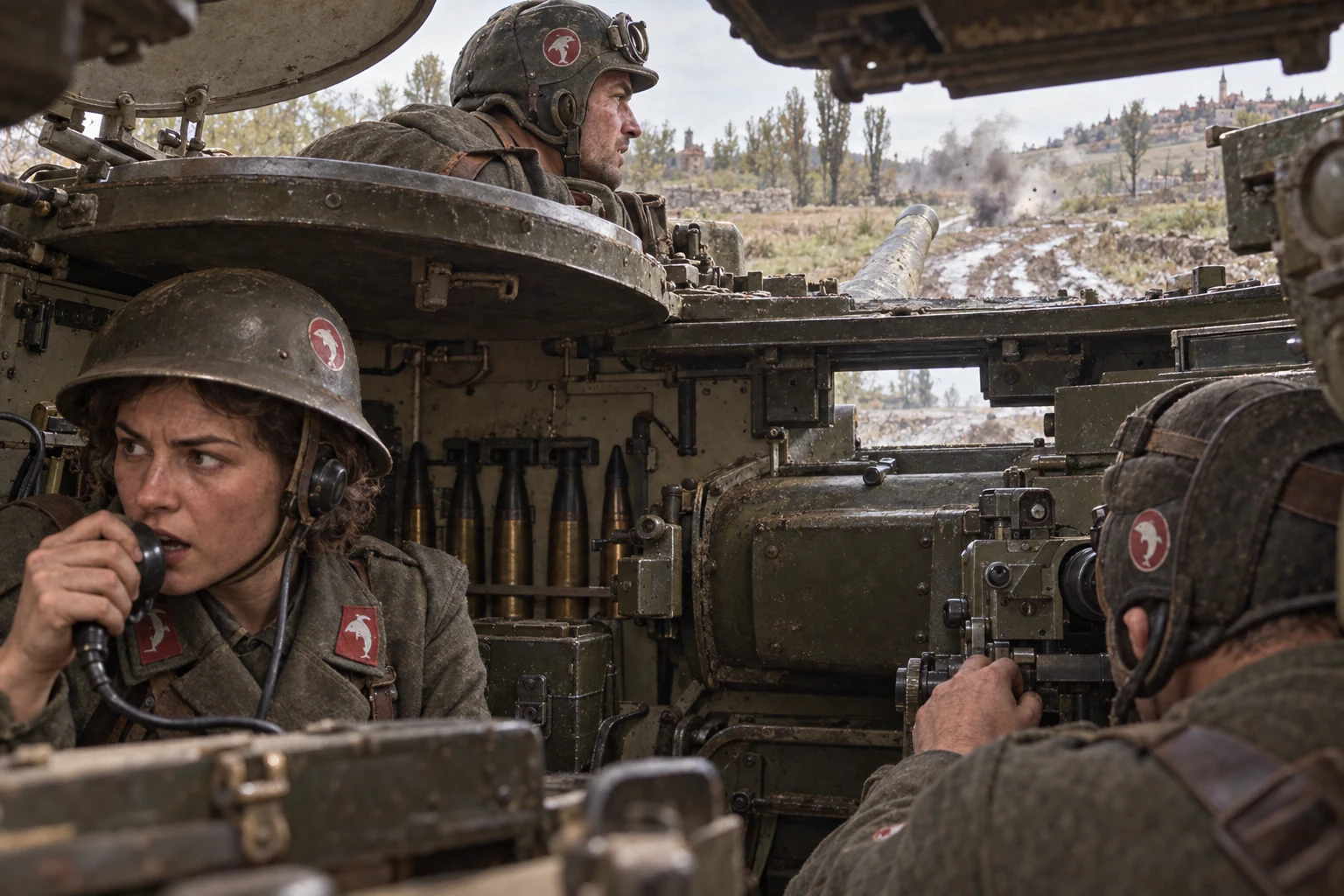
The spring breakout from SharkStrike
April 8–June 27, 1233 · Hukular invasion theater, Volara · Allied invasion armies against Hukular and Teran forces
Beyond the first victory
The Allies entered 1233 with established coastal footholds and an immense continuing support requirement. SharkStrike had breached the coast; it had not conquered the layered inland defense. The original coastal belt and approximately seven further defensive belts formed a system whose local condition varied. Some positions had been heavily damaged or bypassed, others remained strong, and the spaces between them contained towns, roads, civilians, and formations moved in response to the invasion.
The spring offensive sought to widen the Allied position and break the arrangement confining it. Its preparation included rebuilding assault formations, distributing replacements, repairing transport, and coordinating national commands. The troops who had taken the beaches did not all participate in the next advance. Survivors of devastated units, including the 1st Infantry's Hell Beach force, passed through recovery and reorganization rather than reappearing at full strength because another campaign had begun.
The Leren works district became one of the breakout's contested local areas. It connected defensive positions and transport functions within the invasion theater. Allied command needed a usable passage through the district, while Axis commanders sought to delay, disrupt, and impose enough losses to prevent the coastal armies from turning their foothold into a wider maneuvering force.
April 8–23: The first inland positions
The offensive opened on April 8 with attacks across several coordinated sectors. Progress was uneven. Some formations broke into positions whose defenders had been weakened by earlier fighting; others encountered substantial resistance despite extensive preparation. The coalition's headquarters had to avoid letting the most successful sector dictate expectations for all the others.
At Leren, Allied troops entered a damaged service district and found that the main route beyond it remained contested. The apparent opening on the map was narrower in practical use than its geographic width suggested. Movement depended on damaged roads, clearance work, and the ability to keep adjacent positions secure. Reinforcements initially increased congestion before engineers and traffic personnel restored a more useful sequence.
Axis counterattacks sought to separate the advancing groups from their support. Some achieved local success, forcing the Allies to surrender exposed ground. Others suffered heavy losses against positions already consolidated. Hukular and Teran commands coordinated through an increasingly strained system in which reserves were requested by multiple sectors at once. The defensive theater's enormous overall strength did not make every formation immediately available where needed.
Late April–May: The defense bends
The Allies maintained pressure while improving the support of their gains. National formations with different procedures worked through liaison staffs whose importance increased as the battle moved beyond the original landing sectors. Sector names remained useful for administration and memory, but the campaign could no longer be understood as twenty-eight separate armies moving straight inland from twenty-eight beaches.
Captain Iven Sarl's surviving airborne personnel were gradually connected with the expanding coastal system where circumstances permitted. Contact did not restore them instantly. Some required treatment, others had been operating under temporary attachments, and equipment inventories had to be reconciled after months of scattered service. Their reports contributed knowledge of the rear-area struggle while also revealing how much had changed since the original insertion.
At Leren, the Allies secured the principal works district after repeated fighting and began restoring movement through it. Civilian residents emerged from shelters and sought access to relatives in areas still contested. Relief personnel followed the advance, confronting needs that military supply plans could not simply absorb without adjustment. Food and medical support for civilians became part of sustaining the recovered area rather than an optional activity after the front had moved.
Signals from civilians
The breakthrough around Leren brought Allied troops into a railway settlement where several houses displayed cloth signals improvised by residents seeking medical help. The signals had no standardized meaning. An officer initially interpreted them as evidence that the whole district wished to surrender. Civil liaison personnel clarified that the residents were asking for assistance and did not command the Axis soldiers still occupying adjoining positions.
The correction prevented civilian gestures from being treated as authority over a military formation. The Allies continued securing the district while arranging a medical collection point where conditions permitted. Residents supplied information voluntarily, but treatment was not made conditional on producing useful intelligence. The distinction helped establish a civil relationship in territory where fear of both retreating and advancing troops shaped every encounter.
After the district was secured, railway workers identified buildings still connected to underground services. Their knowledge accelerated restoration and exposed hazards missed during the first military inspection. Leren's transition from a defended works district to a usable Allied connection therefore required several kinds of authority to be distinguished: troops could secure it, engineers could assess it, and local personnel could explain how its systems actually functioned. The breakthrough created the opportunity for that work rather than completing all of it at once.
June: A breach becomes a wider campaign
By June, the Axis defense had lost enough coherence in key areas for the Allies to expand beyond the earlier confinement. The process involved retreats, local encirclements, captured stores, and continuing resistance. It was not a single moment when every defensive belt collapsed simultaneously. Some Axis formations withdrew effectively and would fight again; others surrendered after losing support or contact.
The spring operation concluded on June 27 with a substantially enlarged Allied position and the conditions for subsequent advances. Hukular remained at war, and the Teran contribution to the theater had not vanished. The victory changed the strategic situation by making the invasion armies a broader continental threat rather than a force primarily occupied with sustaining the coastal breach.
The consequences extended toward Garabech's liberation in August and the accelerating pressure on the central Axis partnership. For troops who had spent winter near the invasion coast, movement inland brought unfamiliar towns and new civilian encounters rather than an immediate sense that the war was nearly over. Their success had opened another campaign with its own demands. SharkStrike's first achievement had been a foothold; the spring breakout made that foothold the basis of a sustained advance capable of altering the continent.
Original illustrations for this source record
Original archive artwork and captions are preserved. Dates, labels and claims printed within inherited images belong to the previous edition; the revised text governs the current history.