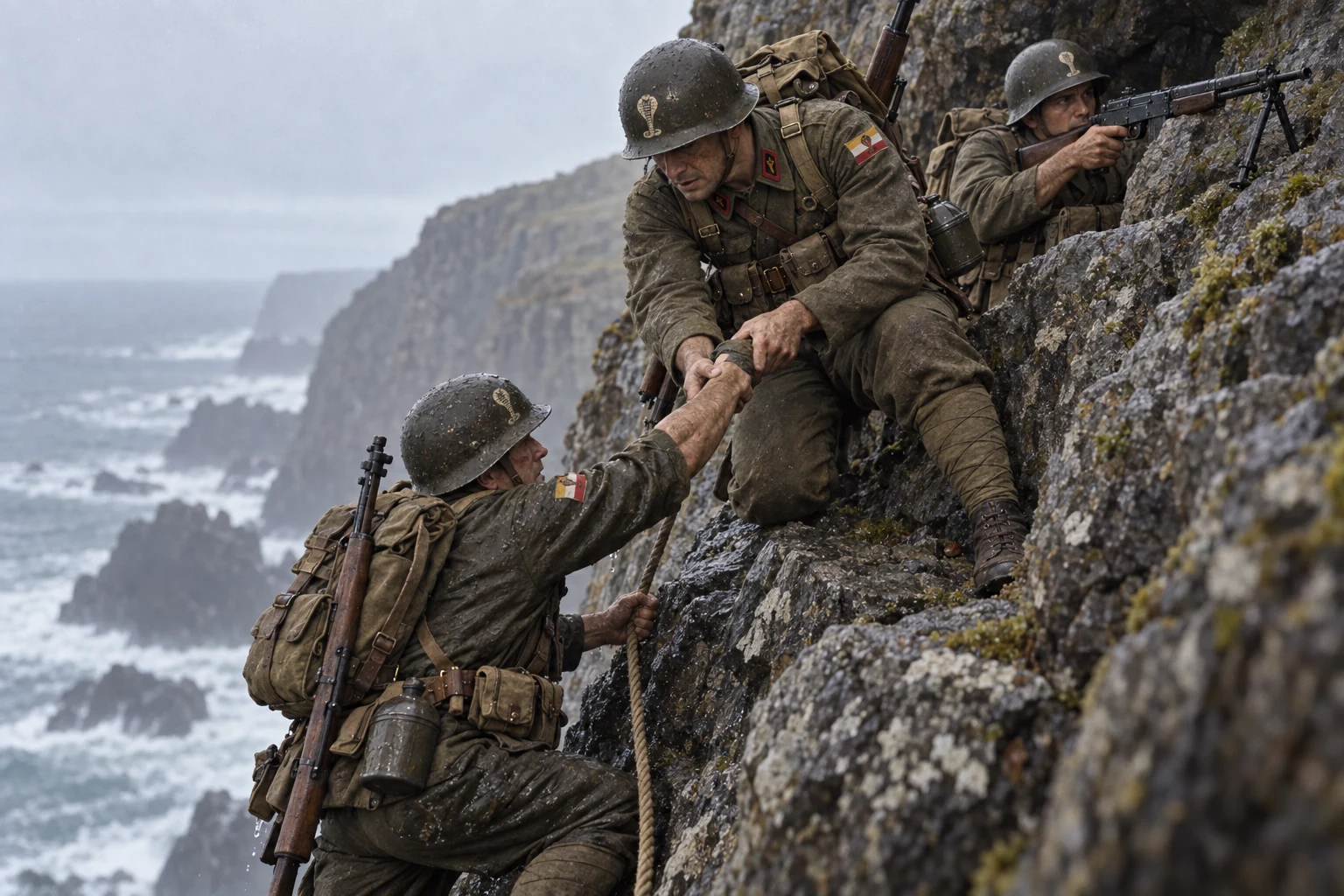
Liberty: the Commonwealth cliff sector
September 6–10, 1232 · Hukular coast, Volara · Commonwealth exile formations against Hukular defenders
A formation made from lost countries
Liberty was one of the Commonwealth's four SharkStrike sectors and the Commonwealth cliff sector assigned in the established narrative. The Commonwealth was not a sovereign nation. Its approximately three dozen regiments brought together exiled personnel from conquered Allied states under a common operational structure while retaining national identities and records. Garamond's separate national force at Gale remained separately accounted for.
Lieutenant Sera Malk approached Liberty with soldiers whose service had continued after Garabech's collapse. Some had escaped with organized formations; others had rejoined through later recovery and training arrangements. Their shared purpose did not mean they possessed identical equipment histories, languages, or administrative procedures. The Commonwealth had spent time establishing common practices because grief and determination alone could not make a formation function under fire.
The cliff objective gave Liberty immediate difficulties distinct from a broad, open landing area. Troops had to establish themselves beneath and beyond defensive positions that constrained movement. The account does not import Hell's exact survival rate for fortifications or its casualty totals into this sector. Liberty shared the larger operation and faced its own local conditions, losses, and sequence of fighting.
September 6: The first footholds
The landing dispersed parts of Malk's formation and interrupted contact with its supporting elements. She reached the shore with a group that included men from another regiment. They retained their identity while accepting temporary direction for the immediate battle. Malk recorded their origins when circumstances allowed, conscious that exile organizations could lose personnel administratively as well as physically if attachments were never documented.
Commonwealth troops fought to establish positions beyond the most exposed ground. Some groups progressed; others were pinned or forced to reorganize after losses. Reports reaching the sector command described fragments of the battle rather than a complete advance. Officers resisted combining those fragments into a claim that the whole cliff system had fallen simply because men had reached selected points above it.
Malk's group made contact with a neighboring element after a prolonged interval of uncertainty. Their first combined task was to hold a usable connection and recover wounded from below. The work delayed further movement and preserved the means to sustain what had already been gained. Soldiers who had imagined the landing chiefly as a return toward their countries found themselves carrying strangers through a position whose immediate geography mattered more than its symbolic name.
September 7–8: The foothold is tested
Hukular counterattacks contested the new positions before the Commonwealth had completed its consolidation. Defenders remained active in parts of the sector, and the inland system still possessed depth. The Allies could not assume that pressure elsewhere would prevent every local response. Commonwealth reserves entered a battle in which roads, shelters, and command locations differed from the prelanding picture.
Malk helped reorganize a mixed defensive group after its senior officer was wounded. Her authority rested on an immediate assignment confirmed through the functioning command chain, not an assumption that any officer could absorb another nation's personnel permanently. The distinction became important after the crisis, when surviving units reconstructed their rolls and commanders sought the return of attached men.
Medical arrangements improved as the beachhead became more usable. Casualties moved through facilities still being established, and personnel from several national services worked together. Names were recorded in variant spellings, requiring later reconciliation. For families already displaced across the Allied world, an incomplete or misspelled record could delay news long after a soldier had reached treatment.
The regiment’s duplicate rolls
Malk's Garabech 6th Exile Regiment entered Liberty within the Commonwealth's 3rd Brigade. The brigade's roll retained affiliation alongside attachment, allowing a soldier to serve under common orders without disappearing from the records of his own country. The arrangement became essential after the landing scattered personnel among neighboring groups. Officers could reconstruct service from both military attachment and national identity rather than treating those categories as competitors.
Regimental clerk Arven Pell landed with duplicate identity summaries held by parties. One packet was lost with its carrier; the other reached a shore administrative post after several hours. Pell recovered additional information from medical labels and statements by surviving companions. He refused to mark a man killed solely because his original landing group had suffered heavily and no report had yet arrived from it.
The caution delayed definitive notices and prevented false ones. It also imposed a burden on families accustomed to uncertainty after the fall of their countries. The Commonwealth's response was to preserve provisional reports, showing what had been confirmed and what remained under inquiry. Liberty's military structure thus had a distinctly national human purpose: it allowed governments in exile to remain accountable to their people while those people fought within a larger coalition organization.
September 9–10: A sector within a larger battle
By September 10, the Commonwealth held a more coherent position and had begun converting its immediate gains into a sustained foothold. Enemy resistance continued, and the sector still depended on support from the larger invasion. The operation's success did not make every Commonwealth regiment equally strong or erase losses suffered in the first days. Some units required extensive rebuilding before undertaking another major task.
Malk wrote a preliminary list of Garabech personnel missing from her group. The act recalled the records carried from the union's defeat the previous winter. This time, however, the list belonged to an advancing coalition with a foothold on the enemy coast. The change mattered without making the missing less absent or guaranteeing that everyone would return home.
Liberty's military result contributed to the coastal breach and the campaign that followed. Its political meaning lay in the participation of people whose countries remained occupied but whose organized service had survived. The Commonwealth did not liberate those countries by raising a single banner on a cliff. It helped establish the force capable of fighting toward them, while preserving the national identities that would eventually make return more than transfer from one military administration to another.
Original illustrations for this source record
Original archive artwork and captions are preserved. Dates, labels and claims printed within inherited images belong to the previous edition; the revised text governs the current history.