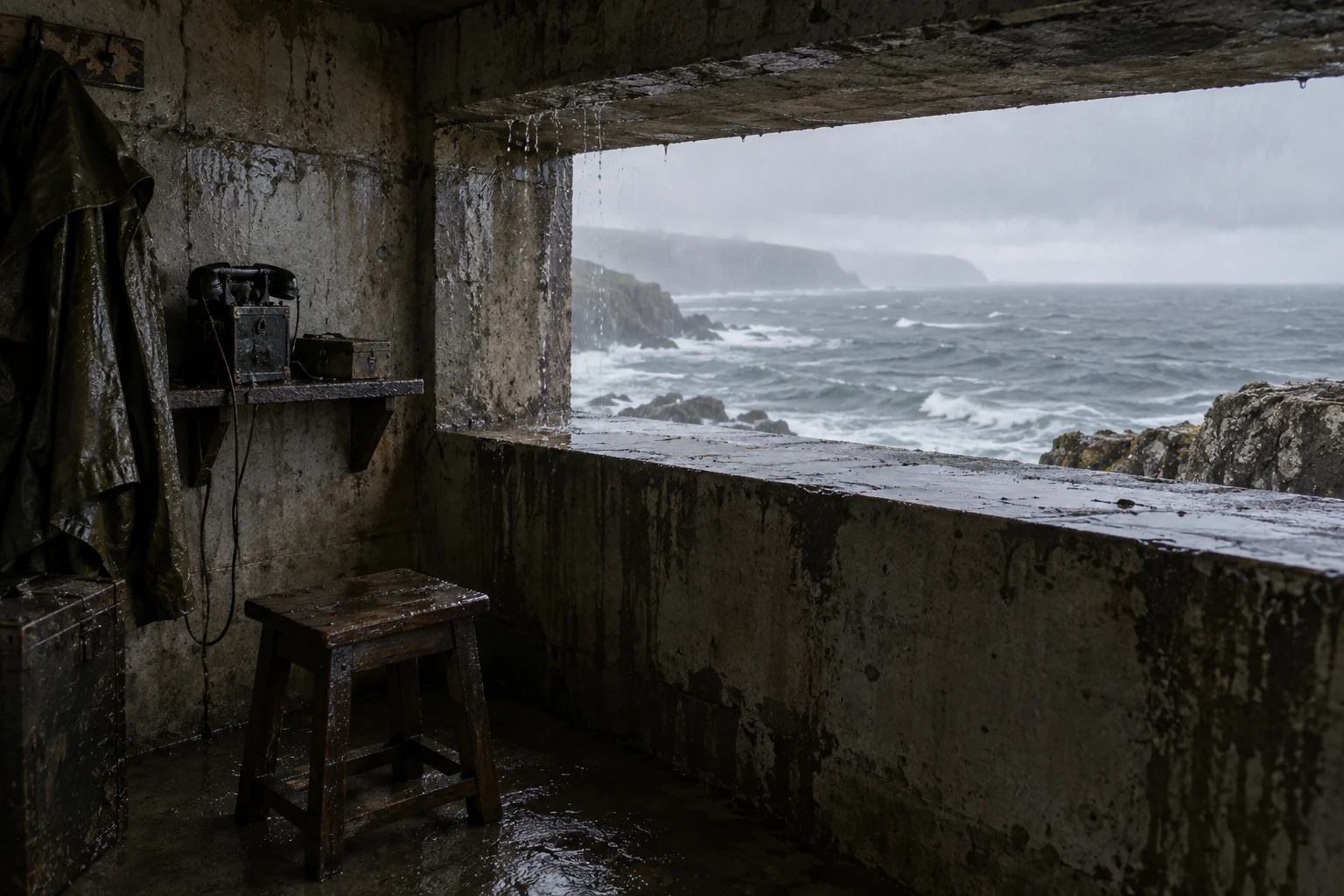
Hell Beach: eight hours
September 6, 1232 · Hukular coast, Volara · Silvian 1st Infantry Division against Hukular sector defenders
The bombardment that failed
Hell was one of SharkStrike's cliff sectors and one of fourteen assigned to Silvia. The operation's broader strength did not change the immediate balance facing the 1st Infantry Division. Approximately 18,000 Silvian troops entered the sector against roughly 24,660 Hukular defenders, about 37 percent more men. Those figures describe the established local forces, not the full 11.6 million Allied commitment or the approximately eighteen million Axis personnel across the wider invasion theater.
A major thunderstorm disrupted radar and contributed to the failure of the preparatory naval bombardment. Approximately eighty percent of the Hukular fortifications survived. Smoke, weather, damage, and incomplete observation prevented the landing force from knowing the full extent of that failure before the assault reached the shore. The men had prepared to encounter resistance. They confronted a defensive system far more intact than the preparation was intended to leave.
Sergeant Rian Tovel approached with infantry whose immediate view was bounded by their craft, nearby vessels, and the obscured coast. Reports from the wider operation could not tell them which positions directly ahead remained active. The first unmistakable evidence came through the fire meeting the landing. Orders were shouted across noise that made even familiar voices difficult to distinguish.
Hour one: The shore refuses to become a base
The first arrivals suffered heavily. Some groups reached their intended area; others landed displaced or became separated before they could organize. Officers and noncommissioned leaders tried to gather men whose own commanders were missing or wounded. Tovel found soldiers from several elements beside him and directed them into a functioning group without waiting for the original organization to reappear.
The beach contained wounded, disabled equipment, damaged craft, and men seeking cover in the same constricted space. A location that protected soldiers from one direction could become dangerous as firing shifted. Movement inland was difficult, and remaining exposed was also dangerous. The survivors made decisions with incomplete knowledge, often judging only whether the next few yards offered a better chance of staying together and continuing the fight.
Medical worker Nessa Corin began treating casualties before any orderly aid station existed. She attached identifying notes where possible and separated those who could move with assistance from those requiring carrying parties. The distinction changed as patients deteriorated or became newly able to move. There was no stable line between treatment, evacuation, and simply keeping someone alive until another interval of safety.
Hours two and three: Infantry against surviving positions
The 1st Infantry fought with the man-portable weapons available to it, including machine guns and rocket launchers, against bunkers, mines, artillery, and machine-gun positions that the bombardment had largely failed to suppress. The struggle was fragmented. Some defensive positions were reduced or bypassed locally, while others continued controlling movement. Progress by one group did not automatically relieve men elsewhere on the beach.
Tovel's group moved beyond its first shelter and made contact with another surviving element. Their officers disagreed about which formation had authority because both were operating with incomplete information. They resolved the immediate problem by agreeing on responsibilities for the ground actually occupied. Formal reconstruction of the unit could wait; confusion over who would hold, move, or recover wounded could not.
Hukular defenders also faced disrupted communications and local losses. The storm and bombardment had not spared every position. Some groups received orders late, while others continued following plans prepared before the landing's actual distribution became clear. Their numerical and structural advantages remained severe, but the defense was not a single perfectly coordinated weapon. Silvian survivors exploited local opportunities created by those imperfections at extraordinary cost.
Hours four through six: No armor ashore
For approximately six hours, the Silvians could not successfully get a tank onto Hell Beach. Infantry therefore carried the immediate battle through a period when plans had assumed heavier support would become available. The delay was not experienced as an abstract missing capability. It appeared in repeated demands to attack or hold against positions the men could not readily overcome with what they possessed.
Casualties accumulated faster than the medical organization could process them. Corin worked among patients whose wounds varied enormously and whose chances depended on access to shelter, treatment, and evacuation. Assistants were killed or injured, and surviving personnel took on unfamiliar tasks. Records remained incomplete during the fighting. The eventual precise casualty accounting should not be confused with a complete real-time understanding of who had fallen where.
Tovel's group received men from shattered neighboring elements. Some were able to fight immediately; others needed time to recover orientation after losing their leaders and companions. He assigned tasks through the surviving junior structure and reported the group's actual condition. Counting every man physically present as equally capable would have overstated what the position could do.
The battle continued virtually without interruption. Local gains opened limited movement while other areas remained under effective defensive fire. The cliffs and surviving works prevented the beach from becoming a broad, freely usable unloading area. Follow-on movement had to contend with the casualties and wreckage of the force already committed.
10:05: The customs stairs
At 10:05, beside the broken customs stairs, Tovel's group encountered a wounded officer carrying a marked sector sketch whose unit had become separated from its intended position. The sketch was useful only after the survivors compared its landmarks with the shore around them. A damaged building still recognizable on paper had disappeared, while a surviving defensive work had been assigned to a different part of the drawing. Tovel retained the officer's annotations and added the corrections supplied by men who had approached from another direction.
The combined account reached Major General Aric Denvar's remaining communications structure through a runner. It did not give the divisional commander a complete view of Hell, but it clarified one connection between surviving infantry groups. Colonel Miren Arda's 2nd Regiment used the information to direct men toward an occupied position rather than the intended position shown on an earlier order. The distinction reduced confusion during an interval when the regiment's original organization had already been badly disrupted.
Corin recorded patients under temporary numbers when names could not be established. One sailor assisting the medical party began copying those numbers into the movement log beside the craft receiving each patient. His duplicate enabled later staff to reconnect treatment and evacuation records after the original pages were damaged. Several men initially listed missing were found in hospitals through that cross-reference.
None of these corrections reduces Hell's fixed death toll or moves casualties out of the original division's account. The process explains how the final figures became reliable despite the disorder in which information was first collected. The eventual totals belong to a completed reconciliation; the men fighting between 06:30 and 14:30 did not possess an exact running census of the division's destruction while they were still trying to secure a functioning beachhead.
Hours six through eight: The beachhead begins to function
Around the sixth hour, armor finally began reaching shore. Its arrival changed the resources available without instantly ending resistance. Vehicles had to enter a damaged, congested battle whose infantry positions did not perfectly match earlier plans. Coordination depended on contact with survivors who could describe current conditions. The first successful arrivals offered support where it could be applied, rather than magically clearing the entire sector at once.
The combined effect of surviving infantry, arriving armor, and renewed support gradually broke enough of the immediate defense to create a functioning beachhead. At approximately eight hours, vehicles and follow-on forces could begin moving through. This was the victory defined by the established account: the beach could sustain the next phase. It was not the capture of every inland belt or the defeat of all Axis forces assigned to the wider theater.
The 1st Infantry's original 18,000 suffered 7,002 killed, exactly 38.9 percent, and 3,960 nonfatal casualties, 22 percent. Total casualties were 10,962, or 60.9 percent. The remaining 7,038 were those without a recorded casualty in that accounting, not an additional reserve or a guarantee that they were rested and fully effective.
For Tovel and Corin, the opening of the beach did not end work. Survivors helped move wounded, identify missing men, and reconstruct units for the battle beyond. Hell became approximately the war's second-most brutal battle in the supplied canon, but its significance was not exhausted by ranking or arithmetic. The division had achieved a necessary result while losing most of its original strength to death or nonfatal casualty. The larger army would pass through a beachhead created by people whose own ability to continue had been shattered in the process.
Original illustrations for this source record
Original archive artwork and captions are preserved. Dates, labels and claims printed within inherited images belong to the previous edition; the revised text governs the current history.