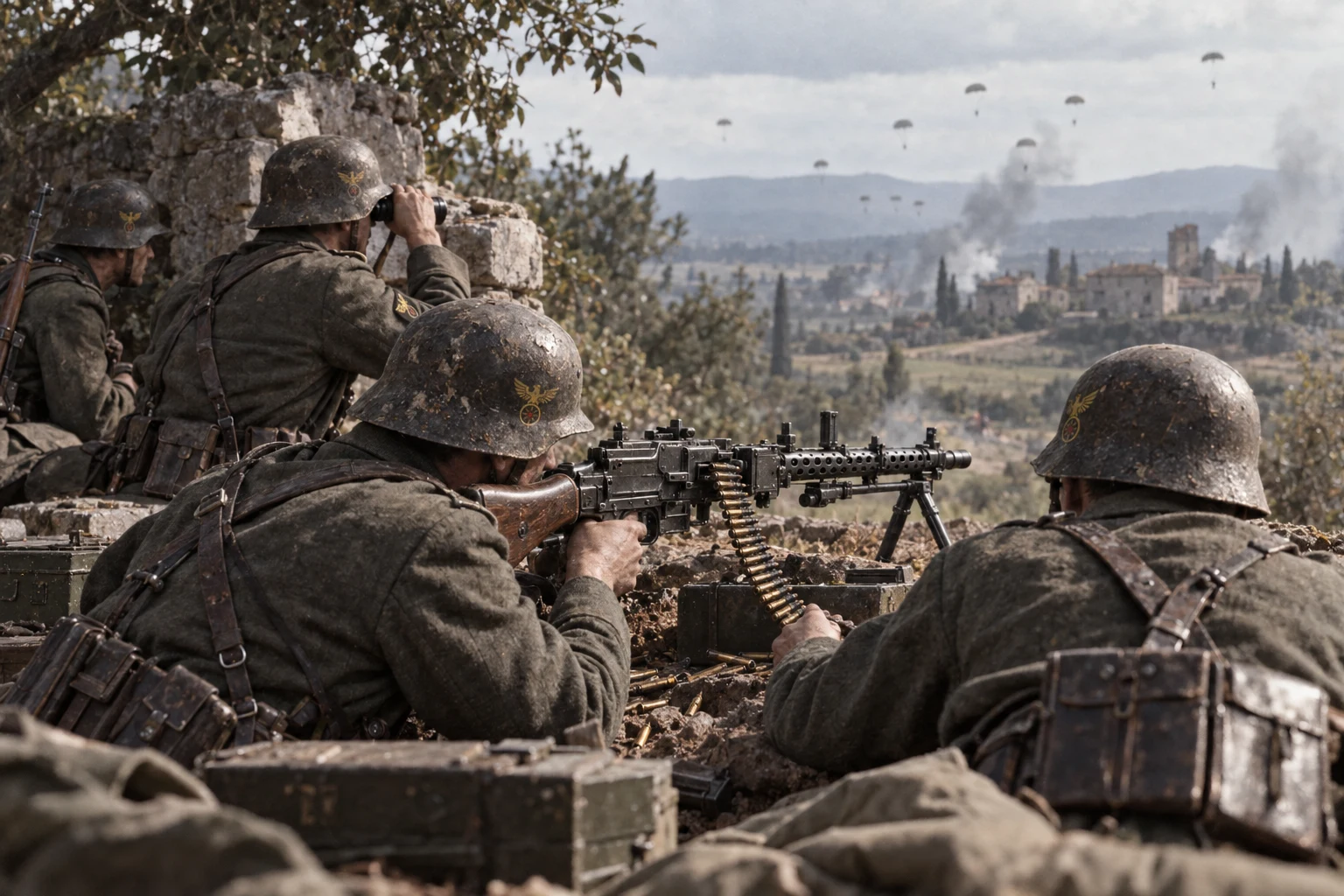
The airborne battle behind the coast
June 6–September 5, 1232 · Hukular invasion theater, Volara · Silvian airborne forces against Axis rear-area and field commands
The opening phase of SharkStrike
The airborne campaign opened on June 6, approximately three months before the September 6 landings. Around 800,000 Silvian paratroopers were committed across the opening insertion phase through many movements and areas. They were not an additional force beyond Silvia's 4.3 million personnel assigned to SharkStrike. Their commitment represented roughly half of the Silvian Airborne Corps and required an immense supporting effort before the first troops reached the ground.
Captain Iven Sarl's unit provides a local view of an operation too large to describe as one continuous skirmish. Its assigned district, called the Ash Orchard area, lay within the Axis rear system supporting the coast. Sarl's task was part of the broader disruption campaign, whose effect depended on many formations acting over time.
The arrival scattered some of Sarl's men and separated personnel from equipment. Others assembled in useful groups and began establishing contact. The first reports were necessarily incomplete. Headquarters had to distinguish units actually functioning in their assigned areas from those known to have arrived but not yet organized. Counting every inserted soldier as an immediately effective combatant would have misrepresented the opening battle.
June: Assembly under pressure
Sarl gathered a mixed group that included personnel from another unit whose officers had not yet been found. He recorded identities and assigned temporary responsibilities rather than treating them as permanently absorbed. The practical arrangement allowed the group to function while preserving information needed for later reunification. Some soldiers returned to their original formations; others remained attached through subsequent fighting.
Axis security and field forces reacted to the insertion with searches, movement restrictions, and attacks against identified airborne groups. Their response was substantial because the scale of the threat could not be treated as a minor raid. It also disrupted ordinary administration and transport. Commanders had to protect rear functions while continuing to sustain the coastal defense and other fronts.
Sarl's group fought to retain contact with neighboring elements and recover wounded after an early clash around an agricultural service district. The action forced movement before all equipment had been recovered. Supplies abandoned during that displacement remained on the unit's original inventory until a later reconciliation. The discrepancy illustrated how quickly a formation could appear better provided than its actual condition allowed.
July: Sustaining a battle behind the line
The airborne troops could not live for three months on what they carried at insertion. Continued supply became a major contested operation. Deliveries were delayed, dispersed, damaged, or recovered by forces other than those intended to receive them. Sarl's unit shared stores with neighboring groups and received assistance in turn. The arrangements preserved local capability while complicating the accounting required to plan future support.
Wounded personnel imposed difficult choices. Some could be moved toward available evacuation arrangements; others remained with medical staff in temporary facilities. Movement exposed patients and escorts to danger, while remaining risked discovery and loss of access to supplies. Sarl's medical officer assessed individual cases rather than assuming that every casualty could be treated through the same route.
Civilian encounters required caution and restraint. Some residents offered assistance, others feared retaliation, and many wanted simply to protect their households. Sarl prohibited treating unwillingness to help as proof of enemy activity. Military necessity did not grant his men ownership of civilian food or information. Relations varied across the theater, and no general claim of universal local support can explain how such a vast force survived.
The missing platoon
Sarl's C Company lost contact with one platoon after a forced movement in July. Lieutenant Haren Ves led the separated men through several temporary attachments before reaching another element of the 18th Airborne Regiment. The regiment's consolidated return listed the platoon as missing because its reporting had not reached the office compiling company totals. Sarl continued reserving places for its survivors in his plans, although he could not assume they would return in time for any particular action.
The platoon rejoined in August with fewer men and attachment records. That record resolved conflicting claims about equipment and casualty responsibility. It also revealed that some supplies sent for C Company had supported the separated platoon through another distribution channel, correcting what had appeared to be a complete loss.
Sarl used the reunion to revise his account of the campaign. He could describe what his own headquarters knew at each stage while acknowledging actions performed beyond its knowledge. The distinction matters in a dispersed operation of this scale: loss of central contact did not always mean inactivity, and the recovery of records did not mean headquarters had possessed that information when decisions were made. The platoon's story became part of the regiment's history without retroactively making its command picture complete.
August–September 5: Pressure without complete paralysis
By August, Axis rear commands had adapted. Airborne units faced stronger efforts to isolate and destroy them, and some groups suffered severe losses or entered captivity. Others remained effective, forcing the defenders to devote troops and resources to the rear while preparing for the expected coastal assault. The campaign disrupted the invasion theater without stopping every train, severing every communication, or making the fortifications helpless.
Sarl's formation reached the final prelanding days reduced and reorganized. Men who had arrived together were missing, hospitalized, attached elsewhere, or buried. The unit still possessed a functioning command and contact with the wider operation. Its contribution lay in the cumulative demands imposed on the Axis system and the continued presence of a force the defenders could not ignore.
The September landings did not instantly relieve every airborne group. Distance, resistance, and the depth of the defensive system kept many separated from the new coastal footholds. Sarl's men received news of the assault as a change in the campaign, not permission to stop sustaining themselves. Their three-month battle had helped create the conditions for SharkStrike while leaving the beach forces to confront defenses that remained formidable, particularly at Hell.
Original illustrations for this source record
Original archive artwork and captions are preserved. Dates, labels and claims printed within inherited images belong to the previous edition; the revised text governs the current history.