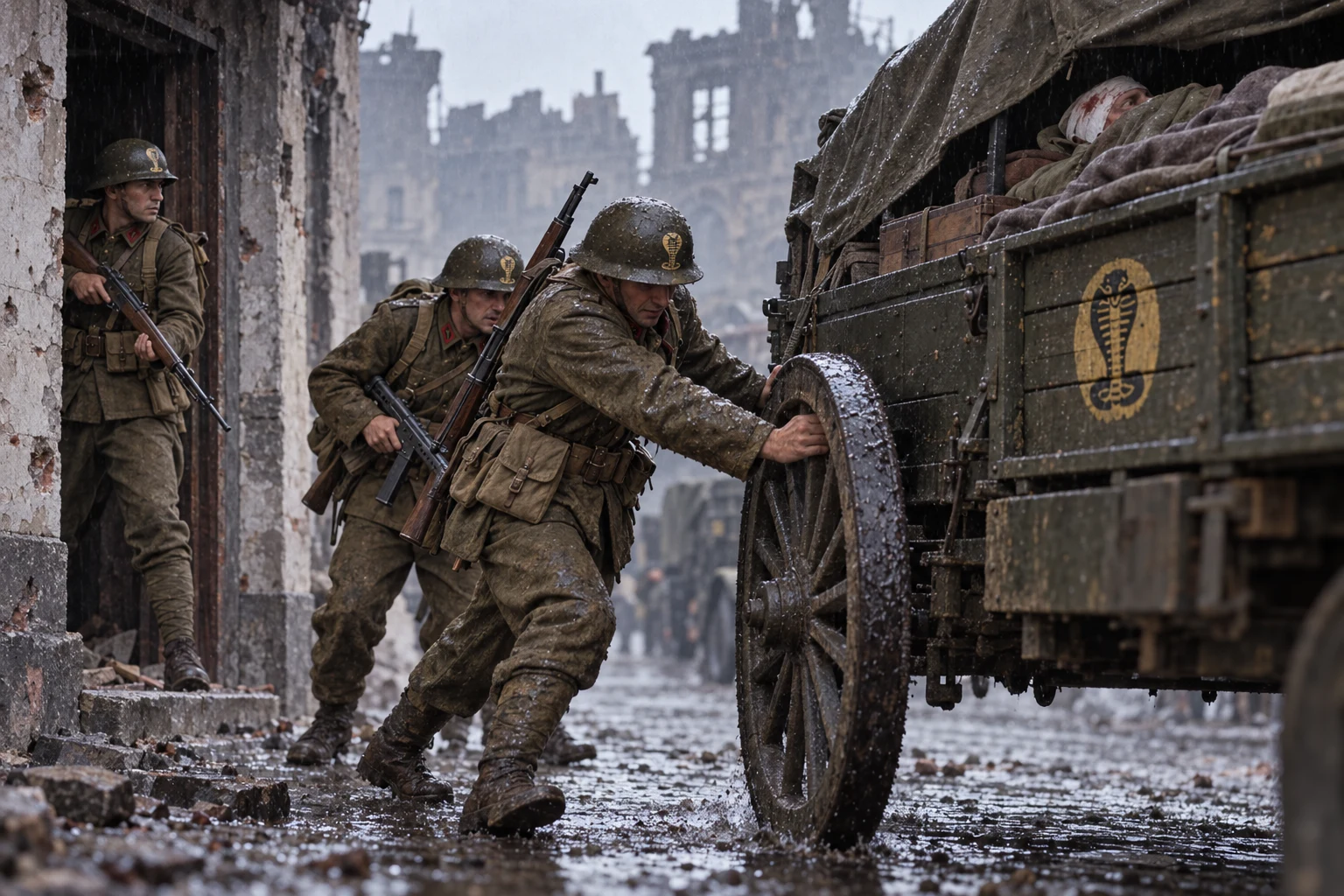
Garabech's winter defeat
October–December 20, 1231 · Garabech Union, Volara · Garabech and Allied support against the central Volaran Axis offensive
A different front from Tassar
Garabech's defeat occurred while Lathorne's army was improving its position elsewhere. The central Volaran offensive involved Hukular-directed forces and other Axis formations already committed to that theater. It did not require Rusk's 87th Corps to leave its western Teran front and fight in two places at once. The simultaneous Allied success at Tassar and catastrophe in Garabech reflected a global coalition unable to concentrate its strength equally across every danger.
Garabech's army had endured years of service while its workshops and receiving facilities supported the wider Allied war. Those roles competed for labor, transport, and protection. By autumn, the union's defense had little uncommitted strength. Its government expected further pressure and underestimated how quickly losses in communications and coordination could turn difficult positions into separate battles.
Lieutenant Sera Malk served with a formation defending an industrial approach district outside the principal administrative center, Meravan. Her later Commonwealth service began with this army's defeat. At this stage she commanded soldiers whose families often lived within the area their unit was ordered to preserve. Local knowledge strengthened the defense and made withdrawal decisions intensely personal.
October–November: The connections fail
The renewed Axis offensive disrupted links between Garabech's field commands and civilian authorities. Some formations continued holding effectively while neighboring units withdrew under pressure. Headquarters received reports of successful local defense and a deteriorating general situation at the same time. The contradiction was only apparent: holding one position did not preserve the routes and services that made it useful to the whole army.
Malk's unit defended a machine-storage complex after its production equipment had been dispersed. The buildings remained valuable as shelter and a recognizable assembly point. During one attack, the formation retained the complex and lost contact with troops on its outer side. Malk led a liaison party to establish where the next friendly position actually stood. The party returned with men from a unit that had been ordered toward a headquarters already evacuated.
The union began moving essential records and personnel out of the principal center during November. Transport requests exceeded capacity. Officials selected documents needed to maintain national identity, pay, and property claims abroad, while military commanders demanded vehicles for wounded and equipment. Some stores supporting the wider Allied network were evacuated; others were lost or destroyed before they could be moved.
December 1–11: The principal center
The final approach battle compressed Garabech's remaining defense. Malk's formation received replacements drawn from units already damaged elsewhere. Their arrival increased strength and added uncertainty about experience, equipment, and command relationships. Officers spent the intervals between attacks establishing a common routine. There was no undamaged reserve waiting to replace the entire exhausted force.
Axis troops entered outer administrative districts in early December. Fighting spread among government buildings, service depots, and residential streets. Civilians sought information at offices that were closing or relocating. Some officials remained without orders because leaving would abandon people waiting for assistance. Their persistence preserved local services briefly and exposed them to capture.
Malk's unit covered a withdrawal through a district crowded with military and civilian traffic. She had orders to move after the last designated column passed, but additional groups continued arriving without clear origin or destination. Waiting indefinitely risked losing the unit; departing at the scheduled moment would leave people behind. The commander extended the delay within the force's remaining capacity, then ordered withdrawal under continuing pressure.
On December 11, the principal administrative center fell. Some formations escaped the closing campaign, while others became isolated and surrendered locally. Garabech's government continued abroad. The defeat destroyed its immediate control over the national territorial defense without ending the country's Allied belligerency.
Venn’s preserved letters
Malk's surviving group included an experienced communications sergeant, Dera Venn, carrying the unit's cipher records and ordinary personnel correspondence together. During withdrawal, she destroyed the operational material under orders and preserved letters and identity lists. A later inspection initially treated the surviving packet as evidence that sensitive documents had been retained. Venn's itemized destruction note established which categories had been separated and why.
The correspondence helped locate families after the unit reached the exile reception system. Some addresses were already obsolete because the same offensive had displaced their occupants. Clerks followed the chain through earlier reception centers, attaching every confirmed change rather than replacing one address with another and losing the history. Several soldiers learned through that process that relatives believed dead had departed before the administrative center fell.
Malk's later Commonwealth company drew partly on men connected through those records. Their reassembly was neither automatic nor complete. Some remained hospitalized, some joined other formations, and others never reappeared. The documents made continuity possible without proving that the original unit had escaped intact. They also explain why the exile organization devoted scarce personnel to clerical work while commanders demanded more soldiers for the line: recovering an army required finding its people as well as recruiting replacements for those who could not be found.
December 12–20: The surviving army becomes an exile force
The remaining days involved scattered resistance, regrouping, and attempts to recover personnel. By December 20, the government abroad acknowledged that it could no longer direct a coherent territorial defense. Malk reached the surviving Allied system with a reduced group and records of men separated during withdrawal. Those records later helped identify personnel joining the Commonwealth structure.
The loss immediately affected the wider Volaran war. Garabech facilities previously used in Allied deployment ceased to be dependable. Stocks already forward, surviving Lydessan receiving capacity, and reorganized movement through consenting Allied facilities prevented instant collapse. They did not replace the lost throughput. Lathorne curtailed further operations while support arrangements were rebuilt, and neutral borders continued to constrain movement.
Garabech's fall made the following year's SharkStrike contribution both military and personal for its survivors. Malk would fight at Liberty as part of an exile formation, not a citizen of a newly created Commonwealth state. Her return in 1233 would follow liberation. The winter defeat supplied the missing connection between those later events: a national army broken on its own territory, a government surviving abroad, and people carrying enough organization through disaster to remain participants in the war rather than only its displaced victims.
Original illustrations for this source record
Original archive artwork and captions are preserved. Dates, labels and claims printed within inherited images belong to the previous edition; the revised text governs the current history.