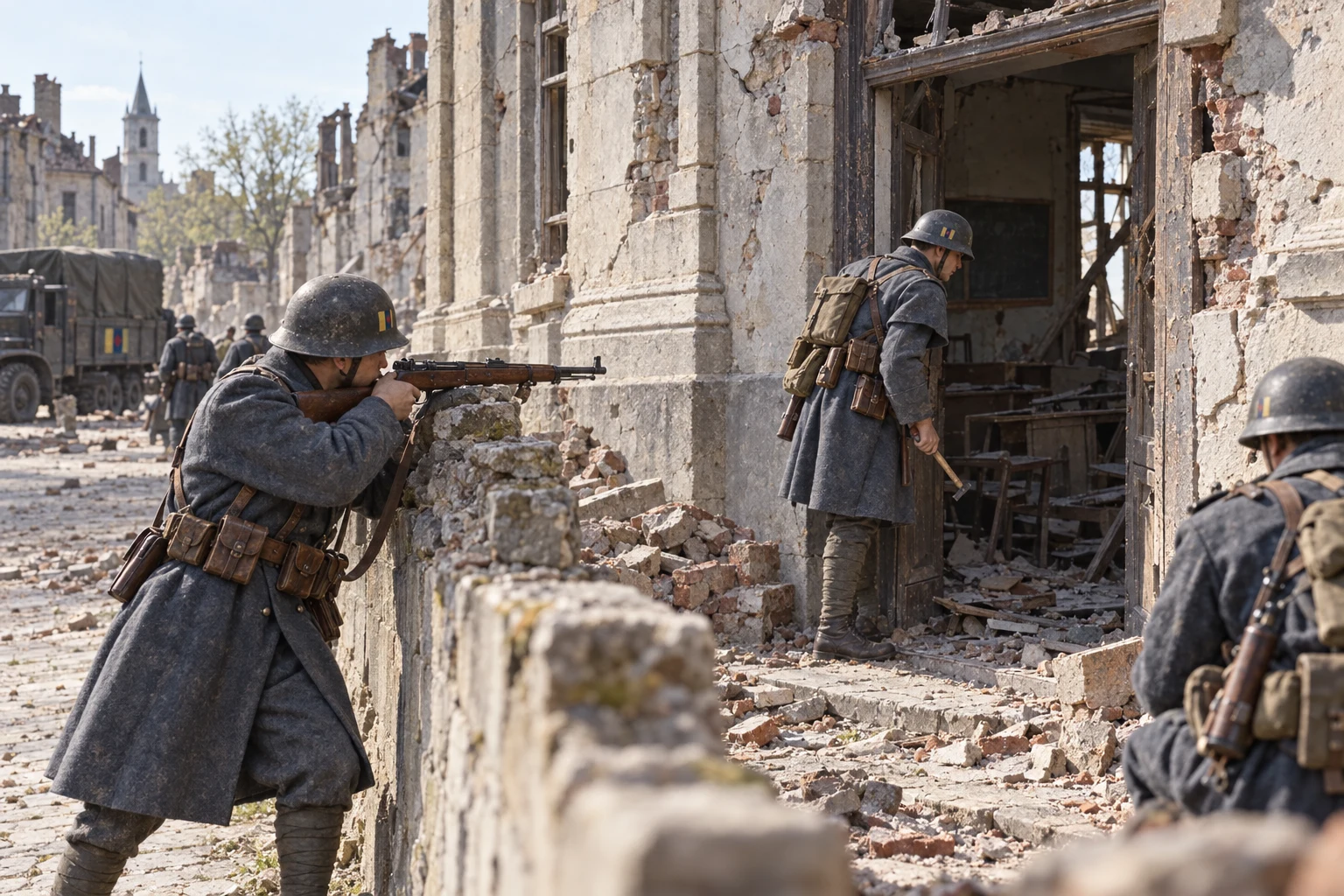
Tassar recovered
March 8–May 19, 1231 · Eastern Aldren, Volara · Lathorne's Allied grouping against Rusk's Teran defense
The fifth year of the contest
The renewed attack began with an army that had learned much and lost many of the people who had learned it firsthand. Lathorne's 7th retained experience through training, staff practice, and surviving leaders. Its formations were not the unchanged veterans who had arrived in 1227. The same was true of the 87th. Rusk commanded an enduring institution whose personnel had been replaced and reorganized throughout years of fighting.
The Allies prepared to recover ground lost in the September 1230 counterstroke and proceed toward the central junction. Aldren participation and pressure from other Allied commands limited Teran freedom to reinforce every threatened area. The campaign's success would therefore depend on more than the repeated duel between two famous formations. Lathorne's staff accounted for those contributions without claiming authority over the entire continental war.
Tassar itself had become a damaged collection of military positions and surviving civilian spaces. Streets appeared on maps whose buildings had disappeared. New paths crossed old properties, and underground shelters connected people who had once lived in separate neighborhoods. The troops preparing to enter needed current information rather than a sentimental image of the town the Allies had lost.
March 8–31: The outer ground returns
The offensive opened on March 8. Allied formations regained parts of the outer district after hard fighting, encountering positions strengthened since the previous year. Vale's formation advanced through ground containing equipment left from earlier battles. Some wrecks remained recognizable to veterans, turning military obstacles into reminders of men no longer present.
Rusk's corps counterattacked where it could preserve the defense's coherence. The effort inflicted serious losses and delayed the Allied timetable. It could no longer restore every position without drawing strength from another threatened sector. Reports to higher command increasingly distinguished between holding the current line and preserving a useful force for the next one.
A sustained action developed around the central repair district's approaches. Allied troops secured one connected group of buildings, lost part of it, and recovered it again after neighboring positions improved. The sequence was costly, but support followed more reliably than in 1230. Wounded and replacements moved through an organization that could absorb interruptions without collapsing each time a local route closed.
April: The defense loses depth
Throughout April, Allied pressure reduced the space within which Rusk could move reserves. The corps continued resisting effectively, but the cost of restoring threatened positions increased. Savin Drel's unit received orders for another shift and found its intended shelter already occupied by wounded and a displaced headquarters. The men waited in damaged buildings while officers resolved a conflict created by several necessary movements happening at once.
Lathorne's command resisted declaring the enemy broken after each local withdrawal. Reconnaissance and prisoner reports showed continued organization. The High General maintained pressure while requiring evidence that supporting units could follow before authorizing larger movement. This caution surrendered some immediate opportunities and helped prevent the army from repeating the unsupported expectations of earlier campaigns.
Residents emerged from areas newly reached by the Allies. Their accounts helped locate shelters and missing people, but also revealed the limits of military knowledge. A building thought empty contained families living below its ruins; a supposed civilian store had long served occupation forces. Recovery teams worked with Aldren officials to separate urgent relief from the collection of military information.
May 1–19: Rusk withdraws
By May, the Teran position had become increasingly difficult to sustain. Rusk requested permission to withdraw formations most at risk of being consumed in the final defense. Higher command eventually authorized a phased retreat. The decision accepted the loss of Tassar while preserving a corps still needed on the empire's western approaches.
The retreat was uneven. Some Teran units disengaged coherently, while others lost contact, abandoned equipment, or surrendered after isolation. Allied forces pressed forward without annihilating the whole defense. Vale's troops entered parts of the central district carrying instructions to secure positions, assist recovery, and maintain contact before pursuing reports of retreating enemies beyond their immediate area.
On May 19, the Allies secured Tassar's principal junction and central district. The town taken on June 9, 1227 had been recovered. Rusk's 87th withdrew as a coherent but diminished formation. Lathorne had achieved an important campaign result and inherited a damaged transport system whose restoration would take longer than the fighting's final phase.
May 27: The school inspection
Mela's return party entered the school on May 27 with an Aldren building inspector and two residents of the street. The inspector prohibited use of the upper floor after finding damage hidden behind a standing wall. A military officer had described the building as serviceable because its roof remained partly intact. The difference reflected two purposes: temporary cover for soldiers and safe daily occupation by children were not the same standard.
The recovered school records were stored in a cupboard beneath fallen plaster. Former caretaker Arin Vell had moved them there during the occupation and marked the cupboard's location in a letter carried to relatives. Mela's party found the letter before entering the building, turning a general search into a specific recovery. Vell had survived and was located at a civilian reception station outside the district.
His testimony clarified which records were original and which had been reconstructed during occupation. Mela kept both, recording their different origins instead of discarding the later documents as automatically worthless. The distinction allowed her to identify children who had entered the neighborhood after her own evacuation. Liberation therefore restored access to a community that had continued changing in her absence, rather than revealing an untouched school population waiting exactly where she had left it.
Mela Orsen returned with a civil assessment party later that month. Her school was unusable, but residents had preserved part of its records. She compared them with the register carried away four years earlier. Some children had become adolescents elsewhere; others remained missing. The military victory allowed the questions to be asked in Tassar itself. It did not provide every answer, and the work of liberation began among precisely those absences that no recovered junction could repair.
Original illustrations for this source record
Original archive artwork and captions are preserved. Dates, labels and claims printed within inherited images belong to the previous edition; the revised text governs the current history.