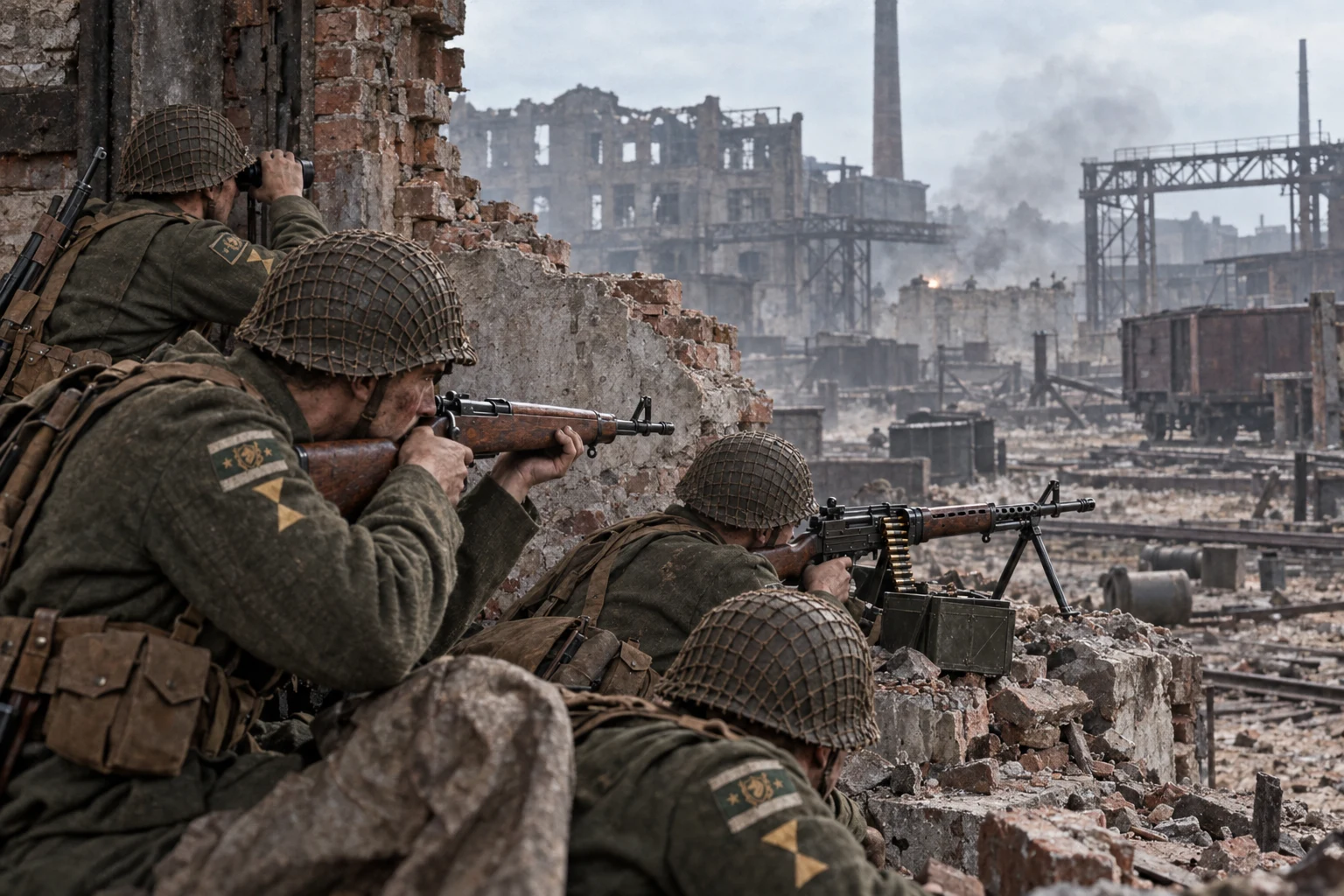
The first assault on Tassar
April 11–May 30, 1230 · Eastern Aldren, Volara · The 7th Army and Aldren against the Teran 87th and supporting forces
The town beyond the victory
The recovery of Meren brought Tassar within a more favorable Allied campaign arrangement without making the railway town an easy objective. Rusk's corps had withdrawn coherently and used the interval to reconstruct its defense. The town's damaged industrial districts offered positions interspersed with civilians, abandoned machinery, and transport routes whose capacity varied sharply. Lathorne's staff could identify the objective clearly and still lack a complete picture of the ground required to reach it.
The April plan sought the principal junction and central district. Allied commanders expected that pressure from the improved Meren position would limit Teran options. Rusk relied on a shortened arrangement, supporting formations, and the ability to reinforce threatened points. His corps no longer possessed the ground it had held in 1228, but remained capable of imposing costs on an attacker entering a defended town.
Vale's unit prepared for industrial fighting with maps assembled from prewar records, recent observations, and Aldren testimony. Mela Orsen's school appeared on one plan as a recognizable building, although no one could confirm its current condition. The presence of familiar civilian names made the objective more concrete and more misleading: a school label did not establish that the building still stood or served anything resembling its old purpose.
April 11–20: The outer yards
The offensive began on April 11 and gained outer ground. Silvian and Aldren formations reached parts of the railway district while encountering organized resistance around workshops and adjoining streets. Some tracks had been removed, others blocked, and several apparent routes ended at collapsed structures. The attackers' movement became increasingly dependent on current local reports rather than the planned sequence.
Vale's formation entered an outer maintenance yard and secured a group of buildings. Its leading companies could see portions of the central complex without having a dependable route into it. Requests for support described enemy positions through structures whose names differed between railway records and military maps. Liaison personnel worked to reconcile the references while the troops held ground already exposed to counterattack.
Rusk committed units to prevent the outer losses from becoming a direct opening into the center. Teran counterattacks recovered some buildings and failed at others. The result was a fragmented contest in which both sides could claim parts of the same named yard. Headquarters increasingly used sketches prepared by troops on the ground, accepting their limited scope in exchange for greater local accuracy.
April 21–May 13: The central junction remains beyond reach
The Allies renewed their effort and suffered heavy losses without securing the principal railway connection. The central district's defense depended on multiple positions rather than one decisive building. Taking a workshop could expose its occupants to resistance from elsewhere while adding wounded and prisoners to a movement system already under strain. Lathorne's reserves were committed to sustaining gains and replacing depleted formations.
Inside the 87th, Savin Drel served in a unit repeatedly shifted between threatened positions. He learned the town through nights spent in different shelters and hurried explanations from departing troops. The corps' resilience rested partly on these transfers and the officers who made them possible. It also meant that nominal rest periods became preparation for another unfamiliar local fight.
Civilian residents remaining in Tassar faced repeated displacement within the town. A cellar safe during one phase became exposed during another. Occupation authorities restricted movement, and fighting made even permitted journeys hazardous. Allied soldiers occasionally encountered people whose information about the district was valuable but whose immediate priority was reaching relatives rather than assisting either command.
The railway accident register
The maintenance yard taken by Vale's formation contained a railway accident register covering both prewar incidents and occupation traffic. Aldren railway officer Sena Tesk identified entries indicating which lines had remained in use shortly before the offensive. The evidence helped explain why a route shown as destroyed on Allied maps still supported movement. It did not establish the current disposition of Teran troops, and Tesk cautioned against treating transport records as an up-to-date enemy order of battle.
An attempt to recover the register's missing volumes was abandoned when the office came under renewed fire. The surviving book went to the theater railway staff, while a copy of its relevant entries remained with the formation. Later accounts credited the document with revealing the whole Tassar system. The actual benefit was narrower: it corrected several assumptions about recent use and directed further inspection toward routes worth examining.
Vale included the abandoned retrieval attempt in his report because the information's value had limits. A useful document did not justify consuming a company to obtain its presumed companions. That judgment reflected the army's developing ability to distinguish a genuine intelligence opportunity from the hope that one more recovered detail would dissolve the defensive problem that successive attacks had failed to overcome.
May 14–30: The attack is stopped
By mid-May, Lathorne's assessment had become more cautious. The army had taken useful outer ground but lacked evidence that another immediate effort would secure the central objective. Subordinates differed over whether the enemy was close to failure. Reports of Teran losses were substantial, yet the defense continued receiving enough support to remain coherent.
The High General ended the main offensive on May 30. The decision left the central junction in Teran hands and disappointed expectations raised by Meren's recovery. It also preserved formations that would be needed to hold the gains and face further enemy action. The later September counterstroke would recover portions of the outer yards, demonstrating that the Allies' April gains were neither trivial nor automatically permanent.
The battle's failure lay in the unachieved principal objective, not an absence of courage or local competence. Vale's troops had captured positions, maintained contact, and endured counterattacks. Rusk's corps had lost ground and remained effective. Both outcomes could coexist because industrial urban defense turned each local success into another support and coordination problem. Tassar would require a further year of rebuilding and another campaign before the Allies recovered the junction they had once hoped to take in the spring of 1230.
Original illustrations for this source record
Original archive artwork and captions are preserved. Dates, labels and claims printed within inherited images belong to the previous edition; the revised text governs the current history.