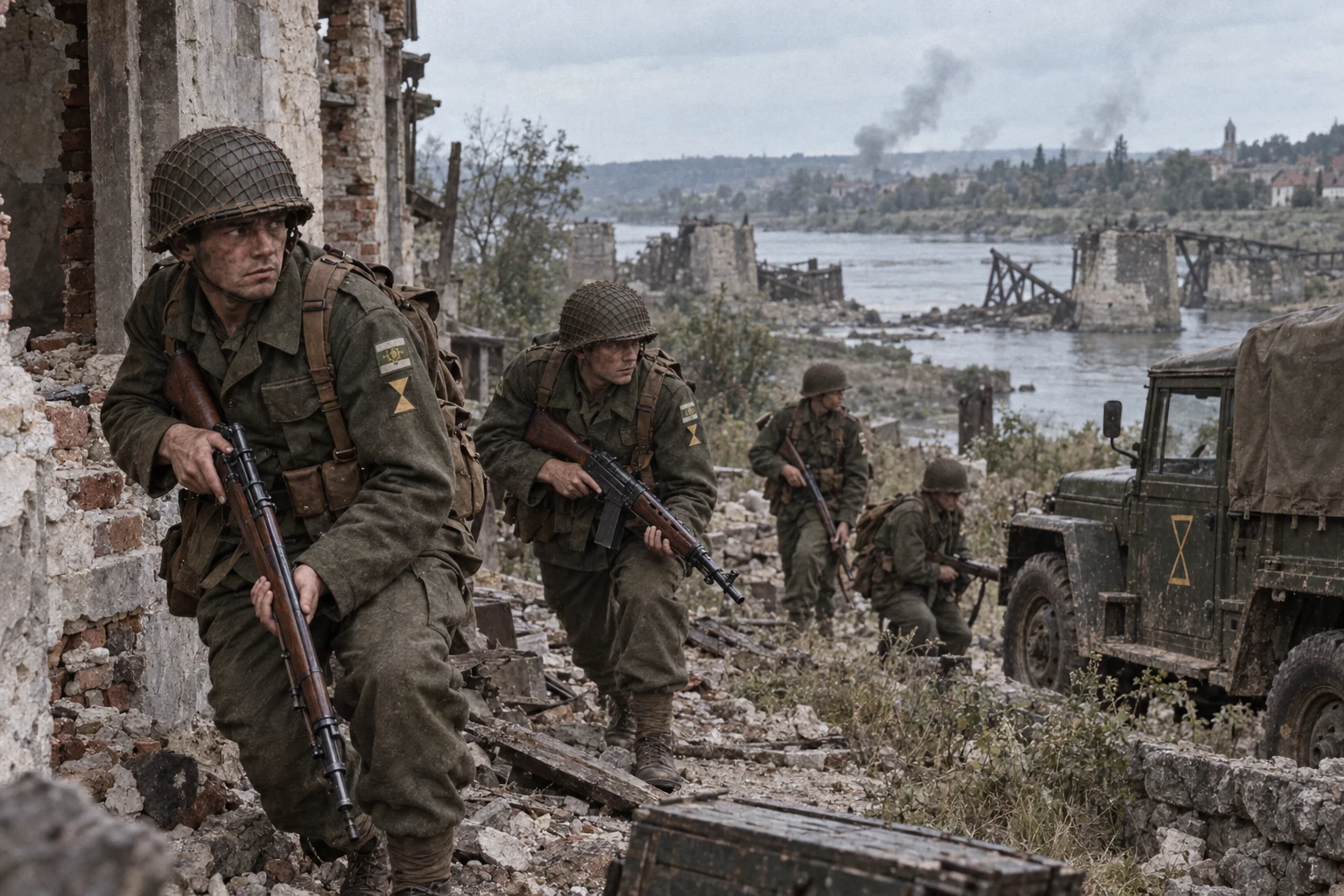
The Darsel crossings
June 12–29, 1229 · Eastern Aldren, Volara · The Silvian 7th Army and Aldren against the Teran 87th and supporting formations
A position from which to fight again
Lathorne's June operation sought a sustainable position across the contested Darsel district. Its purpose was to improve the conditions for a later attack on Meren, not to promise that crossing the river would itself collapse the ridge defense. The distinction shaped the force allocation. Units needed to secure and retain the new ground before the army could treat it as a platform for another campaign.
The Darsel River and its immediate geography lie within the eastern Aldren front. Seasonal water, damaged banks, adjoining cultivation, and existing military works made the crossing area more complex than a single line on the map. Aldren personnel contributed local knowledge, while engineers assessed how years of damage had altered it. Their reports informed the operation without guaranteeing that every condition would remain unchanged under fire.
Rusk's 87th Corps recognized the threat to its wider position. The corps could not prevent every Allied movement while also maintaining its other responsibilities. It prepared to contest the most consequential gains and rely on neighboring formations and theater support where required. The coming battle would test whether Lathorne could hold a result against counterpressure, the recurring weakness of earlier offensives.
June 12–16: Across, but not established
The operation opened on June 12. Leading Allied troops reached positions beyond the initial obstacle under fire and began organizing a defense before all their support arrived. Some groups progressed faster than expected; others were delayed by damage, congestion, or resistance. Headquarters resisted drawing a continuous line through positions that had not yet made dependable contact with one another.
Vale's formation reinforced one of the new positions. He found troops who had achieved their immediate task and were close to exhaustion from defending it. Their commander needed relief, communications, and medical movement more urgently than another order to advance. Vale arranged a transfer that preserved local knowledge, retaining guides and liaison personnel while the most depleted men withdrew for treatment and rest.
Teran fire and local counterattacks complicated every movement into the new area. Supplies arrived in irregular intervals, making it difficult to distinguish a temporary delay from a failing system. Lathorne's staff compared deliveries with actual consumption and condition reports rather than relying only on the tonnage sent forward. The accounting exposed shortages while there was still time to adjust the commitment.
June 17–23: Rusk's counterpressure
The 87th committed forces to reduce the Allied foothold. Its attacks recovered some exposed ground and failed elsewhere. Savin Drel, a Teran conscript newly entering the narrative in this period, served among veterans who taught him the district through immediate duties rather than a complete explanation. He learned which positions had been occupied yesterday and discovered that the answer could change before the next relief.
Drel's unit participated in fighting near an abandoned agricultural yard. The attack reached part of the position and stalled under renewed Allied resistance. Wounded men remained between groups that could hear one another without making safe contact. After withdrawal, the survivors argued over whether the original objective had been reached. Their disagreement arose because different sections of the yard had different military significance, while the order had used one name for all of it.
On the Allied side, the pressure forced Lathorne to choose between expanding the foothold and strengthening what he already held. He favored consolidation, accepting criticism that the army was surrendering momentum. Additional support went into maintaining movement and restoring depleted units. This did not make the battle less costly, but it reduced the chance that a local success would fail through overextension.
The stretcher parties’ testimony
The stretcher parties gave Vale the account of a Teran counterattack that had otherwise appeared to come from several directions at once. They had moved through adjacent positions while carrying casualties and could distinguish firing heard nearby from troops actually entering a location. Vale recorded their observations separately, then compared them with reports from the companies. The resulting reconstruction showed one attack developing through ground hidden from several Allied viewpoints, rather than the larger enveloping movement initially feared.
This correction allowed Lathorne's local command to retain a reserve for the next crisis instead of committing it against an exaggerated threat. It did not make the counterattack harmless. The forward position suffered serious losses and required relief after the fighting subsided. The benefit lay in matching the response more closely to the problem, preserving strength elsewhere without denying the danger faced by those under attack.
The parties received formal credit for the information, although their commander warned against diverting stretcher personnel routinely into reconnaissance. Their useful observations arose from work they already had to perform. Turning that incidental contribution into another standing duty would have reduced the capacity that made it possible. Vale's report distinguished using available testimony from demanding that exhausted specialists perform every task their experience enabled.
June 24–29: A foothold that survives
By the final week, the Allied position had become more coherent. The troops could be supplied and relieved with greater regularity, and medical evacuation no longer depended entirely on individual improvisation. Teran counterattacks continued to impose losses but failed to dislodge the principal gains. Rusk preserved his corps rather than committing everything to an effort whose prospects were diminishing.
The battle ended on June 29 with a sustainable Allied position in the contested Darsel district. The result did not recover Meren or Tassar. Its significance lay in changing the conditions under which the next campaign could be fought. Lathorne had obtained useful ground and retained the means to employ it after the immediate action ended.
For Vale's men, the improvement was visible in the routine that followed. Replacements arrived through an organized system, wounded departed with records, and the line did not have to be rescued anew each morning. Drel's Teran unit experienced the same result as a narrowing set of defensive choices. The 87th remained formidable, but it would now face the next Allied offensive from a less favorable arrangement than the one that had defeated Lathorne in 1228.
Original illustrations for this source record
Original archive artwork and captions are preserved. Dates, labels and claims printed within inherited images belong to the previous edition; the revised text governs the current history.