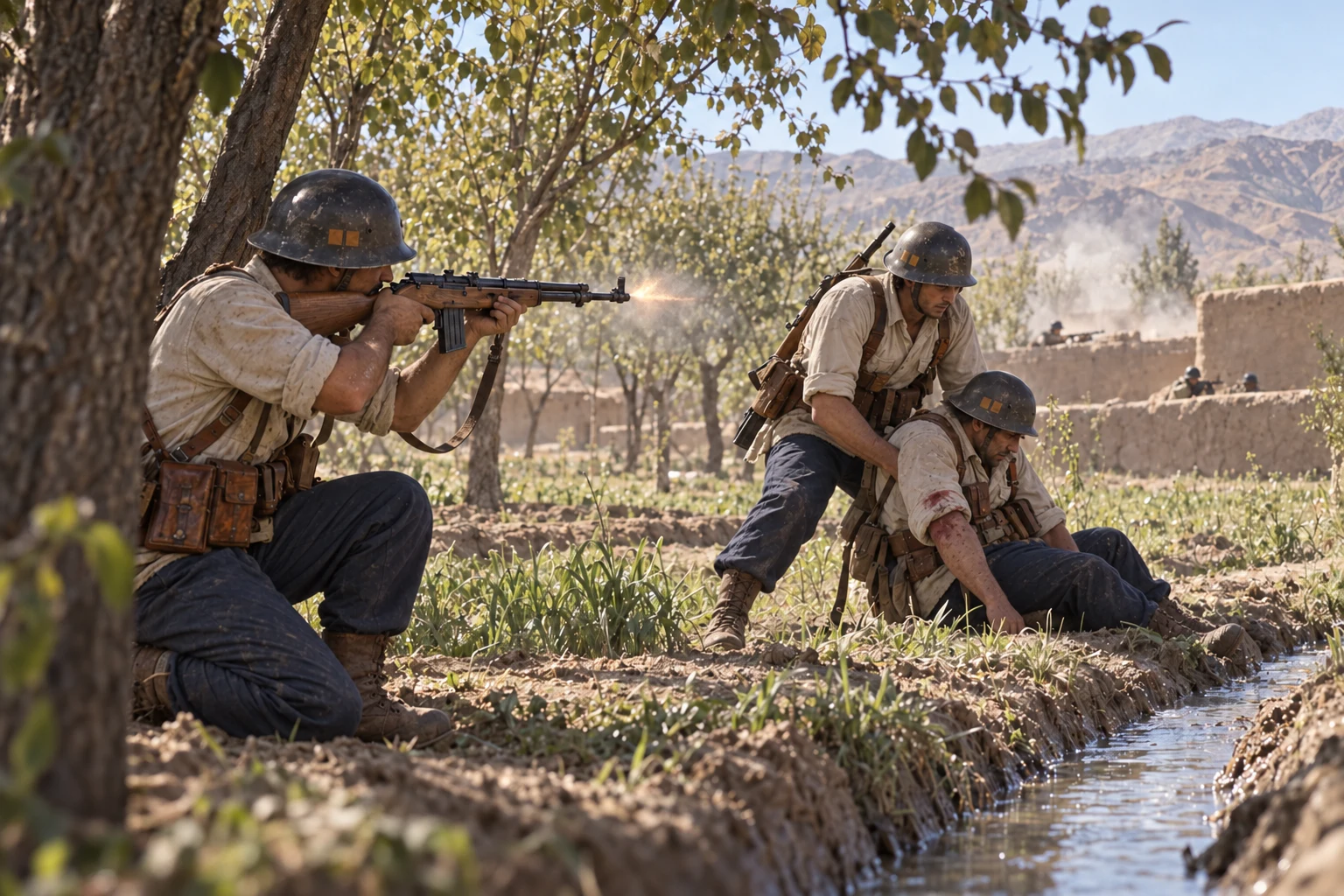
The stalled Gaften offensive
April–June 1228 · Established Handistan–Qarim theater, Gaften · Allied regional armies and Silvian forces against Ruuyaq's coalition
Fresh troops, old constraints
The arrival of Silvia's Gaften commitment had enabled exhausted Allied formations to receive relief during 1227. By spring 1228, commanders hoped to convert that improvement into a sustained recovery of contested territory. The plan drew on Handistani, Qarimi, Trenoan, Huqaiti, Syran, and Silvian participation through existing theater arrangements. It did not assume that those armies could move freely across every intervening country or that Ruuyaq shared a direct frontier with Handistan.
The Sarem agricultural district lay within the established contested campaign area. Its roads, settlements, and irrigation works made it valuable to military movement and civilian survival. Silvian General Tessa Varin commanded one of the participating expeditionary groupings, subordinate to the agreed campaign arrangements rather than supreme commander of Gaften. Her immediate objective was to help recover a connected district that could be supplied after occupation.
Local officers warned that the area's water and transport capacity had already been damaged by years of fighting. The plan included repairs, but its schedule underestimated the labor required to restore systems while advancing. The larger Allied establishment created confidence that shortages could be solved by allocating more men. Some shortages concerned skills, equipment, and timing rather than the number of people available to work.
April: The first gains
The opening attacks recovered outlying positions and several settlements. Ruuyaqi and partner formations withdrew from some exposed ground while holding more important connections. Allied reports emphasized the advance, and political representatives visited recently recovered areas before the support system had caught up. Residents asked about food, missing relatives, and whether they should return to farms still within reach of fighting. The answers were less definite than the public description of liberation suggested.
Varin's leading troops reached a damaged processing complex that had served the surrounding agricultural economy. Its storage buildings offered shelter, but the machinery needed to make local stocks useful was incomplete. Officers initially listed the captured contents as available food. Civilian specialists corrected the assessment, explaining what could be consumed immediately and what required work the army had not planned to support.
Ruuyaq's local counterattacks disrupted movement and forced the Allies to reinforce positions intended only as stages in a continuing advance. The growing commitment reduced the reserve available for later objectives. Varin requested a revised timetable after inspecting the actual condition of her forward formations. Their numerical strength concealed fatigue from carrying and construction work as well as combat losses.
May: The advance reaches its limits
The principal May battle centered on a road-and-waterworks district called the Three Reservoirs. The name referred to local facilities, not a claim that all water in the theater depended on three structures. Damage to the distribution system nevertheless affected nearby civilians and troops. Repair teams could work only intermittently while fighting continued, and military consumption placed additional pressure on the usable supply.
Allied infantry gained part of the district and failed to secure the whole connection. Enemy resistance came from formations whose own shortages encouraged them to defend selectively rather than everywhere. The resulting contest produced repeated local advances that did not combine into a dependable route. Varin's staff began recording which positions could be reached regularly, exposing the gap between territory colored Allied and territory functioning as part of the army's support system.
Civil authorities challenged requisitions that threatened the next harvest. Their objection was military as well as humanitarian: consuming the remaining seed, animals, or local transport would deepen dependence on shipping later. A joint board restricted some military demands, forcing commanders to obtain supplies through slower national channels. The decision reduced immediate convenience and preserved resources needed beyond the current offensive.
Four categories of grain
Varin's civil liaison conference met in a cooperative office, where the ledger separated household grain, seed, wages owed in kind, and stores available for sale. Army inventories had grouped all four under food stocks. Qarimi administrator Halen Suri demonstrated that requisitioning the total would consume both current subsistence and the means of the next harvest. Varin suspended the order and required the categories to remain separate.
The correction reduced the supplies her formation could obtain locally and made the offensive's dependence on imported stores more visible. Critics accused the civil authorities of hiding resources at the moment of greatest need. Suri opened the ledger to a joint audit, which found discrepancies but confirmed the distinction. The army received a lawful allocation and assumed a transport burden.
After the operation was curtailed, surviving farms planted part of the preserved seed. Their harvest did not feed the whole theater, but it reduced the district's relief requirement and allowed some displaced residents to remain near their homes. Varin's decision therefore imposed a military cost in return for a later benefit that could be measured. The record avoids the easier story in which respecting civilian needs always produced instant battlefield advantage; at Sarem, the value depended on accepting a real delay.
June: The offensive is curtailed
By June, the operation had reached a position from which further advance required a reconstruction of support rather than another simple addition of combat strength. Some commanders believed the enemy was equally exhausted and urged continuation. Varin argued that reciprocal exhaustion did not guarantee a useful outcome for the attacker. The theater command curtailed the offensive while retaining supportable gains.
The result disappointed governments expecting the fresh Silvian commitment to produce a rapid reversal. It also prevented the force from consuming itself around objectives it could not yet sustain. Hospitals, maintenance, water provision, and replacement training received increased priority afterward. These measures were consequences of the battle, not administrative improvements unrelated to the fighting.
Sarem remained partly recovered and partly contested. Residents moved according to the actual availability of shelter and food rather than the dates in military announcements. The battle demonstrated that Gaften's front possessed its own constraints, which Silvian island experience could help address without automatically solving. The continent would require another sequence of limited recoveries, counterattacks, and sustained pressure before Ruuyaq's final defeat in 1234.
Original illustrations for this source record
Original archive artwork and captions are preserved. Dates, labels and claims printed within inherited images belong to the previous edition; the revised text governs the current history.