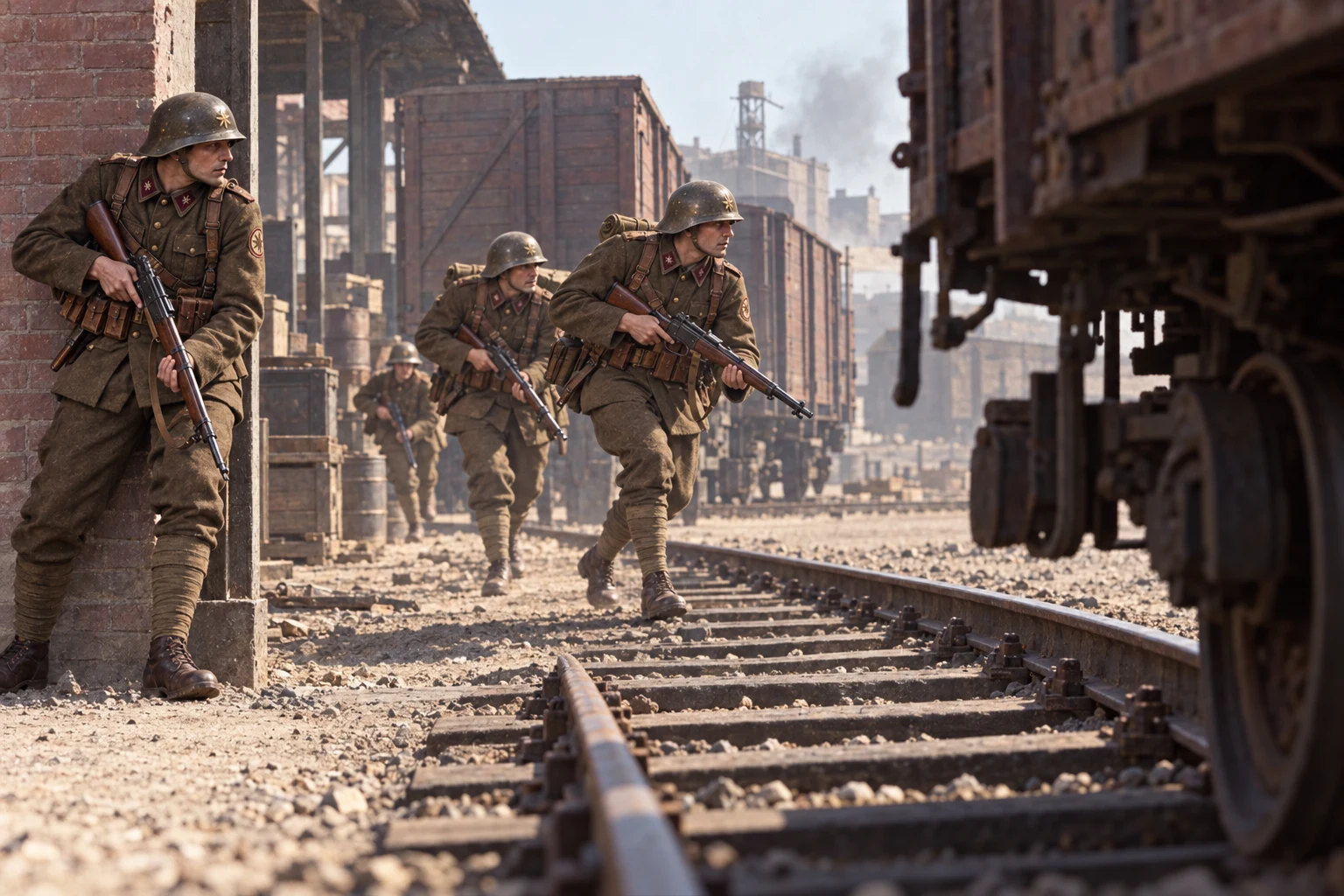
Tassar lost
May 18–June 26, 1227 · Eastern Aldren, Volara · Silvian 7th Army and Aldren against the Teran western command
The new army meets an old front
Silvian High General Hujo Lathorne's 7th Army had assumed its sector on March 14. It possessed substantial experience and remained incomplete in concentration. Some formations had reached their positions while supporting services were still establishing themselves. The transition from island campaigning to a continental front required different movement and coordination. Familiar military competence helped the army adapt; it did not mean every requirement had already been met.
The Teran western-command offensive began on May 18. General Cevan Rusk's 87th Elite Battle Corps served as a principal striking formation with neighboring units and theater support. Its role was important without making it the sole force attacking an entire Allied army. Rusk sought to disrupt the Silvian concentration and take useful ground in eastern Aldren before Lathorne could impose his own timetable.
Tassar's railway facilities made the town a consequential objective. The surrounding district contained housing, workshops, schools, and routes already crowded with military movement. Aldren officers knew that losing it would affect more than the line of defense. Civil authorities began preparing evacuation arrangements while hoping the army could prevent their use. Teacher Mela Orsen helped identify pupils whose families lacked transport.
May 18–31: The breach
The Teran attack opened a dangerous rupture in forward Allied positions. Some Aldren formations withdrew coherently; others lost contact and reappeared under neighboring commands. Lathorne committed available Silvian units to stabilize the situation. The first reinforcements arrived with uneven support, forcing commanders to distinguish what could be done immediately from what their complete establishments would normally permit.
Rusk's corps maintained pressure through local setbacks. Its leading troops encountered resistance around village buildings and railway approaches, while supporting elements struggled to keep up with changing directions. The corps' elite status brought priority and high expectations. Officers warned that repeated demands for another effort were consuming experienced personnel, but the wider command judged the developing opportunity too valuable to surrender.
Eran Vale's formation entered the battle as part of Lathorne's containment effort. The men found a landscape more open than Lethan and just as capable of obscuring the true front through scattered reports. A position could appear deserted because its defenders had moved behind cover, not because the enemy had gone. Vale delayed a movement after patrol reports contradicted the headquarters map, drawing criticism until the supposed opening proved actively defended.
June 1–9: The junction
Fighting reached Tassar's approaches in early June. The railway organization attempted to move military stores and civilian evacuees while facilities were still functioning. Mela brought her mother and pupils to an assembly point that changed twice as the situation deteriorated. Her school register became a practical tool for determining which children were present, which were with relatives, and which had been seen at another departure point.
Teran troops entered the outer yards while Allied defenders held workshops and adjoining streets. The battle fragmented around structures whose importance changed as tracks and roads became unusable. A signal building ceased directing trains and became an observation point. A repair shed contained wounded after its machinery had been removed. Maps retained the old labels, encouraging assumptions about functions that no longer existed.
Lathorne authorized withdrawal from positions that risked being isolated, preserving forces needed to contain the larger advance. Aldren officers accepted the necessity unevenly because the ground being surrendered contained their own communities. Some rear guards remained longer than intended to protect civilian movement. Their resistance helped people leave and increased the risk that the soldiers themselves would not escape.
On June 9, Teran forces secured the principal railway facilities and most of Tassar. Mela's group had departed, but several families remained separated. The town's capture gave Rusk a substantial success and created a salient the Allies would spend years trying to recover. It did not grant the corps unlimited capacity to continue advancing.
The last platform allocation
The evacuation train carrying part of Mela's school group left Tassar without two pupils recorded on its preliminary manifest. One had been reunited with an aunt and placed aboard an earlier movement; the other remained at the assembly point with a sick brother. Mela refused to mark either child absent without preserving the last known location. Her amended register later helped the reception authorities distinguish a separation from a disappearance under enemy occupation.
At the same station, Major Vale's transport officer sought priority for ammunition wagons held behind the civilian loading. The Aldren railway superintendent, Oran Tesk, showed that moving them first would block the platform needed for immobile patients. Vale accepted a revised sequence that delayed his supplies and allowed the medical departure. His unit received only part of the expected load before further damage closed the route.
The decision was defensible and costly. Vale's soldiers subsequently fought with tighter allowances, while the evacuated patients reached care beyond the threatened town. Lathorne's staff included the sequence in its review because it exposed a real conflict between legitimate requirements, rather than an error that better intentions would automatically have removed. Tassar's loss was shaped partly by such choices, whose consequences appeared in separate military and civilian records and could be understood only when those accounts were read together.
June 10–26: Containment
The 7th Army and its partners established a firmer defensive arrangement beyond the lost town. Reinforcements arrived into a more intelligible situation, and support increasingly matched the units requiring it. Teran attacks continued but encountered an opponent less dispersed than during the opening phase. Rusk's formations also carried the cumulative cost of the advance and needed replenishment.
By June 26, the offensive had lost its earlier momentum. The Allies had prevented a larger rupture while leaving Tassar and the stronger Meren positions in Teran hands. Lathorne's first major continental result was therefore containment after defeat, not a victory disguised by disciplined withdrawal. Rusk had gained valuable territory and preserved an effective corps, but had not broken the Allied theater.
The aftermath established the long contest's political burden. Silvia expected its veteran army to relieve Allied exhaustion; Aldren expected liberation; Teran authorities proclaimed the new positions secure. Soldiers on both sides began repairing and deepening the ground where the advance had stopped. In a borrowed classroom west of the front, Mela resumed teaching children whose questions about returning home would remain unanswered through several more campaigns.
Original illustrations for this source record
Original archive artwork and captions are preserved. Dates, labels and claims printed within inherited images belong to the previous edition; the revised text governs the current history.