The Lethan forest campaign
May–June 1225 · Naviri, Grand Isles · Silvian and Naviri forces against Kelonese defenders
A forest containing a society
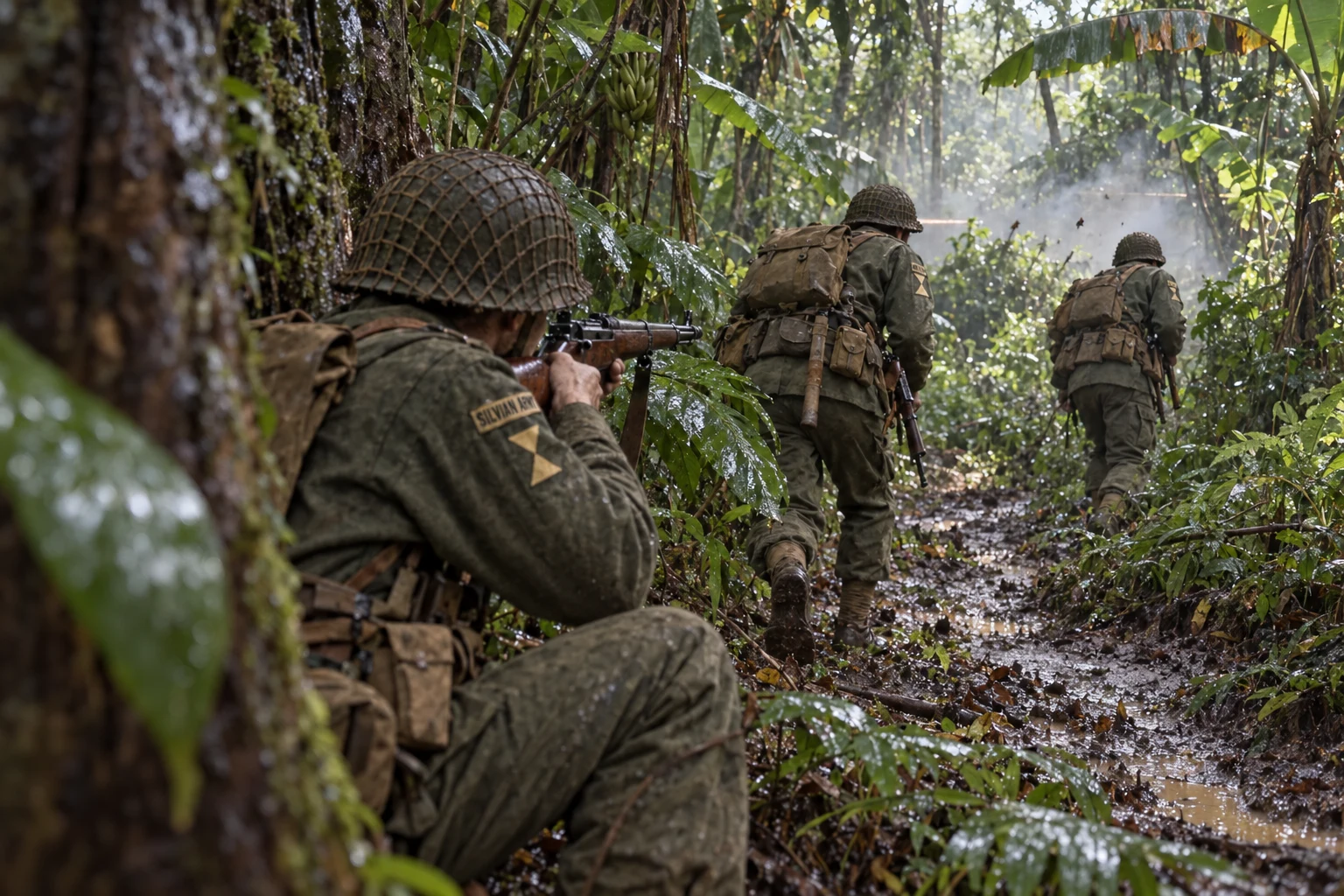
The Lethan campaign moved the Silvian expedition deeper into a war that could not be understood from coastlines alone. The forest district contained settlements, abandoned cultivation, occupied facilities, and paths altered by years of military use. Naviri's officers objected when early briefings described it as an empty interior. People remained there, and their movement, food, and knowledge would affect the campaign whether planners acknowledged them or not.
General Mira Dalen assigned the operation a sequence of limited objectives connected to the existing Allied foothold. Naviri formations and local authorities participated in planning rather than merely supplying guides after decisions were made. Their intelligence remained uneven. A report based on a resident's recent journey carried different weight from a recollection of a path used before occupation, and staff officers began marking those distinctions explicitly.
Eran Vale's unit had become more capable through repeated service, but its composition continued changing. Experienced soldiers taught replacements how to interpret orders in a landscape where a short distance could take hours to cross. The instruction emphasized staying connected with the unit and reporting uncertainty. It could not eliminate fear, exhaustion, or the errors of men whose first combat occurred far from the shore they associated with safety.
The first movement inland
The opening advance secured several positions that Kelonese defenders had used to observe and pressure Allied movement. Some were abandoned before contact, leaving signs of recent occupation and little indication of where the defenders had gone. Others resisted from ground whose importance became apparent only when the Allies tried to move beyond it. Dalen's staff resisted interpreting every empty position as evidence of a general retreat.
Vale's company entered a settlement whose residents had dispersed among nearby shelters. The troops found cooking equipment, damaged carts, and stores too small to explain the number of houses. A Naviri civil officer accompanying the force identified the site as a redistribution point rather than a self-contained village. That information changed how headquarters understood reports of missing food: the district's civilian system extended beyond the place the soldiers had occupied.
Fighting developed around a plantation service track and its adjoining buildings. The Kelonese defense delayed movement without attempting to hold every structure. Allied troops repeatedly found themselves occupying positions whose exits remained contested. Vale requested support to secure contact with neighboring units before proceeding. The decision cost time and prevented the company from extending beyond its ability to receive supplies and evacuate casualties.
The middle weeks
As the campaign continued, rain, illness, and fatigue affected both sides. Equipment deteriorated under constant exposure. Men spent rest periods cleaning, repairing, and reorganizing rather than sleeping. Medical officers pressed for evacuation of soldiers whose condition was worsening even when their wounds or illnesses appeared minor individually. Commanders who ignored those recommendations risked losing more strength later through preventable deterioration.
Kelonese counterattacks struck recently occupied ground before the Allies had completed its consolidation. In one action, a Naviri formation held while the adjoining Silvian unit reorganized after casualties. Their coordination depended on liaison personnel who knew both commands and could explain why an order acceptable in one system required clarification in the other. The delay was frustrating; the resulting agreement prevented both formations from assuming the other would cover the same vulnerable interval.
A group of civilians reached the Allied line carrying an injured Kelonese soldier they had sheltered. Their arrival challenged simple assumptions about loyalty and conduct under occupation. Naviri officials arranged treatment and questioned the group about missing residents. The information proved useful, but the civilians' immediate need was protection and food, not a role in military intelligence. The episode entered the campaign record because it changed local command practice concerning people emerging from contested territory.
Who owned the grain
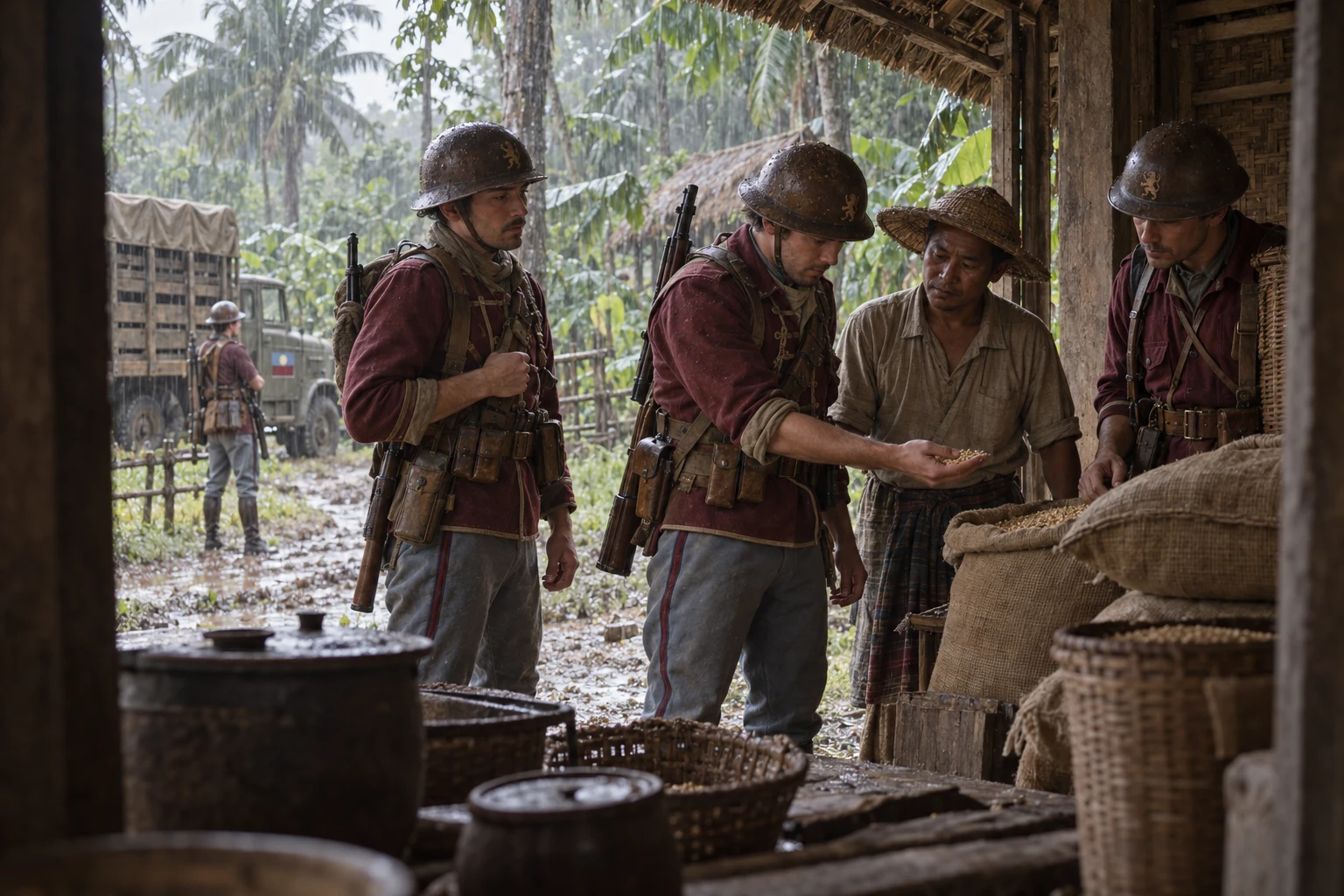
Naviri liaison officer Tovan Eri accompanied one of the registration parties entering the recovered plantation settlement. He recognized a warehouse mark used before the war to identify households receiving grain. The mark had survived on containers moved between several locations during occupation. It helped officials reconstruct distribution without assuming that every stock belonged to the building where soldiers found it.
Vale initially wanted the stores transferred to the army collection point for protection. Eri argued that doing so would sever obligations to households farther inside the district. The compromise recorded the stocks, placed guards where necessary, and retained civilian direction of distribution. Military personnel received allocations through separate receipts, making their consumption visible rather than allowing it to disappear into a claim of captured supply.
A later audit found that the arrangement had prevented duplicate military requisitions from two adjoining commands. It also revealed losses that civilian administrators had concealed to avoid anger from residents. The resulting correction affected both systems. Eri's contribution mattered because he knew the district's institutions, not because local testimony was reliable. Lethan's recovered communities required verification conducted with people who understood what the records meant. The battle had opened access to those records; the work following it determined whether the population would actually benefit from Allied control or merely answer to another set of competing demands.
The campaign's limited end
By late June, the Allies held a more connected set of positions and had reduced Kelonese pressure on the approaches supporting them. Dalen halted the principal movement while the force consolidated and recovered. The decision left enemy troops in the surrounding region. It also preserved a coherent advance whose support had not been exhausted by an attempt to turn every success into immediate pursuit.
Naviri authorities began restoring limited civilian administration in recovered settlements. That work revealed losses the army had not recorded: missing livestock, interrupted schooling, destroyed property documents, and families divided across the remaining front. Military success made those problems accessible to the government without solving them. Some residents returned quickly; others refused until the area had remained quiet for longer than a few days.
Lethan strengthened the Silvian expedition's reputation because it showed improvement inland as well as at the waterline. The force could now fight, maintain contact, and stop at a defensible result with greater consistency. Vale's survivors did not describe the campaign as easy. They described knowing where their neighbors were, receiving supplies before complete exhaustion, and having officers willing to admit uncertainty. Those ordinary conditions distinguished a maturing army from the larger but less coherent force that had failed at Orava.
Original illustrations for this source record
Original archive artwork and captions are preserved. Dates, labels and claims printed within inherited images belong to the previous edition; the revised text governs the current history.