The Orava disaster
February 12–19, 1224 · Taluman approaches, Grand Isles · Silvian expeditionary forces and Allied support against Kelonese defenders
The island on the briefing table
Orava was a local island objective within the established Taluman approaches. Its apparent advantages were clear: a useful anchorage, a limited area to occupy, and a chance for Silvia's new expeditionary force to establish momentum. General Mira Dalen's staff expected strong resistance near the landing area and a more rapid advance beyond it. Taluman officers warned that vegetation, broken ground, and existing defenses made that division unreliable. Their knowledge entered the briefing without changing the operation's basic confidence.
Admiral Oren Vask's naval staff had concerns of its own. The force could carry the troops and provide support, but the landing schedule assumed that boats, unloading parties, communications, and infantry would remain aligned after contact. Rehearsals had exposed delays without reproducing the confusion of a defended shore. Dalen accepted revised timings and considered the major difficulties resolved. Vask believed they had been reduced rather than removed.
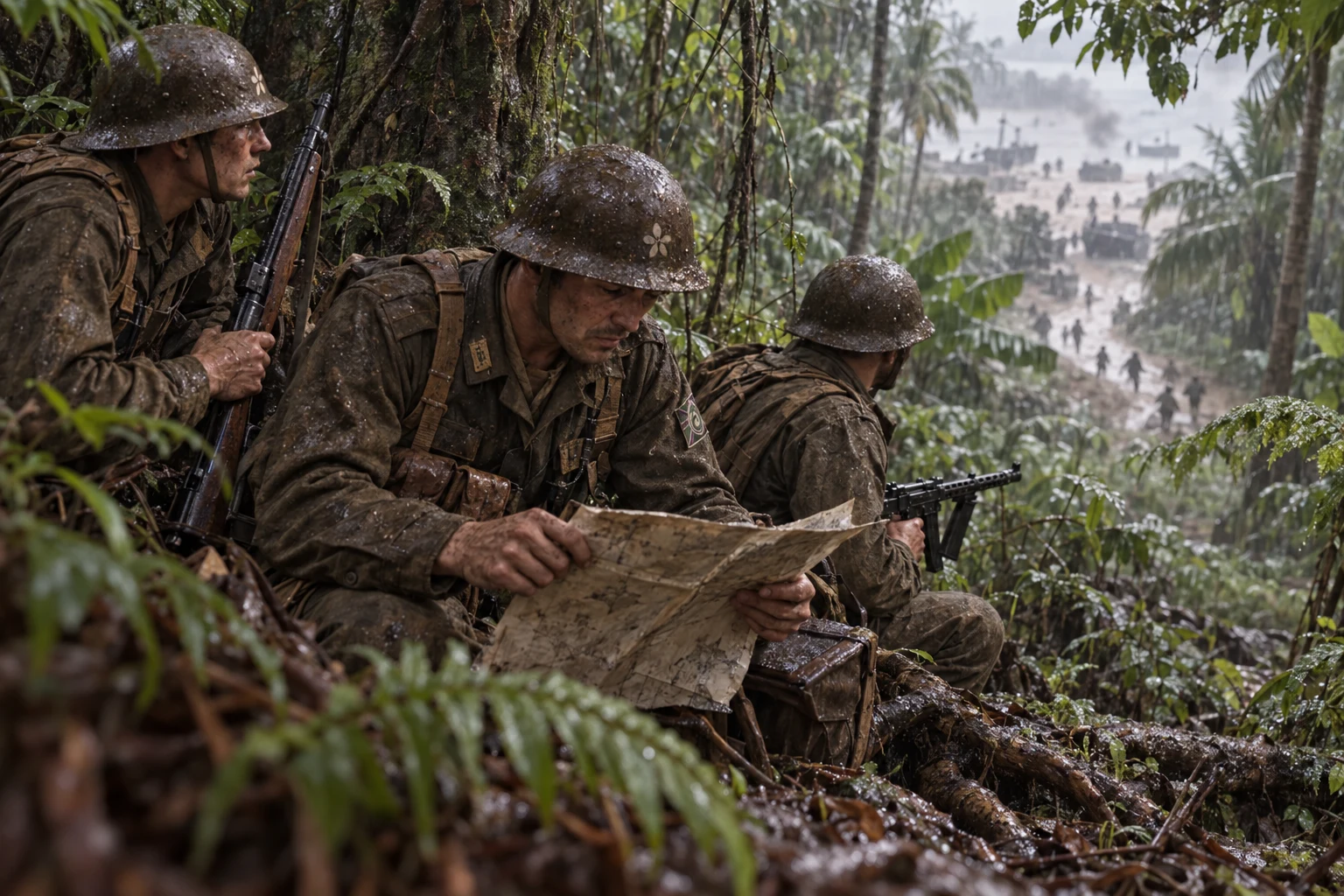
Lieutenant Eran Vale went ashore with an infantry element whose men knew their immediate task better than the island. Their sketches showed an inland path and a plantation building intended as a reference point. The building's roof had been damaged since the sketch was prepared, and several paths resembled the one described. The first uncertainty was therefore not whether the enemy would resist, but whether the unit had reached the place from which its next movement was supposed to begin.
February 12: The beachhead reported secure
The initial landing placed substantial numbers ashore. Kelonese defenders yielded some exposed ground while retaining positions farther in. Silvian headquarters received reports of progress and described the beachhead as established. On the ground, units remained mixed with equipment and personnel intended for other tasks. Radios, ammunition, medical loads, and food had not all arrived beside the troops that needed them.
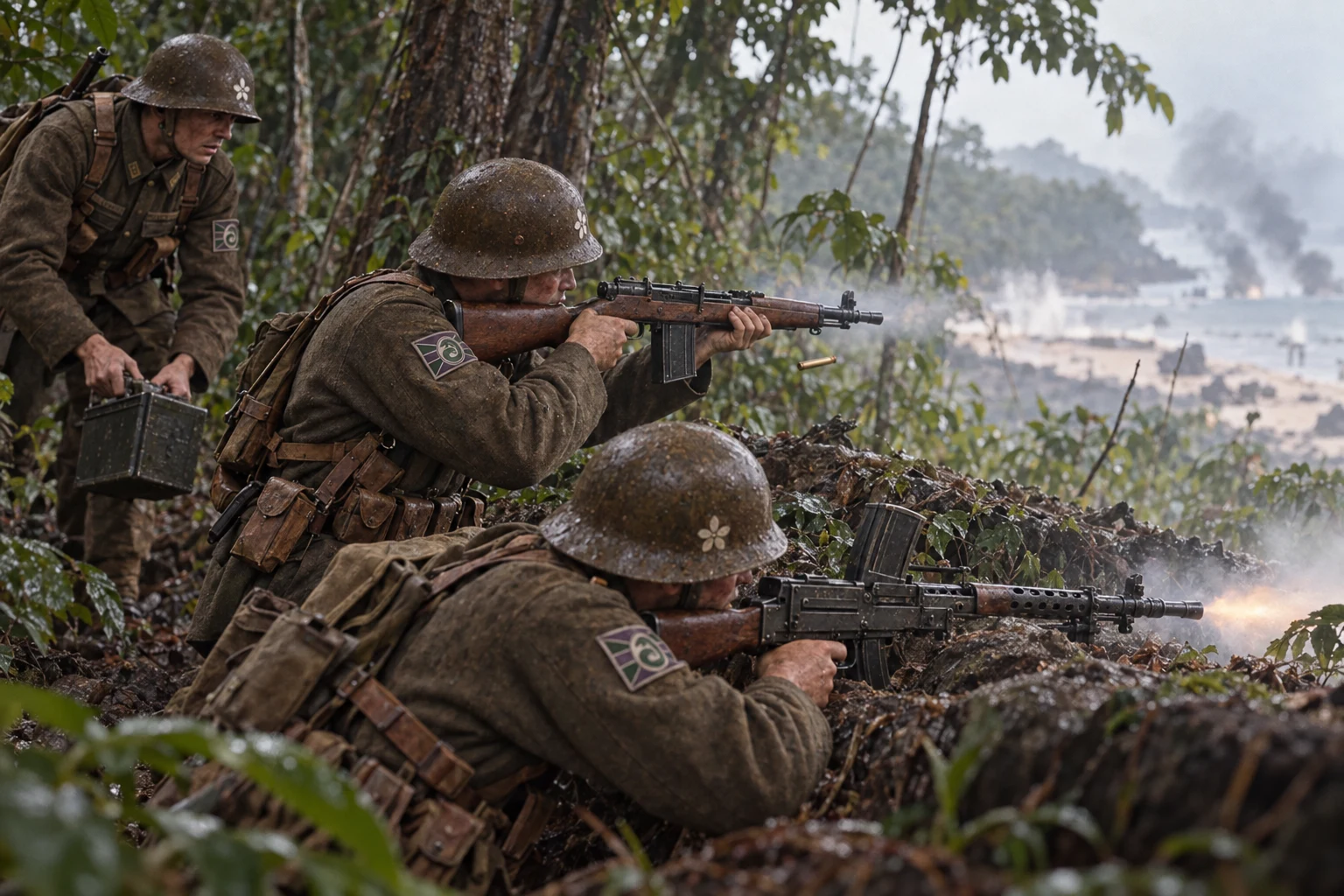
Vale's group advanced along what appeared to be the assigned path and encountered fire from a position that had not been located in the opening bombardment. The leading men took cover among roots and damaged vegetation. Those behind them could hear the engagement without seeing its shape. A report that the company had reached the plantation became a headquarters mark that suggested a firmer position than the scattered troops actually held.
Naval support was available in principle and difficult to apply to an uncertain location. Messages described enemy activity through landmarks not shared consistently between shore and ship. Officers delayed requests they could not reconcile rather than risk striking friendly men. To infantry awaiting help, the delay felt like abandonment. To the naval staff, the same messages demonstrated that the landing force's apparent progress had outrun its communications.
February 13–15: The jungle separates the army
Kelonese defenders pressured exposed Silvian groups and interrupted movement between them. The resulting battle was not a continuous front advancing through trees. It consisted of positions, paths, uncertain intervals, and units trying to discover whether the next firing belonged to neighbors. Some Silvian formations held useful ground; others occupied places whose relationship to the wider operation remained unclear.
Vale lost contact with his company headquarters for part of February 13. He gathered men around a damaged plantation outbuilding and sent reports through the few routes known to remain usable. Wounded soldiers accumulated under a roof that leaked during rain. Men carried water from behind the position, returning too exhausted to participate fully in the next movement. Ammunition was present, but not always in the quantities or types required by the weapons still functioning.
Dalen's headquarters committed reserves in an effort to restore momentum. Some arrived at the beach before their intended routes had been cleared. Their presence increased demand on unloading and movement without immediately increasing effective strength inland. Officers questioned why troops visibly available near the shore were not reinforcing threatened positions. The answer lay in the same disconnected system that prevented supplies from reaching them reliably.
February 16–18: The decision to leave
By February 16, the operation's cost had become impossible to reconcile with the original objective. Vask warned that maintaining the exposed commitment would consume additional naval support and shipping needed elsewhere. Dalen initially sought another limited effort to stabilize the force before deciding. Reports from the shore showed that stabilization itself required resources beyond what the operation could sustain.
Withdrawal was authorized after difficult discussions. The decision did not make departure simple. Troops had to disengage, find the correct collection points, and move wounded through ground where contact remained uncertain. Vale's group left behind equipment it could not carry and searched for men last seen at an earlier position. Some were found with another unit; others remained missing. The difference would not become clear for days or weeks.
Kelonese pressure continued during the evacuation. Rear guards fought to keep movement possible while naval and medical parties organized embarkation. Boats arrived at points where troops were not yet ready and returned later to find more people than expected. Officers resisted loading able-bodied men ahead of immobile casualties, but confusion and danger produced outcomes no order could completely control.
Three versions of Vale’s report
Vale's company report reached Dalen's staff through two relays, each of which shortened it. His original description said that a patrol had reached the plantation building, that the company was dispersed behind it, and that the route remained contested. The copy plotted at headquarters retained the first statement and omitted the qualifications. A position occupied by a few men consequently became the apparent location of an organized company. The subsequent order to continue inland was based on that altered account.
Signaller Eda Nerin preserved the original when she left the shore. During the inquiry, the three versions could be compared directly. Their differences did not prove a deliberate attempt to deceive commanders. They showed operators shortening messages under pressure without understanding which clauses carried the meaning. Dalen ordered the expedition's communications school to use the example when teaching both composition and relay practice.
Nerin also identified an error in the evacuation roll. Two soldiers listed as having departed in the same boat had actually boarded separate craft after one was redirected. Their names appeared together because a loading party copied a preliminary list instead of the final embarkation record. Both survived, but their units initially searched for one in the wrong receiving hospital. The correction connected the same underlying problem to two very different consequences: information simplified to make movement manageable could cease to describe what had happened. The procedures required preservation of corrections, including cancelled destinations, so that later staff could reconstruct changes instead of treating the last clean copy as the whole history.
February 19: The accounting begins
The evacuation ended with the Orava objective unachieved. Silvia had landed a powerful force and failed to make its components function as a sustained operation. Kelonese defenders retained the island position after inflicting a serious defeat. The survivors returned with incompatible impressions that were all partly true: some had fought effectively, some had waited uselessly, and some had never reached the place their orders described.
The inquiry that followed examined planning, local advice, communications, unloading, medical evacuation, and command relations. Vale's testimony emphasized the distance between a reported location and a position actually held. Dalen remained central to the expedition's development, but the failure forced changes that later victories would depend upon. Orava became formative because the institution studied its errors and changed, not because suffering alone transformed inexperienced troops into an amphibious army.
Original illustrations for this source record
Original archive artwork and captions are preserved. Dates, labels and claims printed within inherited images belong to the previous edition; the revised text governs the current history.