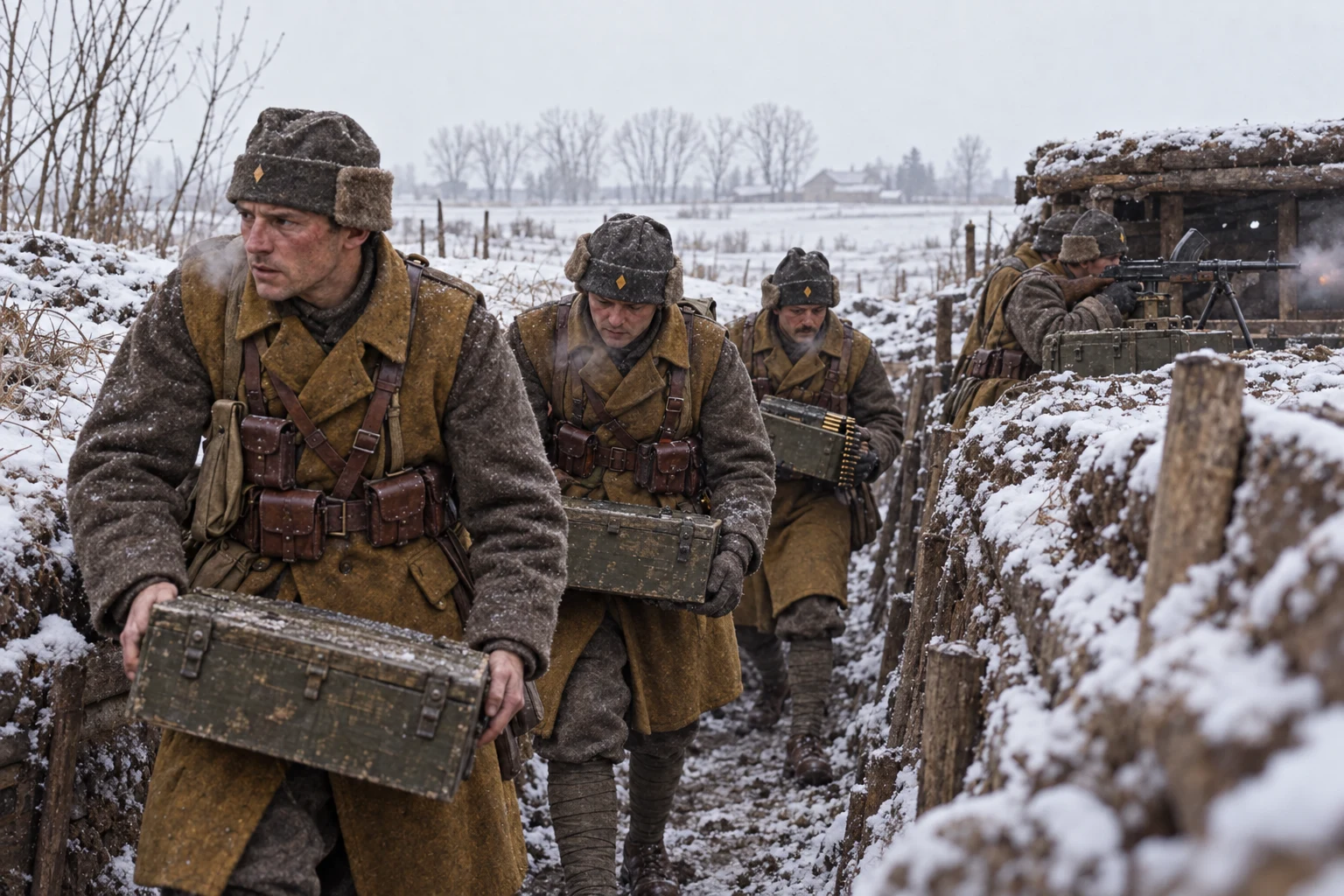
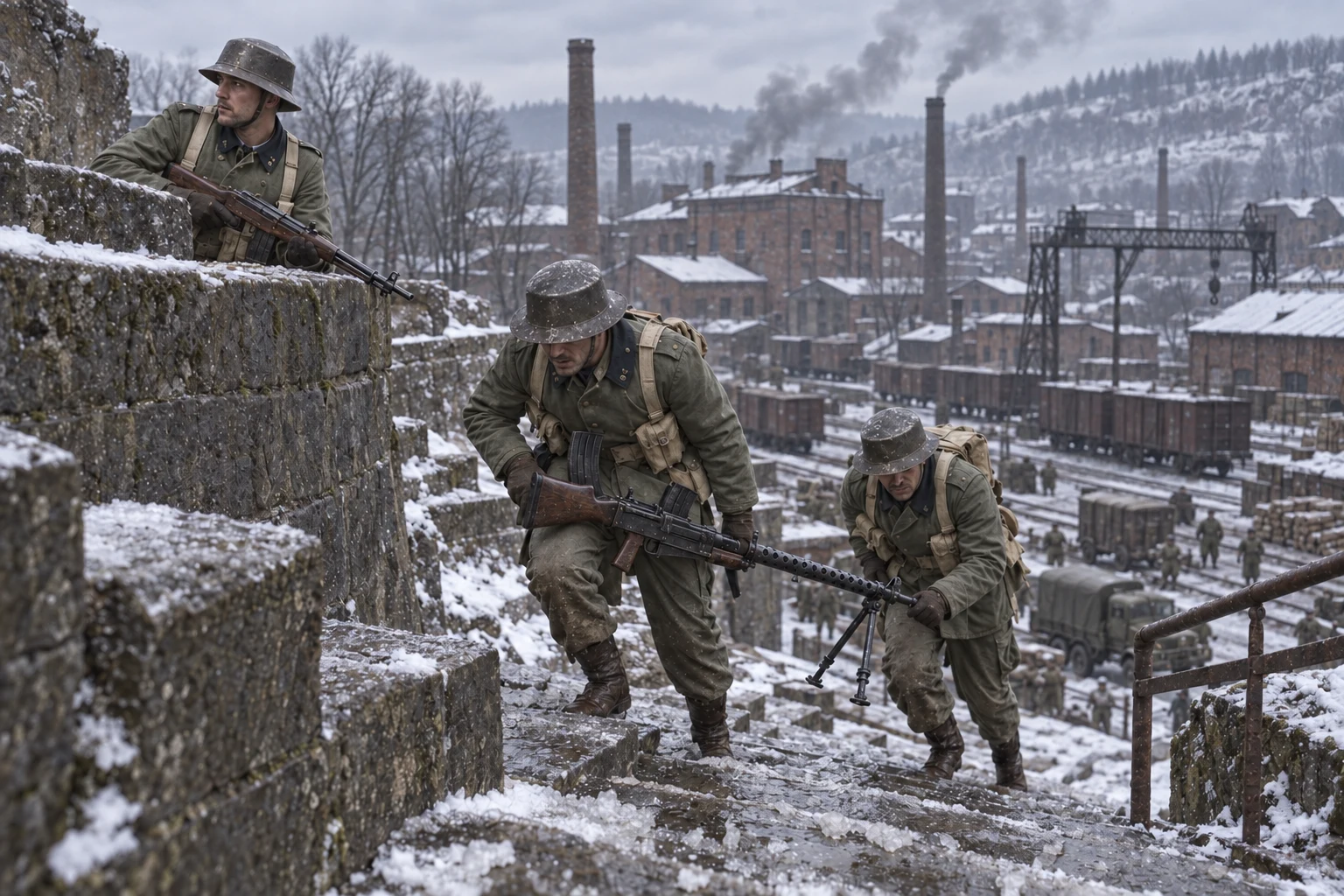
The Helion winter positions
January 19–February 12, 1222 · Helion front, Viar · Helion and Allied support against Novren-led forces
A front overshadowed by diplomacy
While Silvian and Kelonese representatives argued over inspections and maritime interference, the existing Viar war continued. The Helion front had endured pressure since Novren's attack in 1211. Its soldiers did not experience 1222 as a diplomatic prelude to someone else's entry. They faced another season in which the enemy sought useful ground and their own command tried to preserve a functioning army with limited relief.
The Eren steps were a series of rising settlements and industrial cuts within an established contested district. The name described local terrain rather than a new feature asserted on the supplied continental map. Helion's Colonel Iria Sen commanded the defense, supported by Allied services allocated through theater arrangements. Her positions had been occupied for so long that units inherited routines whose original purposes were no longer always understood.
Novren's command planned a limited attack to improve its position and place additional pressure on the Allied network. It did not expect to conquer Helion in one movement. The operation's restricted scale made preparation easier to conceal among ordinary activity, but it also limited the reserves available if the first attacks failed. Both sides entered the battle with a realistic understanding of what they could attempt and an incomplete understanding of their opponent's condition.
January 19–25: The lower settlement
The attack opened on January 19 against the lowest defended settlement. Helion troops lost several buildings and withdrew toward positions overlooking the approach. The movement was orderly in some companies and confused in others because visibility and damaged communications separated local experiences. Sen received a report that the entire lower line had gone, followed by a message from a unit still holding within it and requesting permission to leave.
That unit occupied a municipal store and neighboring dwellings. Its commander believed departure would expose troops above, while those troops believed he had already withdrawn. A liaison party established contact and arranged a coordinated movement. The delay cost additional casualties but prevented the isolated group from being abandoned entirely through a misunderstanding of the map.
Novren forces secured the lower settlement and attempted to extend their gains. Their infantry encountered stronger resistance where Helion's positions had better support. The first success therefore became a foothold requiring maintenance rather than the beginning of an uninterrupted advance. Supplies had to pass through damaged streets whose civilian residents were still sheltering nearby, complicating movement and control.
January 26–February 4: The workshops above
The principal struggle shifted toward a workshop district higher in the local terrain. Helion used its buildings for maintenance and shelter, while the adjoining ground connected several defensive sectors. Sen initially sought to retain all of it. Reports from her engineers showed that some facilities could no longer perform their industrial function, and she reduced the defended area to preserve the connection that still mattered.
A local counterattack on January 28 recovered a service road and relieved pressure on one isolated position. It did not eject Novren from the lower settlement. Soldiers returning from the action brought prisoners whose clothing and equipment revealed shortages resembling their own. This did not reduce the danger of the enemy, but it contradicted briefings that sometimes presented Axis persistence as evidence of limitless reserves.
Medical evacuation became particularly difficult as weather and damage affected exposed movement. Stretcher teams improvised pauses in buildings no longer used by either side as formal positions. One team sheltered with wounded from both armies after losing contact with its escort. They were recovered during a later lull, and their account helped identify men previously listed as missing. The incident remained exceptional rather than evidence of a general suspension of fighting.
Inspector Dalen’s warning
Sen's local adviser was municipal inspector Rova Dalen, unrelated to the later Silvian expeditionary general. She maintained records of the industrial cuts and knew which abandoned passages had become unsafe after repeated damage. An infantry officer proposed using one to move a relief party beyond an exposed street. Dalen identified a collapse recorded the previous year and directed the party toward a longer authorized route that remained open.
The warning initially seemed excessively cautious because the passage's entrance was intact. An inspection confirmed that debris blocked it beyond the first bend. The avoided delay mattered: the relieving troops reached their destination before the defending company exhausted its medical supplies. Sen included Dalen's report in the intelligence file, giving civilian inspection records a defined place beside patrol information.
After the battle, workers disputed military plans to occupy the workshops indefinitely. Their equipment was needed to repair civilian distribution as well as army vehicles. Sen negotiated hours and protected work areas rather than requisitioning the entire complex. The arrangement remained fragile under renewed alerts, but it preserved a functioning workforce whose continued presence the defense required. Holding the upper connection had not ended competing demands on the district; it had made those demands governable through institutions that remained present instead of fleeing before another change of military purpose.
February 5–12: Neither side gets the whole objective
Novren renewed its effort in early February but failed to take the upper connection. Helion's defense held with support from adjacent Allied commitments, while Sen declined another attempt to recover the lower settlement immediately. Her force could sustain the improved line; it could not both hold and undertake a fresh offensive without relief. The theater command accepted the distinction and brought the local operation to an end on February 12.
The result left Novren with a limited territorial gain and Helion with the principal upper connection intact. Both sides claimed enough success to justify the effort, but neither had achieved everything it sought. The lower settlement's residents now lived under a different military authority, while those above remained exposed to a front that had moved closer without becoming decisive.
Sen's after-action review focused on inherited assumptions: which facilities still worked, which positions genuinely supported neighbors, and which routines had survived after their purpose disappeared. The battle added no famous capital to the war's list of losses. Its significance lay in the continuing expenditure of trained people and repair capacity across Viar. That pressure would later shape what Silvian reinforcements could accomplish, because they would join a theater with its own long history rather than an empty front awaiting outside initiative.
Original illustrations for this source record
Original archive artwork and captions are preserved. Dates, labels and claims printed within inherited images belong to the previous edition; the revised text governs the current history.