The front enters Havera
October 4–November 2, 1218 · Eastern Havera, Volara · Havera and Allied partners against Hukular-led forces
The boundary crossed
The attack that carried the front into eastern Havera followed Pavren's exhaustion and the June field armistice of an isolated Pavren grouping. That armistice did not end Free Pavren service with the Allies. Some of those soldiers entered the new battle beside Haveran units, bringing practical experience and the knowledge that their own home districts already lay behind enemy lines. Their presence made warnings about retreat more immediate than any briefing could.
The Deren works district became one of the threatened areas. It contained factories, workers' settlements, and rail facilities useful to the Allied war effort. General Elsen Rove, surviving from the defense of the approaches in 1215, now faced a different problem. The enemy had advanced through years of cumulative pressure, and the space available for further defensive adjustment had narrowed. Holding the national boundary carried political importance beyond the military value of any particular field.
Rove nevertheless prepared alternate positions. He ordered industrial authorities to identify machinery that could be moved and machinery whose removal would consume more transport than its value justified. Factory managers objected that military officers were deciding the future of civilian livelihoods. Joint inspection teams reduced the disagreement without eliminating it. Workers watched equipment depart while being told that the army still intended to defend their district.
October 4–10: The first penetration
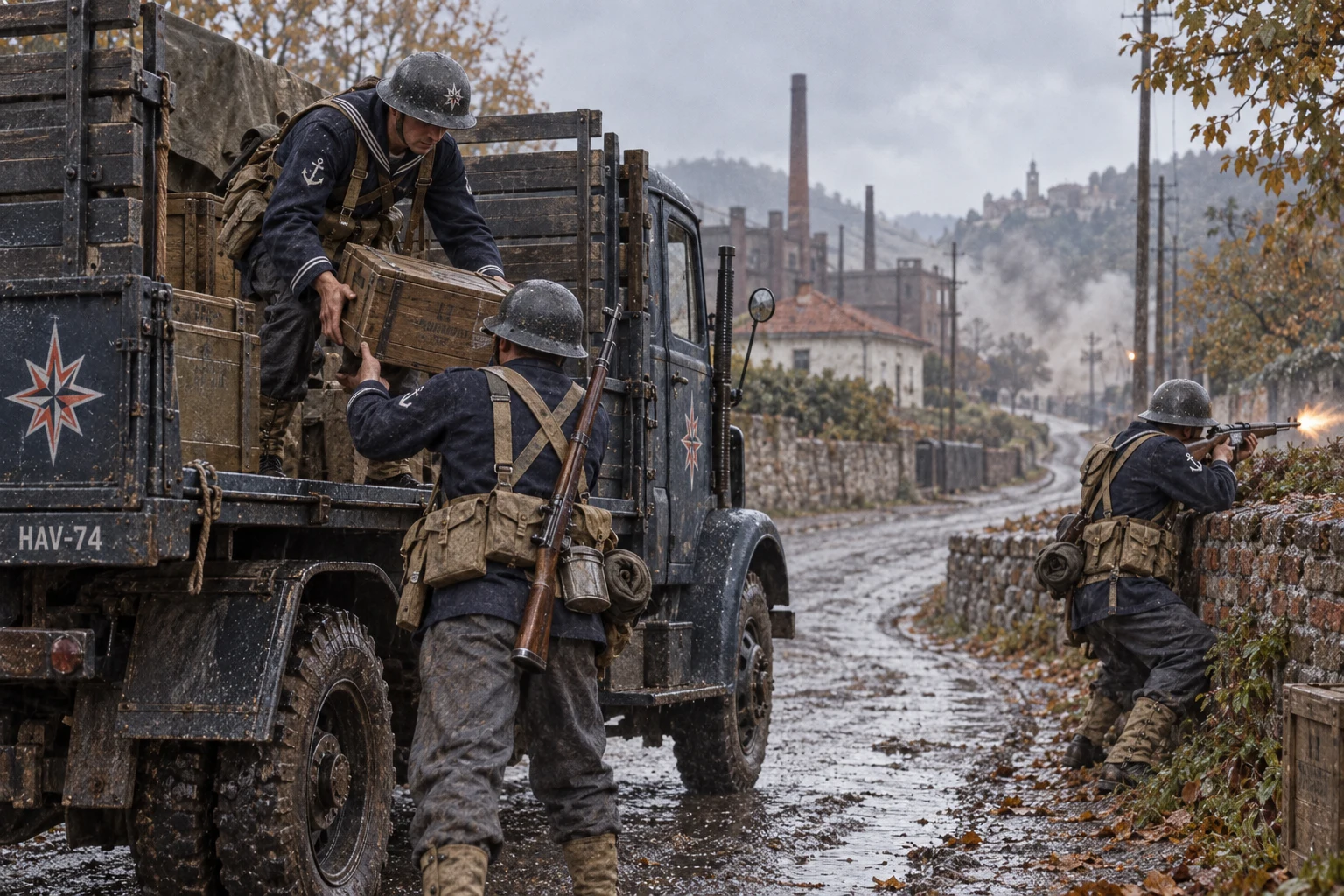
Hukular's attack began on October 4 and broke into the eastern defensive area. Forward Haveran units resisted, but several positions became untenable when adjacent ground was lost. Rove authorized withdrawal from an exposed belt before every unit had received the same picture of the battle. Some companies moved promptly; others stayed because the enemy directly before them had been repulsed and the order seemed inconsistent with their experience.
A Free Pavren battalion helped stabilize a position beside the works railway. Its soldiers were familiar with the signs of a retreat becoming disorganized: abandoned transport, contradictory destinations, and officers searching for units that had already moved. They directed stragglers toward assembly points and supplied guides to incoming formations. The work did not appear heroic beside the fighting at the factories, but it preserved useful strength that might otherwise have disappeared into the rear.
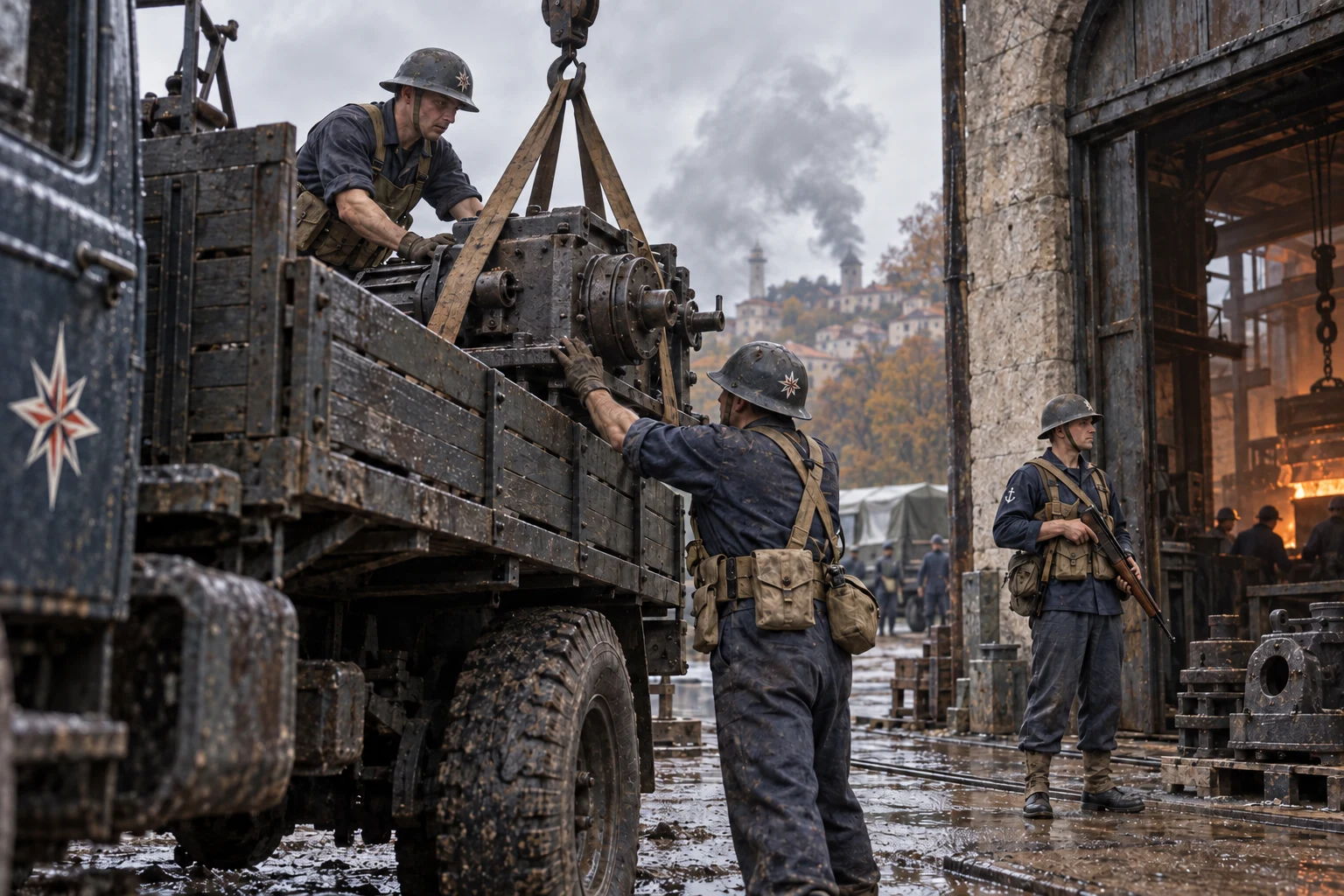
At a foundry annex, Haveran infantry held through repeated shelling while workers completed the removal of specialized equipment. A crane failed with a load suspended above the workshop floor. The evacuation stopped until mechanics could make the area safe, keeping soldiers in a position whose military purpose had become the protection of a civilian industrial decision. Rove eventually imposed a departure deadline and accepted the loss of the remaining machinery.
October 11–22: The industrial streets
The battle moved into workers' districts where cellars offered shelter but connected poorly with one another. Families remaining underground depended on brief pauses to obtain water and news. Soldiers passing through carried rumors that the entire eastern front had collapsed. Local officials used noticeboards and messengers to distinguish confirmed evacuation instructions from speculation, often correcting information already out of date when it reached them.
Hukular troops gained parts of the industrial area and encountered buildings stripped of useful equipment. Some positions still contained active defenders; others contained only workers protecting property or looking for relatives. The invaders' local command struggled to distinguish them consistently. Detentions increased, and movement restrictions complicated efforts to remove civilians from areas still being shelled by both sides.
Rove's reserve counterattacked on October 17 and recovered an approach to the main defensive line. The operation did not recapture the works district. Its purpose was to prevent further penetration from separating adjacent Allied formations. Headquarters described the result narrowly, avoiding a claim that the enemy had been expelled from Havera. That restraint mattered to soldiers who could see occupied buildings from their new positions.
What Sel could save
The foundry evacuation was directed by engineer Arven Sel, whose original plan prioritized a large press regarded as the works' most valuable machine. Inspection after shelling showed that its foundation had shifted and removal would require work the remaining timetable could not accommodate. Sel revised the list toward smaller tools, measuring equipment, and specialist components. Factory managers initially opposed the change because losing the press seemed to reduce the salvaged establishment to fragments.
Rove supported the revised plan after Sel explained which future operations those fragments could restore. The departing load therefore contained equipment less impressive than the machine left behind but more usable at receiving workshops. Workers traveling with it brought maintenance records and the practical knowledge required to fit unfamiliar equipment together. Several families joined the same movement under separate civilian arrangements, preventing the specialists' departure from becoming an order to abandon their dependents.
The salvaged tools entered service in western Havera during the following winter of 1219. The great press remained in the occupied works and was damaged beyond economical repair before liberation. Those later outcomes did not make Sel's decision obvious when he made it. They confirmed that the evacuation had preserved productive capacity by selecting what could actually be moved and used, rather than defining success through the single most conspicuous object on the inventory.
October 23–November 2: The line holds farther west
By the final week of October, Hukular's advance was meeting stronger resistance and greater support demands. The Allies established a new line while continuing limited withdrawals from positions that no longer served it. Several local battles persisted after the main movement had slowed, as each side sought better observation or a more defensible boundary. These actions caused casualties without changing the general result.
The campaign closed on November 2 with Hukular holding territory inside eastern Havera. The national capital and western government remained secure enough to continue the war; the country had not capitulated. Rove's force had preserved a coherent defense while losing valuable industry and populated districts. The next year's fighting would deepen the pressure rather than begin from an untouched frontier.
For Haveran civilians, the battle ended the distinction between supporting a neighboring war and living under its direct territorial consequences. Evacuees entered communities already hosting displaced Pavren families, and military transport competed with the movement of salvaged machinery. The Free Pavren soldiers who had helped steady the retreat watched another ally confront losses they understood intimately. Their continued service demonstrated that national defeat in one place could become experience sustaining resistance in another, without making either country's suffering interchangeable.
Original illustrations for this source record
Original archive artwork and captions are preserved. Dates, labels and claims printed within inherited images belong to the previous edition; the revised text governs the current history.