Recovery of the western approaches
February 9–March 3, 1214 · Pavren front, Volara · Allied northern forces against Hukular-led defenders
The objective made smaller
The offensive of 1214 began with a restriction that disappointed those expecting a reversal of the previous spring's failure. Allied command intended to recover a limited approach district and improve its own position, not announce another immediate march through occupied Pavren. The Fen House road connection was selected because its capture would reduce the exposure of existing supply movements. It was a practical objective with consequences that could be evaluated without waiting for an entire campaign to succeed.
Pavren's Colonel Haren Vol, whose formation had suffered in 1209, participated in planning with officers who had fought the 1213 offensive. Their disagreements were specific. Some wanted to include a neighboring rise whose defenders could still observe part of the recovered road. Others argued that doing so would enlarge the attack beyond the force available. The final order retained the narrower objective and explicitly reserved authority for deciding whether any extension was justified.
The defending Hukular force occupied battered positions that had acquired depth through years of use. Its troops knew the local ground and had adapted shelters, communications, and observation to it. Winter damage had nonetheless weakened some positions and complicated relief. The defenders were neither an unsuspecting force awaiting a clever attack nor an invulnerable system. Their strength lay in familiar arrangements whose usefulness varied from place to place.
February 9–14: Into the farm district
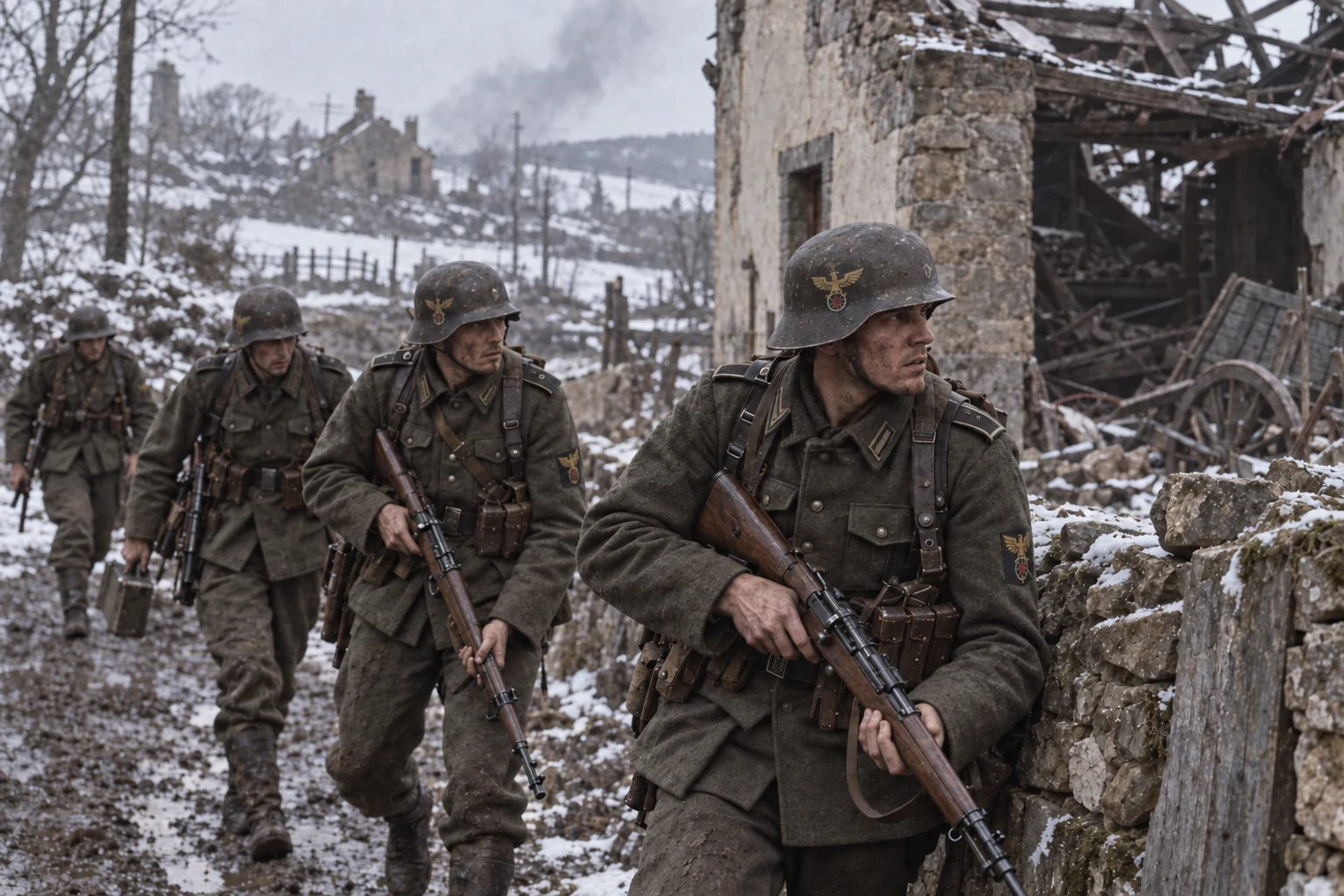
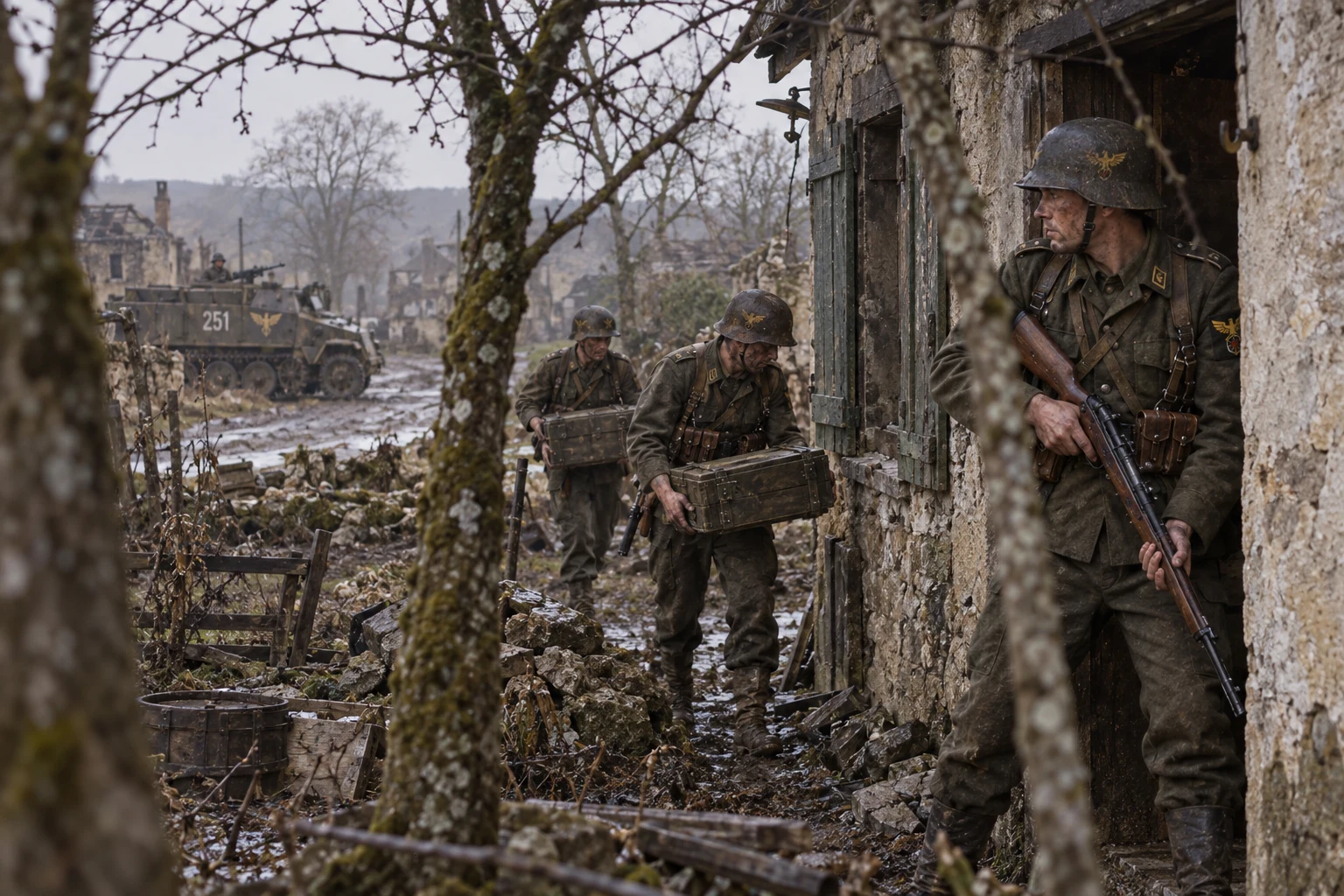
The opening attack recovered outlying positions and reached a cluster of farm buildings east of the Allied line. A Pavren company entered a barn whose walls still stood while its roof lay collapsed across stored tools and carts. The position offered concealment and poor movement. Its commander shifted most of the men outside rather than allowing the apparent solidity of the building to dictate the defense. That decision reduced losses when renewed shelling struck the ruins.
At Fen House itself, Hukular defenders resisted from several connected properties. The fighting moved through orchards and boundary walls, with local advances repeatedly interrupted by uncertainty about adjacent troops. Vol sent a reserve company to establish contact rather than ordering it immediately toward the next visible objective. The move slowed the apparent advance and prevented the leading units from becoming separate islands of occupation.
On February 12, the Allies secured the principal road connection. Engineers and transport officers inspected it before headquarters announced that it was open for regular use. They found damage that allowed foot movement but made heavy traffic unreliable. Repair work began while infantry held the surrounding district. The distinction between capture and usability, neglected in earlier operations, now determined when additional stores could safely be committed.
February 15–23: Hukular's reply
Hukular counterattacks sought to recover observation over the road and make the Allied foothold too expensive to retain. One attack temporarily retook an outlying cottage group. Allied officers resisted the temptation to send every nearby reserve after it. Instead, they concentrated on retaining the positions that protected the actual transport objective. This left a conspicuous patch of lost ground on the map and preserved the more important result.
The most difficult fighting occurred during a relief on February 18. Incoming troops reached a position as the defenders were responding to renewed pressure. For several hours, two company headquarters occupied the same cramped shelter and neither possessed complete authority over all the men outside. A senior officer remained until the transfer was finished, resolving requests in person. The episode did not become a celebrated action, but it prevented confusion at a vulnerable moment from undoing the preceding week's work.
Civilian residents began emerging from shelters and returning from nearby refuge areas. Some mistook the limited advance for the liberation of a much larger district and attempted to travel toward homes still beyond the line. Military police and local officials established a reception point to explain the actual boundary of control. The conversations were bitter because the visible distance between safety and an occupied village could be small while the practical barrier remained absolute.
The culvert and the return lane
The civilian return to Fen House exposed a mistake in the clearance report. A lane marked passable had been inspected for marching troops, not for the carts bringing bedding and elderly residents. One cart overturned where a culvert narrowed the usable surface. Nobody was killed, but the accident blocked an ambulance and revealed that the same word had been used for two different standards of access. Vol ordered confirmation for civilian movement rather than treating the return of residents as an extension of military traffic.
The change required Aldren-trained Hestunian engineer Lieutenant Mira Tarn to inspect the lane with a Pavren road surveyor, Jeren Pel. They disagreed over whether to repair the culvert immediately or establish an alternative passage. Pel's knowledge of property boundaries identified a temporary route whose owner had already authorized municipal use. No emergency seizure was necessary, and the owner received a acknowledgment before the first carts crossed.
The incident became part of the victory's accounting. Fen House was useful because soldiers, supplies, ambulances, and eventually civilians could move through it under rules suited to their different needs. Capturing the district had created the opportunity; the less conspicuous inspections made the opportunity real. Vol included the delayed ambulance in his report so that the retained objective would not be described as fully functioning before the work establishing its function had actually been completed.
February 24–March 3: A victory that stops
Pressure continued, but the Allies retained Fen House and the recovered approaches. Vol recommended no immediate expansion. His formation had suffered losses, and the road's restored capacity was already needed to sustain the existing defense. The command accepted the recommendation despite requests from political representatives for a more dramatic conclusion. The offensive formally ended on March 3.
The result was a limited Allied victory. It improved movement, shortened some exposed journeys, and returned a district to civilian administration. It did not reopen a route through Quorin, dissolve Hukular's wider front, or undo the occupations of earlier years. Its value came partly from the command's willingness to stop while the result remained supportable.
Soldiers who had fought the previous spring recognized the difference in what happened afterward. Their units were relieved, supplies reached the positions, and the captured road began serving the purpose for which they had attacked. The victory did not erase casualties or repair every home, but its benefits were visible to those who had paid for it. In a war increasingly dominated by exhaustion, that connection between objective and result became an important source of confidence.
Original illustrations for this source record
Original archive artwork and captions are preserved. Dates, labels and claims printed within inherited images belong to the previous edition; the revised text governs the current history.