Garamond's central battle
June 18–July 30, 1213 · Central Garamond, Volara · Garamond against Zaganar
The final concentration
By June 1213, Garamond's defenders had spent more than a year repairing formations with diminishing resources. Their central region contained military headquarters, civilian administration, workshops, refugees, and hospitals displaced from earlier fighting. Concentration made some services easier to coordinate and exposed more of the state to damage within the same area. A shell striking an ordinary commercial building might destroy a relocated ministry, a clothing store, or both.
Colonel Vesa Rinn, surviving from the opening Ordan campaign, now commanded a reduced formation whose title concealed repeated reorganizations. Its soldiers included industrial guards, regular infantry, and men recovered from hospital before they had regained full strength. They were experienced in defending damaged positions, but experience could not replace equipment no longer produced or imported in sufficient quantities. Rinn's reports increasingly distinguished what a unit could hold briefly from what it could sustain.
Zaganar's command prepared a renewed effort against the center. The attacking force also carried the effects of a long campaign, but possessed better access to replenishment. Its objective was to separate Garamond's remaining military positions and make coordinated defense impossible. The operation opened on June 18 with pressure across several connected sectors, forcing the defenders to decide which local crises could be left unanswered.
June 18–30: The administrative edge
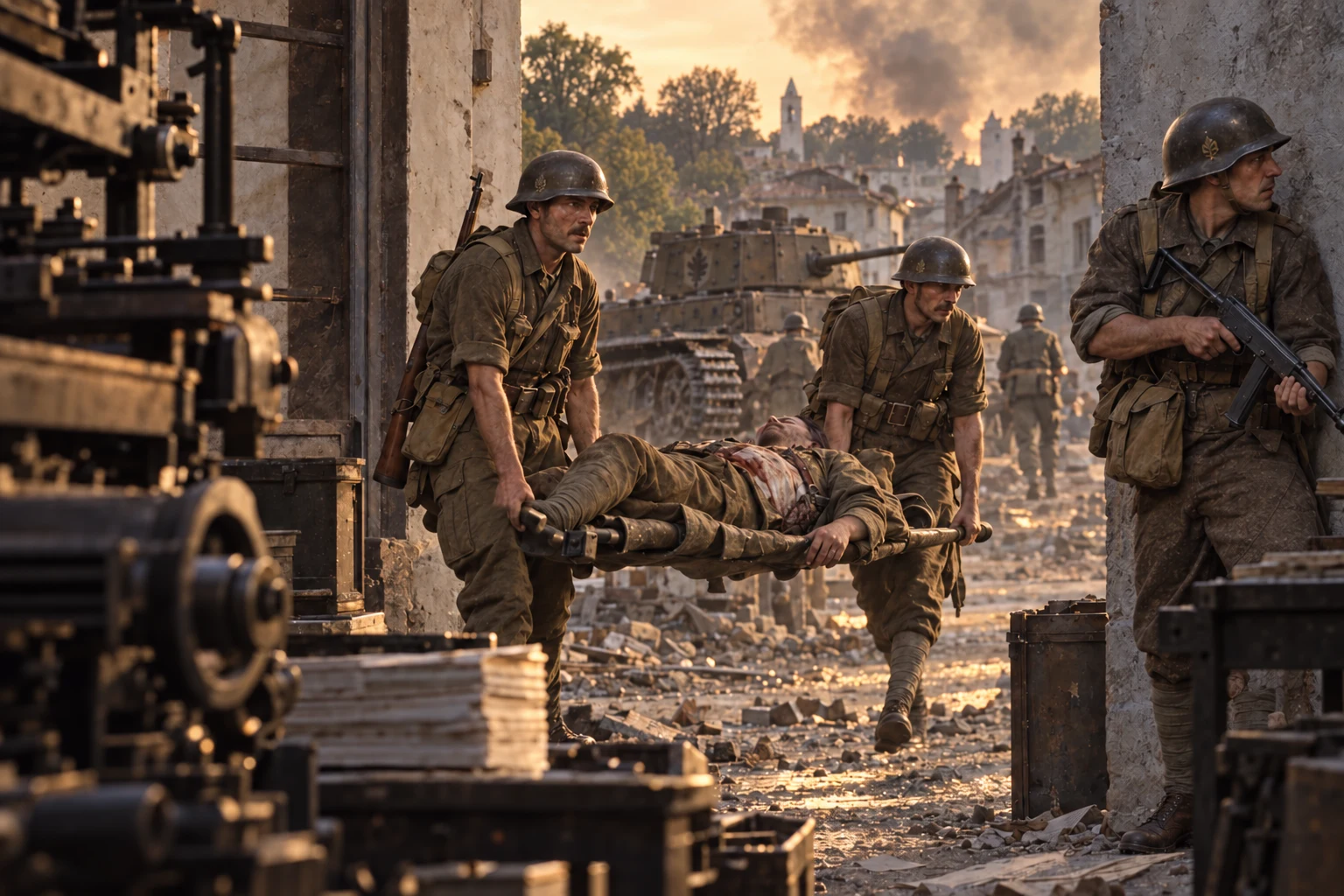
The earliest fighting reached a district of warehouses and government service buildings outside the principal center. Garamond had converted offices into sleeping quarters and aid stations, making the area more important than its prewar map suggested. Rinn's troops held a printing works where administrative forms, notices, and replacement ration documents were still being produced. The machinery's survival mattered because the state was trying to govern a displaced population with missing records.
When electricity failed, workers completed limited jobs by alternate means while soldiers fought outside. A final batch of blank identification forms left with a messenger party. Later, the loss of the printing works was described only as the capture of another strongpoint. For officials trying to distinguish residents, soldiers, and separated children, the disappearance of its output created a different kind of military emergency.
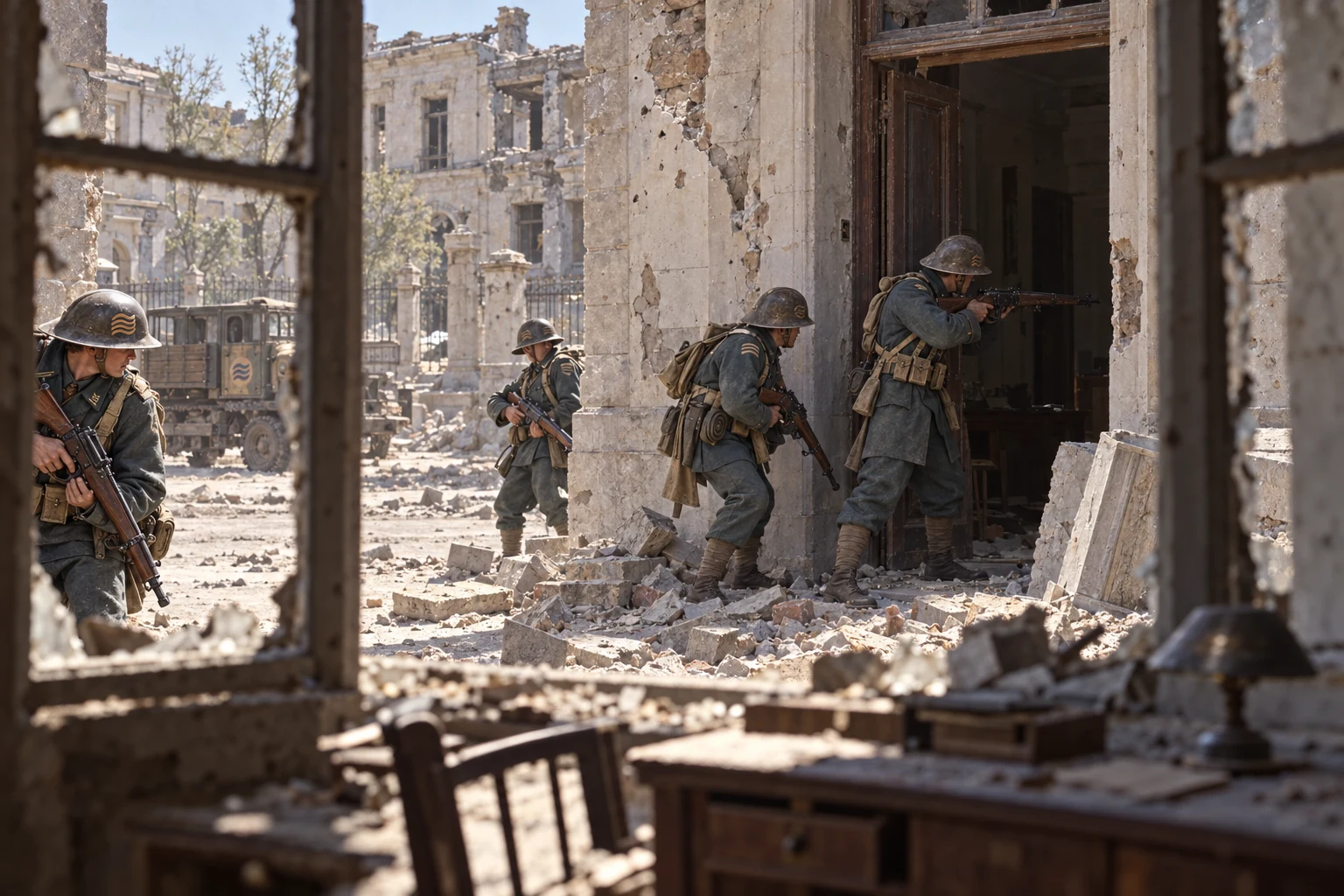
Zaganar troops entered the district through gaps created by withdrawals elsewhere. Garamond's local commanders sometimes learned of neighboring retreats from unfamiliar firing directions rather than orders. Rinn sent officers to reconnect positions, but each journey took longer as roads became blocked. On June 28, she abandoned part of her assigned frontage to preserve contact with the remaining central defense. The move was authorized afterward, a sequence that would later complicate judgments about responsibility.
July 1–14: The center falls
The first fortnight of July compressed military and governmental decisions into the same rooms. Officials prepared departure lists while officers requested vehicles for ammunition and wounded men. External escape remained limited; there was no secure land corridor through the surrounding hostile system. Some personnel had already left by small-scale arrangements. Others would remain because transport, access, or time failed, not because an orderly evacuation plan had selected every outcome.
Rinn's force defended a municipal service complex containing pumps and maintenance stores. Its loss threatened the remaining population as well as the troops. Zaganar's attack damaged the pumping equipment before the buildings were fully occupied. Water distribution deteriorated on both sides of the immediate fighting. Defenders carried containers from farther away, reducing the number available to move wounded and supplies.
On July 14, Zaganar secured Garamond's principal center. Some government representatives escaped or had already established themselves abroad; others were captured. The fall did not mean every defending formation surrendered that day. Rinn withdrew with part of her command into remaining positions, now deprived of the administrative and transport system that had connected them. Orders became statements of intent whose delivery could no longer be assumed.
The last exchange
The last telephone exchange in Rinn's sector operated from a basement beneath a accounting office. Operator Mira Pell knew several military callers by voice because their units had used the same circuit for months. On July 9, an unfamiliar caller requested the withdrawal schedule of a neighboring position. Pell declined to transmit it without the verification required, despite the caller's insistence that delay endangered troops. The request was never authenticated. Whether it originated with an enemy party or a displaced friendly office remained unresolved during the battle; later investigation identified it as a Zaganar signals detachment using captured equipment.
Pell's caution preserved the schedule while delaying several calls during the ensuing checks. Rinn ordered a confirmation process rather than allowing suspicion to halt the remaining network entirely. The exchange continued for two more days before damage forced its abandonment. Pell carried out a subscriber list that helped survivors locate units after the central defense fragmented.
She entered captivity with a medical party on July 24 and survived until liberation. Her testimony settled the exchange's fate and corrected a claim that its operators had all died at their posts. The account still recorded two deaths, but allowed the surviving staff to be remembered as people whose service continued through imprisonment rather than as an anonymous group made more heroic by an inaccurate ending.
July 15–30: The army breaks into fragments
The final phase consisted of isolated battles, attempted movements, local negotiations, and captures. Some Garamond units continued fighting because they believed relief remained possible. Others sought terms for wounded men and civilians sheltering with them. Rinn rejected a proposal to make an unsupported general attack toward a reported opening after scouts failed to confirm it. Her remaining soldiers preserved their cohesion for several more days, but cohesion could not create a route that did not exist.
By July 30, Garamond's coherent conventional defense had collapsed. Surviving personnel reached the wider Allied war through varied later paths, while others entered captivity or remained under occupation. The government in exile preserved the country's belligerent identity. Its eventual contribution at SharkStrike's Gale sector would draw on that continuity, not on an army that had somehow marched intact through the encirclement.
For Zaganar, the campaign achieved its central military objective and created an occupation burden. For Garamond's survivors, the defeat divided lives into those who had left, those who had remained, and those whose fate was unknown. The administrative forms carried from the printing works became one small means of reconnecting them. They recorded identities after the institutions that had issued them had lost their buildings, territory, and immediate power to protect the people named on the paper.
Original illustrations for this source record
Original archive artwork and captions are preserved. Dates, labels and claims printed within inherited images belong to the previous edition; the revised text governs the current history.