The Larvan convoy action
June 24–27, 1211 · Open waters serving the Grand Isles · Larvan Allied escorts against Kelonese naval forces
The first contested passage
The Larvan states' entry against the Kelonese Empire on June 3 created commitments before their navies had developed a common operating routine. The convoy later called the First Northern Passage carried repair materials, medical stores, and military cargo toward consenting Allied facilities in the Grand Isles. Its escorts included vessels from Aldvik and Brenholm, supported by other participating Larvan services. It did not pass through neutral ports under an assumed right of military access.
Captain Rena Holt of Aldvik held coordinating responsibility for the passage. Her authority covered the agreed convoy task, not unrestricted command over another country's navy. Brenholm's senior officer retained national responsibilities and requested written clarification of changes affecting his vessels. The arrangement was cumbersome at moments, but it prevented disputes from remaining hidden until combat. Both officers agreed that delivery of the merchant ships mattered more than pursuit of an enemy contact.
The convoy's slowest merchant vessel had recently completed repairs and could not sustain the speed originally reported. Holt reduced the formation's movement rather than leaving it behind immediately. The decision lengthened exposure and preserved a cargo of machine components difficult to replace. Merchant captains learned of the change through signals that some read promptly and others misunderstood, producing an untidy first night at sea.
June 24: Contact in poor visibility
A lookout reported unfamiliar smoke during the afternoon of June 24. The first sighting did not establish identity or intent. One merchant captain altered course before receiving an instruction, opening a gap that neighboring ships attempted to close. Holt's staff spent the next interval restoring order while the distant contact remained uncertain. The eventual identification of Kelonese vessels transformed an administrative problem into an immediate combat risk.
The Kelonese force sought to interrupt the passage and damage its escorts without becoming trapped in an extended engagement far from its own support. Its commander saw merchant ships spread less neatly than expected and judged that pressure might scatter them. The opening exchange damaged an Allied escort's upper works and interrupted its signals. The ship continued maneuvering, leaving the convoy uncertain whether its silence indicated obedience, injury, or loss of command.
An Aldvik signalman improvised communication from a secondary position while repair parties worked below. Messages became shorter and less complete. Holt ordered the merchants to continue under the remaining escort arrangement and declined to draw them toward the damaged ship. The choice exposed some cargo vessels to anxiety and uncertainty, but prevented every decision from revolving around the most visible casualty.
June 25: The disabled freighter
The next day's fighting struck a freighter carrying workshop machinery. Flooding and a machinery failure reduced its movement, while smoke made the extent of damage difficult to judge. Its master initially reported that he could continue. Engineers below knew the situation was worsening but had not yet reached a definite estimate. By the time the report changed, the rest of the convoy had drawn away.
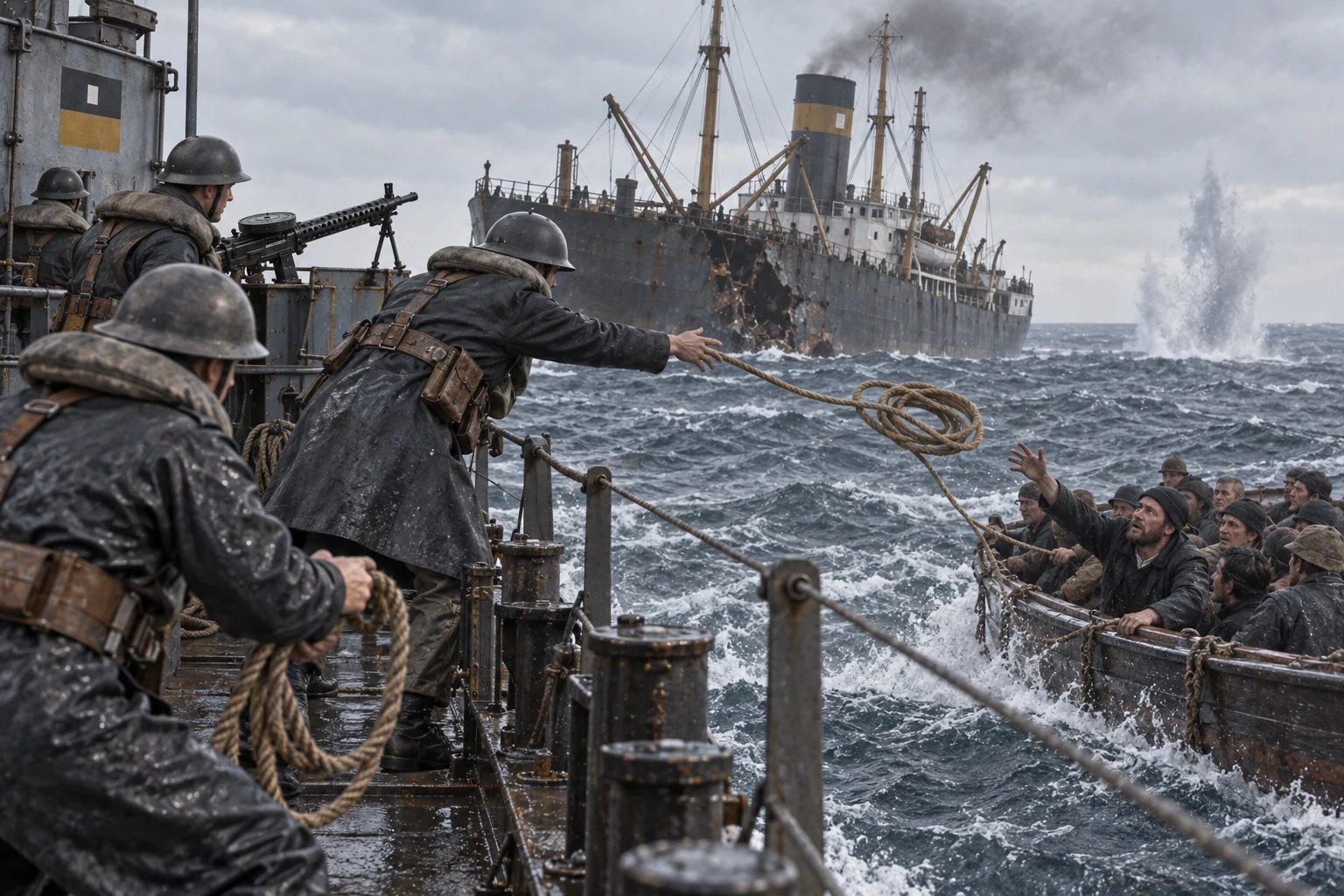
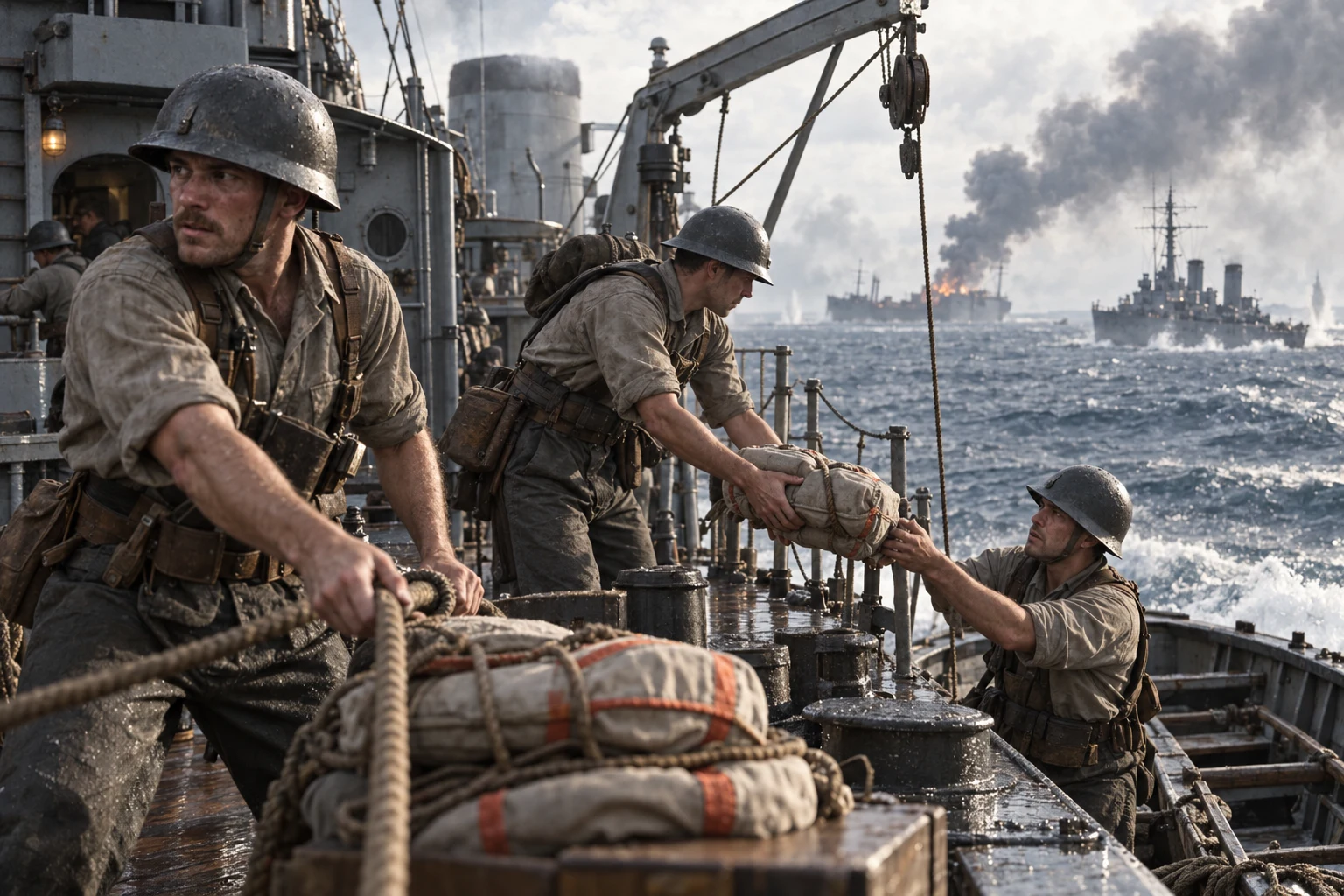
Brenholm's senior escort remained with the freighter long enough to remove wounded personnel and attempt assistance. The work took place under the threat of renewed contact rather than constant close combat. Men waited beside boats while officers decided whether saving cargo still justified the risk. Ultimately, the freighter had to be abandoned. Some machinery was lost with it, and personnel who had guarded that cargo throughout loading watched it disappear after surviving the attack themselves.
Kelonese ships renewed pressure but did not destroy the convoy. Their own damaged vessel required attention, and uncertainty about additional Allied forces limited pursuit. The encounter broke into separated actions and searches rather than a single orderly line of ships exchanging fire. Each command reconstructed the other side's position from sightings that were already becoming obsolete.
Edrun Light and Copper Finch
The damaged escort was Aldvik's cruiser Edrun Light, commanded by Captain Mera Vossik. Its upper signal position lost both equipment and personnel during the first exchange. Quartermaster Lian Tor assembled a replacement team from sailors who had completed signaling instruction but served elsewhere aboard. Their messages were slower and lacked the familiarity of a practiced watch. Holt shortened instructions accordingly, reducing the burden on a team whose mistakes could separate ships during an already confused action.
The abandoned freighter, Brenholm's freighter Copper Finch, had carried replacement lathes and electrical machinery as well as ordinary stores. Its master, Jana Orel, remained aboard until the last recoverable patients had left. She brought the original cargo manifest in a waterproof dispatch case, enabling receiving authorities to distinguish equipment lost with the ship from consignments transferred before sailing. Without that document, workshops might have waited weeks for machinery still shown as in transit.
Orel and Vossik later gave evidence at the joint review. Neither claimed the decisions had been obvious as events unfolded. The carrier of indispensable machinery could also become an unacceptable demand on escorts needed by many other ships. The review recorded that conflict explicitly, rejecting later accounts that treated the freighter's loss as either proof of cowardice or a sacrifice whose necessity had been clear from the first hit.
June 26–27: Arrival and accounting
The surviving merchants reached Allied reception facilities over two days. Arrival lists initially counted a vessel diverted to another approved harbor as missing. A second ship entered with its identification obscured by damage and smoke, producing a duplicate report under an abbreviated name. Clerks and naval officers reconciled the records before announcing losses. Families ashore had already heard rumors that the entire convoy had been destroyed.
The action was an Allied delivery success accompanied by a significant cargo loss and damaged escorts. Kelonese commanders had imposed cost but had not severed the new Larvan contribution to the island war. Holt's refusal to turn protection into a pursuit became the central point of the review. Some officers criticized the restraint; the merchant captains who reached port tended to understand its purpose more readily.
The next convoy benefited from revised communications and clearer responsibility for disabled ships. Those changes were paid for by the men who had waited beside the damaged freighter, uncertain whether rescue or renewed firing would reach them first. Larvan's participation had ceased to be a declaration on paper. It now included repair bills, bereaved households, missing machinery, and the practical knowledge required to keep sending ships after the first losses.
Original illustrations for this source record
Original archive artwork and captions are preserved. Dates, labels and claims printed within inherited images belong to the previous edition; the revised text governs the current history.