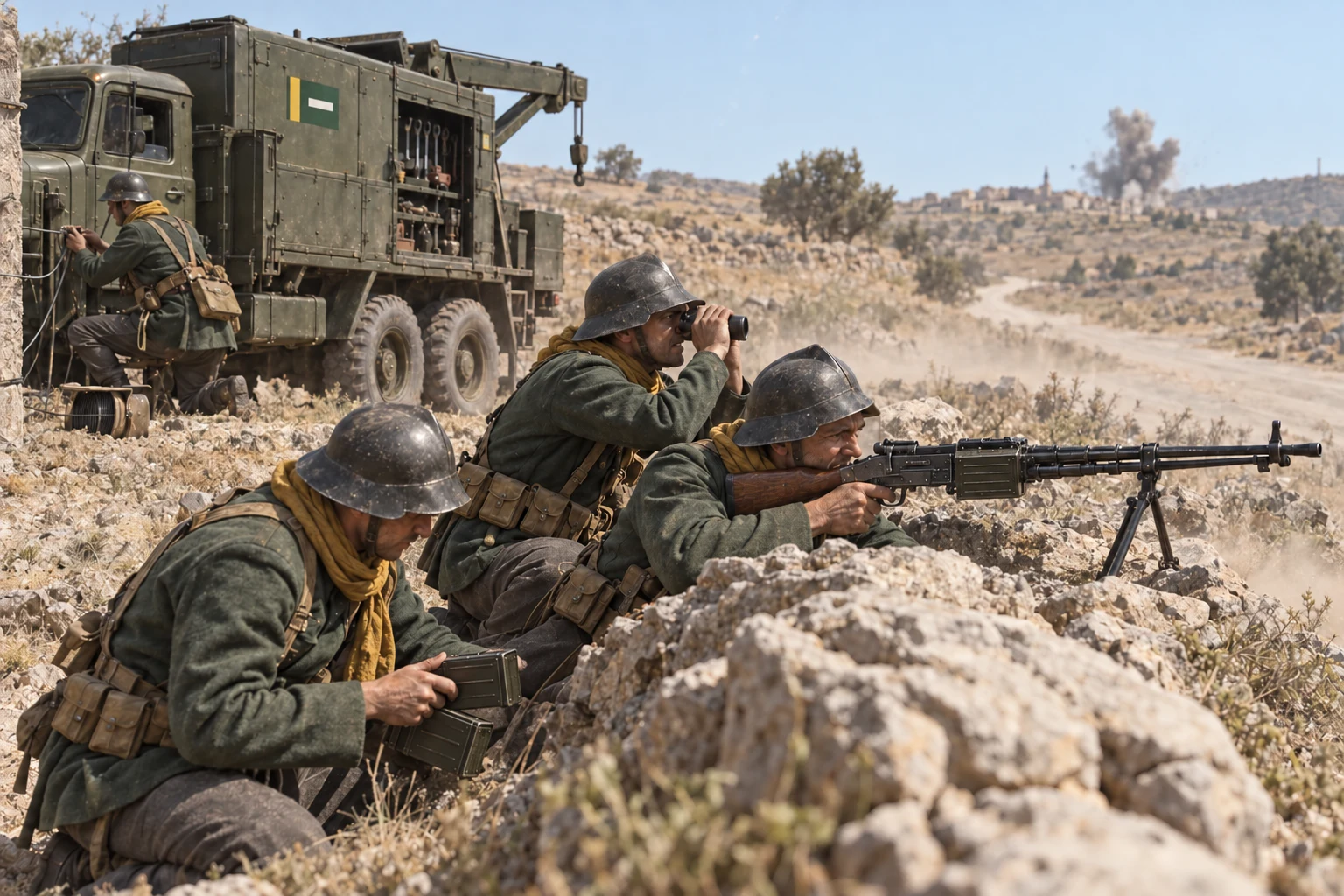
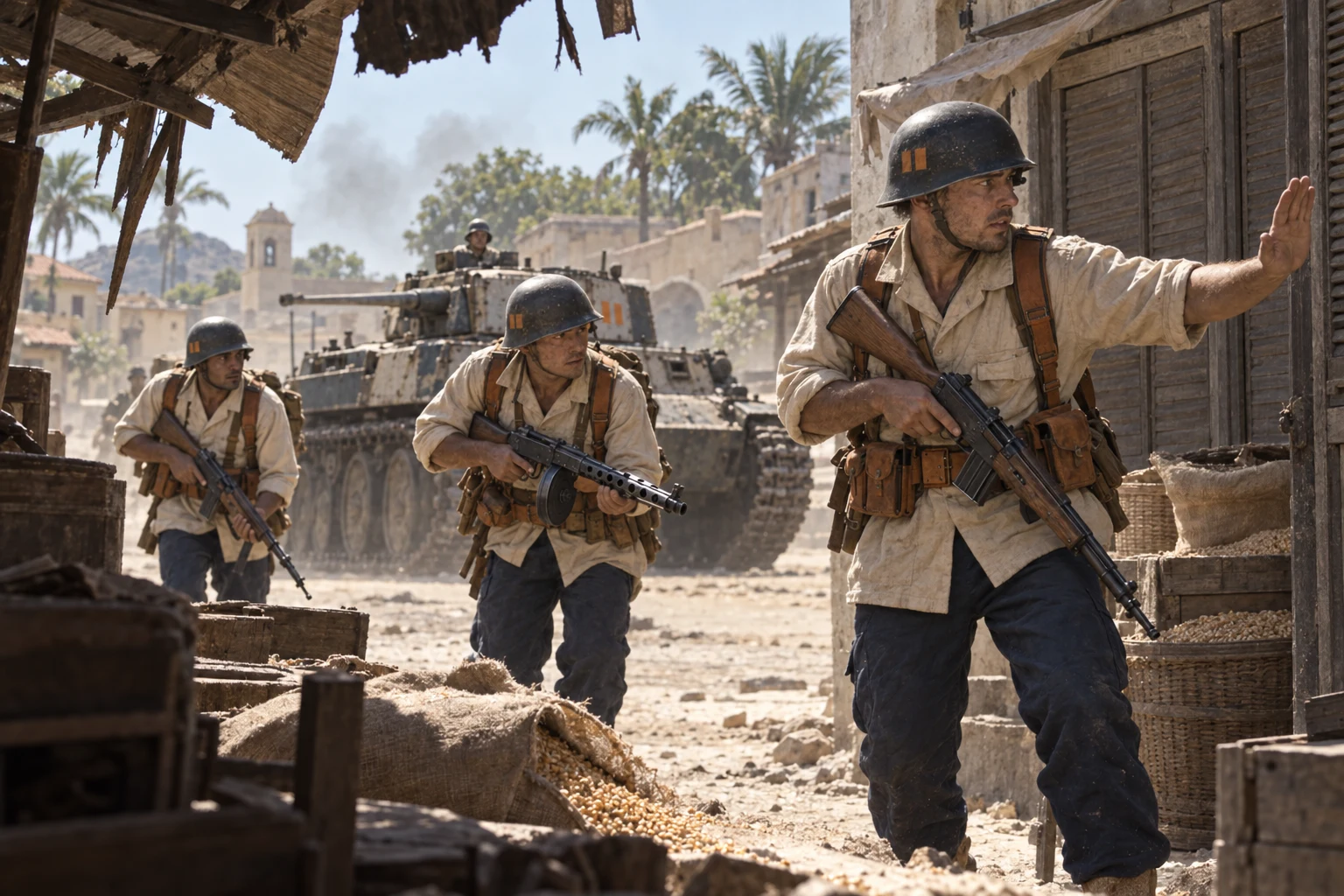
The Handistani road battle
June 6–18, 1210 · Handistan theater, Gaften · Handistan and arriving Allies against Ruuyaq's expeditionary forces
An invasion dependent on access
Ruuyaq's opening campaign against Handistan did not cross an imaginary shared national frontier. Its expeditionary forces depended on the regional access and coastal arrangements that enabled the wider Gaften war. Those arrangements brought troops into the theater without solving their supply problem. Once ashore or concentrated through permitted approaches, units still had to move through inhabited districts whose roads supported agriculture and ordinary commerce as well as armies.
The Darun road district became an early point of resistance. It contained cultivated settlements, a market depot, and a series of difficult road sections rather than an empty expanse waiting for maneuver. Handistan's Colonel Samin Varel commanded troops whose initial assignment had been to cover mobilization. The attack on June 6 forced them to conduct a sustained defense with incomplete transport and reserves still arriving from other parts of the country.
Ruuyaq's commanders expected political intimidation to magnify the effect of their military advance. Their proclamations described resistance as both futile and illegitimate. The population's behavior did not conform to that language. Some families fled; others remained to protect crops or care for relatives. Local officials who opposed the invasion still negotiated limited arrangements to recover wounded people. Such contacts did not constitute a transfer of national allegiance.
June 6–9: The market depot
The first fighting centered on the approaches to Darun's market depot. Handistani troops held positions near buildings that had not been prepared for bombardment. Roof tiles and masonry injured soldiers who believed they were adequately protected indoors. Varel moved command functions from the most conspicuous offices while retaining messengers at the old location so that arriving units would not find an empty headquarters and assume it had fled.
A Ruuyaqi advance reached the depot's outer sheds on June 7. Its leading troops found food stocks but little useful military supply. Some stores had already been distributed to civilians, and others were unsuitable for immediate consumption without processing. The invaders' reports nevertheless described a captured supply center. Higher command reduced the priority of deliveries to the forward force, misunderstanding commercial stocks as a substitute for its own transport system.
Huqait entered the war on June 8. Its first practical contribution to this sector was liaison and support rather than an entire army appearing at once. Officers arriving with relief arrangements discovered that Varel's map and their own used different names for several local roads. Civilian drivers resolved the confusion, but the delay postponed delivery to a threatened position. A truck column reached it after its defenders had withdrawn and had to reverse amid wounded men moving the other way.
June 10–14: A defense in layers of exhaustion
Trenoa and Syran declared war on June 10, widening the political commitment behind Handistan. At Darun, however, Varel still had to manage the force immediately available. He abandoned an exposed forward belt to keep the road behind it usable. The withdrawal shortened his front while putting additional villages within reach of Ruuyaqi troops. Village leaders demanded protection for wells and livestock that military plans had treated as background features.
A sustained fight developed around a stone school and neighboring terraces. The school became a dressing station until repeated damage forced its evacuation. Teacher Halin Sef helped medical personnel distinguish storerooms from occupied classrooms and locate residents sheltering below. When the building could no longer be used, its doors were removed to carry patients. The makeshift stretchers later appeared in military returns only as equipment expended, without recording where they had come from.
Ruuyaq's infantry gained ground but reached positions its transport could not supply regularly. The same road damage that slowed Handistani withdrawal also delayed pursuit. Men arrived without the stores expected to follow them, and commanders demanded another effort before fatigue became apparent in formal reports. Several local attacks achieved little beyond forcing the defenders to remain awake and increasing casualties on both sides.
Marid’s water ledger
Darun's water superintendent, Hessa Marid, kept a notebook identifying which distribution points still served particular neighborhoods. Varel's staff first requested it as intelligence about the enemy's likely requirements. Marid insisted that its immediate purpose was to prevent the same source being assigned simultaneously to soldiers, hospitals, and residents. The staff copied her information and appointed a liaison officer to update it after each withdrawal. This gave the defense a picture of supply that a map of wells alone could not provide.
On June 12, a distribution cart failed to arrive at the school dressing station. The driver had followed a superseded instruction and reached an evacuated building. He returned to the collection point rather than abandoning the load, but the delay left patients without the expected delivery. Marid's liaison officer found the cart and redirected it, then changed the reporting procedure so that a closed destination had to be recorded at dispatch as well as at the former receiving point.
The episode neither stopped the invasion nor solved Gaften's water shortages. It prevented a repeatable administrative failure from masquerading as a resource shortage. Varel later cited the superintendent's work when defending the continued civilian management of distribution. Her staff knew obligations the army's lists omitted, including homes where people unable to walk depended on delivery after the fitter population had already left.
June 15–18: The advance loses its timetable
By June 15, Handistani and arriving Allied support had established a more dependable defensive arrangement behind Darun. Varel's troops yielded the depot district in stages while covering the removal of medical cases and useful supplies. The decision preserved a functioning force but gave Ruuyaq an identifiable success to announce. Official accounts of captured buildings concealed how much time the operation had already consumed.
The last major attacks in this opening sequence ended on June 18 without the collapse of Handistan's defense. Ruuyaqi commanders had to pause, repair transport, and reconcile their claims of plentiful captured supply with the shortages reported by their units. Handistan had lost ground and suffered disruption, but the coalition supporting it was now materially wider than at the invasion's beginning.
Darun established the recurring character of the Gaften front. Roads, water, crops, and civilian labor were inseparable from military endurance. A formation could advance far enough to threaten its opponent and still become less capable of continuing with every additional district it occupied. The battle left neither side with a decisive answer, but it destroyed Ruuyaq's expectation that intimidation and an initial thrust would make a prolonged coalition war unnecessary.
Original illustrations for this source record
Original archive artwork and captions are preserved. Dates, labels and claims printed within inherited images belong to the previous edition; the revised text governs the current history.