The operation
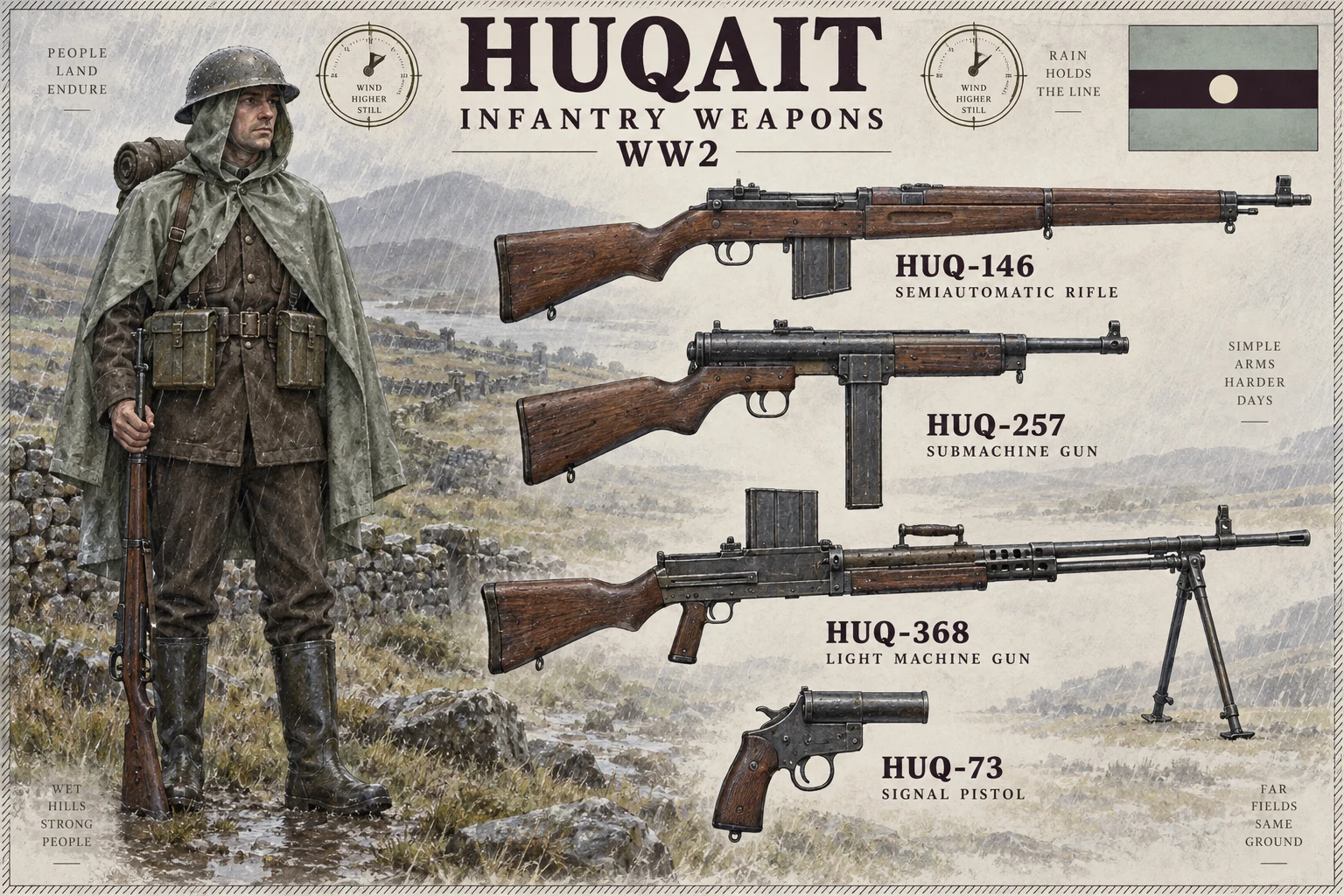
The Huqaiti advance at Qeran put Hadin Serk's established mountain supply line in danger. Troops retook a saddle junction and occupied shelters from which they could disrupt movement supporting the Hukular 1st Gaften Expeditionary Corps. Serk responded between April 16 and 24, 1231, seeking to recover that junction and a shorter defensible line. The counterstroke aimed at the shoulder of the Huqaiti advance, where reinforcement and heavy evacuation had to pass. Restoring every lost mountain position would have consumed the reserve before securing the supply connection. Serk chose a bounded recovery that could preserve the resident deployment under growing Allied pressure elsewhere in Gaften.
The corps' endurance depended on a rear system built over time. Its original deployment and continuing replacements arrived by sea through consenting Ruuyaq and Azmar reception facilities, under newly authored agreements for defined unloading and support. Supplies then moved by Axis-controlled approaches into existing lodgments and onward to the mountain front. These arrangements did not create a land frontier with Hukular or rights through neutral Amarin. Raden Thesk coordinated the overseas commitment from headquarters in Hukular, while Soren Kast directed national strategy there. Neither commanded the saddle fight on site. Serk's resident workshops, vehicles, and stocks were distinct from the separate expeditionary force operating in Viar.
Huqaiti troops held the upper shelters and kept them supplied along a hidden pack trail when the main road became unsafe. Hamir Qel served through authorized Allied partner arrangements, helping connect the field response rather than appearing as a Hukular commander. The defenders of the captured saddle understood that possession alone would not sustain their advance. They dispersed carrying parties and conserved supplies in the upper positions while seeking to push pressure down toward the road. The pack trail let them remain in strong ground despite artillery attention to more visible approaches. Serk consequently could not expect that restricting one road would force an immediate withdrawal from every shelter.
The holding group absorbed renewed Huqaiti pressure while the counterstroke reserve stayed behind it. That separation was difficult to maintain when the forward infantry requested help, but Serk needed a force still able to attack once the Huqaiti advance exposed its shoulder. The reserve drew ammunition from a separate collection point and prepared on routes tested for movement and recovery. The holding troops reported which enemy positions received support and which had begun to move independently. Those reports showed a widening gap between the strong upper shelters and the route needed to reinforce the forward advance. Serk planned to attack that connection while keeping enough support with the holding group to prevent its collapse.
The first counterstroke movement met a defense able to shift by the pack trail. Huqaiti infantry pressed the road-facing positions and retained cover above the route Serk needed. Hukular supporting fire changed toward the reinforcement approaches as the reserve advanced, but could not abandon the holding troops entirely. Serk moderated the movement when the leading parties threatened to outpace their own carrying route. Fuel and recovery capacity mattered for mobile elements reaching the lower approaches, while stores beyond vehicle access still traveled in smaller loads. A reserve arriving at the shoulder exhausted would offer little relief to the holding group and might create another isolated commitment.
The Huqaiti command answered by concentrating around the shelters and shifting loads along the concealed trail. This preserved resistance after the main road came under greater pressure. Leading units still held useful ground, but their common route narrowed as Hukular parties gained the shoulder approach. Qel's partner network sought to maintain communication between troops staying forward and those guarding the junction. Serk's reserve pressed the junction while the holding infantry fixed the strongest road-facing positions. That combination made reinforcement harder without requiring the attackers to overwhelm every upper shelter simultaneously. The contest turned on whether the Huqaiti forward groups could continue advancing together from the ground they had taken.
When Hukular retook the shoulder junction, the answer changed. Forward Huqaiti units retained strong points, but supplying and evacuating them as one force became more difficult. The defenders withdrew from the exposed salient with part of their equipment intact rather than abandon every position in flight. Serk's infantry recovered the shelters connected to the junction and established contact with the holding group. The reserve stopped at the regained line instead of pursuing along unfamiliar upper paths. Its task had been to relieve the supply threat; extending farther would place the corps back in the same predicament, with strong forward positions and an increasingly vulnerable route behind them.
The recovered line needed repair and redistribution immediately. Holding troops had endured the attack before relief arrived, and the reserve had consumed stocks and mechanical capacity during its movement. Medical transport and equipment recovery competed with fresh ammunition on the narrow approaches. Crews cleared receiving areas and repaired damaged shelter before additional loads moved forward. Serk assigned guards where the concealed pack route could still support renewed pressure, accepting another continuing claim on infantry. The breathing space enabled the corps to reorganize its sea-fed reserve and workshops. It did not remove the reception limits, shipping demands, or mountain gradients that determined how quickly another operation could be prepared.
Capture and withdrawal left people whose movements were not described adequately by the regained front line. Huqaiti medical workers and surviving comrades preserved names of the wounded and those taken into custody, checking copies against transfer information where it could be obtained. Relatives pursued those records even when formal requests failed to explain an absence. Hukular's guards remained responsible for prisoners' treatment despite congestion on the road. Residents around the shelters also faced restrictions on paths used for ordinary supplies, and some carried essential tools away before military parties claimed the surviving buildings. These acts preserved personal histories and practical resources without implying that the counterstroke had resolved their vulnerability.
By April 24, Hukular had recaptured the shelters and trail junction and preserved its resident deployment through a shorter line. Increasing Allied pressure across Gaften continued, and Huqaiti survivors retained forces and routes beyond the recovered position. No exact local strengths or losses are authored; national establishments do not measure the troops at the saddle. Qeran's detailed movement and shelter relationships are schematic fictional additions within the retained Huqaiti theater. Serk's unchanged fictional quotation distinguishes the recovery from total victory: the opponent still had strong points, but had lost the connection that made them advance together. The corps used that interval for repair rather than claiming a continent restored by one counterstroke.
Forces & losses
No verified engagement-level strength figures have been authored for this record.
No verified engagement-level casualty figures have been authored for this record.
Voices from the campaign
At Qeran Saddle Counterstroke, the enemy still held strong points after the road shoulder fell. What they no longer held was a way to make those points advance together.Hadin Serk · Authored fictional archival excerpt
Participants and command
Hukular, Huqait, Ruuyaq Axis partners
Soren Kast, Hadin Serk, Raden Thesk, Hamir Qel