Proposed canon. Dates, tactical sequences and local positions are newly developed unless the text explicitly identifies a creator or source anchor. Related images document the wider war; they are not photographs of this proposed battle.
Strategic objective
Hestunia seeks to sustain its distant maritime connections against Kelonese interception. Success is measured by delivered cargo and returning transport capacity, not by a claimed tally of enemy ships.
Ground & operational constraints
The proposed passage crosses exposed sea lanes between staging ports. Weather and the distance between repair facilities matter more than a continuous territorial front. Neutral Braskor is not a belligerent escort provider.
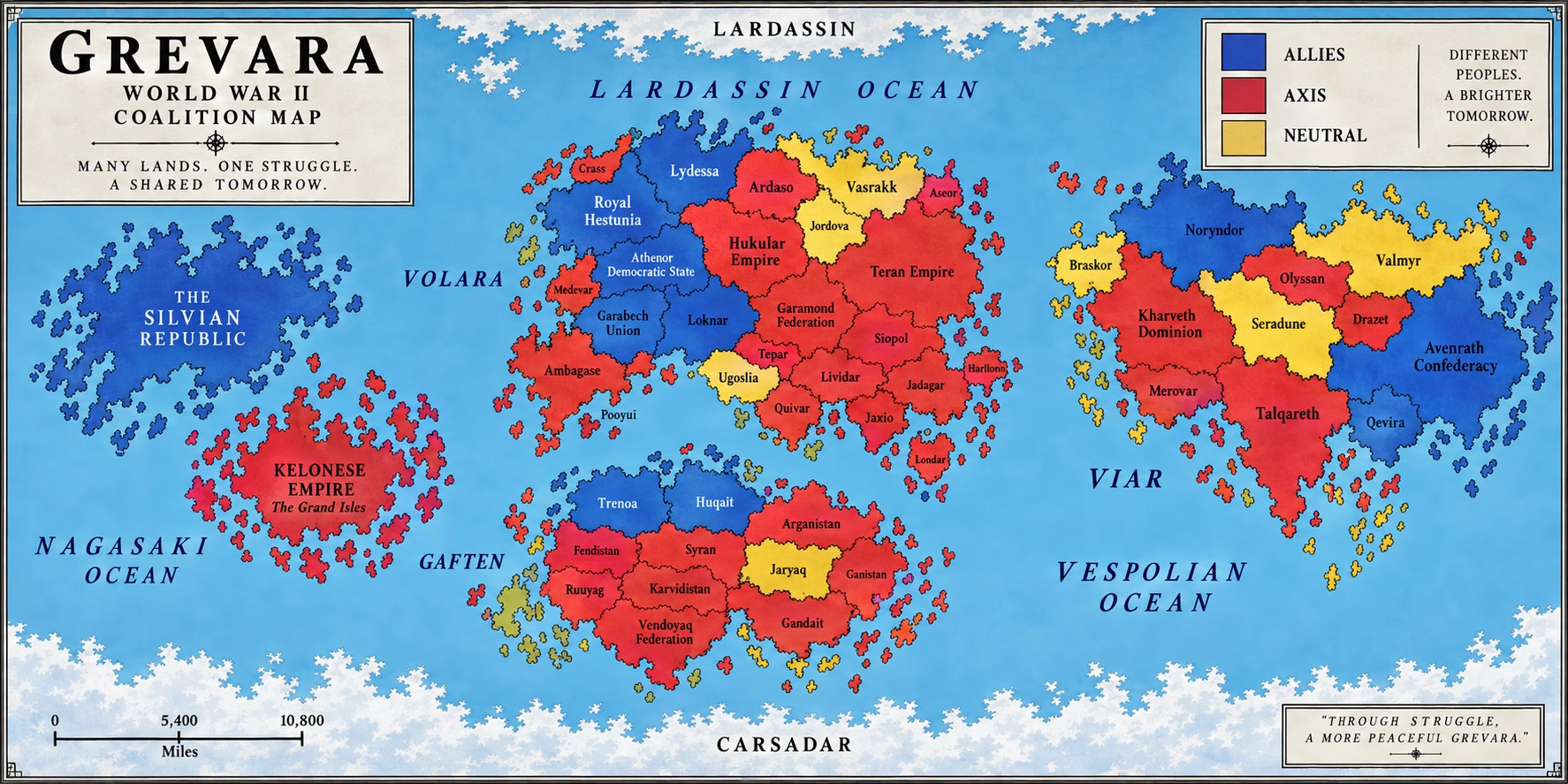
● Axis ● Allied ● Neutral · Zoom reveals cities, engagements and local positions. Drag to pan; use +/− or Ctrl+scroll to zoom. Hold over a marker for 5 seconds; click, tap or press Enter for immediate details.
Battle reference table
| Reference | Record |
|---|---|
| Dates | 1212-02-08 — 1212-12-19 |
| Participants | Kelonese Empire; Royal Hestunia |
| Scale | Colossal |
| Status | Proposed canon |
Commands & participating forces
Named operational commanders and supporting force groupings below are proposed additions unless explicitly marked creator-established. They are not a recovered order of battle or a claim of precise unit strength.
| Nation | Commander | Status | Forces |
|---|---|---|---|
| Kelonese Empire | Kezan Morai | Proposed operational commander | Imperial naval forces, naval infantry, island garrisons and dispersed coastal transport defend bases while competing for fuel, repair capacity and trained crews. |
| Royal Hestunia | Oren Valcrest | Proposed operational commander | County-raised infantry, assault engineers, artillery and transport units sustain the front. Royal and coalition authorities retain separate responsibilities. |
Fighting, tactics & logistics
The opening phase concentrates Hestunian shipping into scheduled departures so that scarce escorts do not disperse across every merchant movement. Kelonese forces respond by watching the approaches to receiving ports, where ships must eventually converge regardless of their earlier route. The encounter therefore develops around access to unloading facilities rather than an attempt to occupy an entire ocean.
A second phase exposes the weakness of concentrating arrivals. Vessels awaiting berths consume fuel and remain vulnerable while their cargo is still unavailable to the intended formations. Hestunian port officials stagger unloading priorities, moving medical supplies and essential repair components before lower-priority bulk cargo. Damaged transports receive separate handling so that a disabled vessel does not block the principal channel.
The later contest becomes one of endurance. Escort maintenance, crew rest and available towing capacity limit how frequently protected sailings can occur. Kelonese interception forces face their own distance and servicing problems. The proposed campaign ends with an unreliable but functioning Hestunian passage, rather than complete control of every sea lane.
Civilian consequences
Merchant crews, dock laborers and island households carry much of the risk. Delayed military shipments also delay ordinary goods where they share ships and receiving facilities. No unsupported shipping-loss total or civilian casualty estimate is assigned.
Outcome & wider significance
The revised proposal preserves an Allied maritime connection without assigning a national combat role to neutral Braskor. Hestunian shipping remains costly to protect, while Kelonese forces fail to turn intermittent disruption into permanent closure.