Proposed canon. Dates, tactical sequences and local positions are newly developed unless the text explicitly identifies a creator or source anchor. Related images document the wider war; they are not photographs of this proposed battle.
Strategic objective
Arganistan’s Axis command seeks to improve highland connections supporting pressure on Huqait. Huqaiti forces aim to prevent local road gains from becoming a sustained additional offensive route.
Ground & operational constraints
Ridges divide movement into separate road systems. A usable track is not necessarily capable of carrying heavy vehicles or sustaining repeated supply runs. Neutral Jaryaq is excluded from the belligerent order of battle.
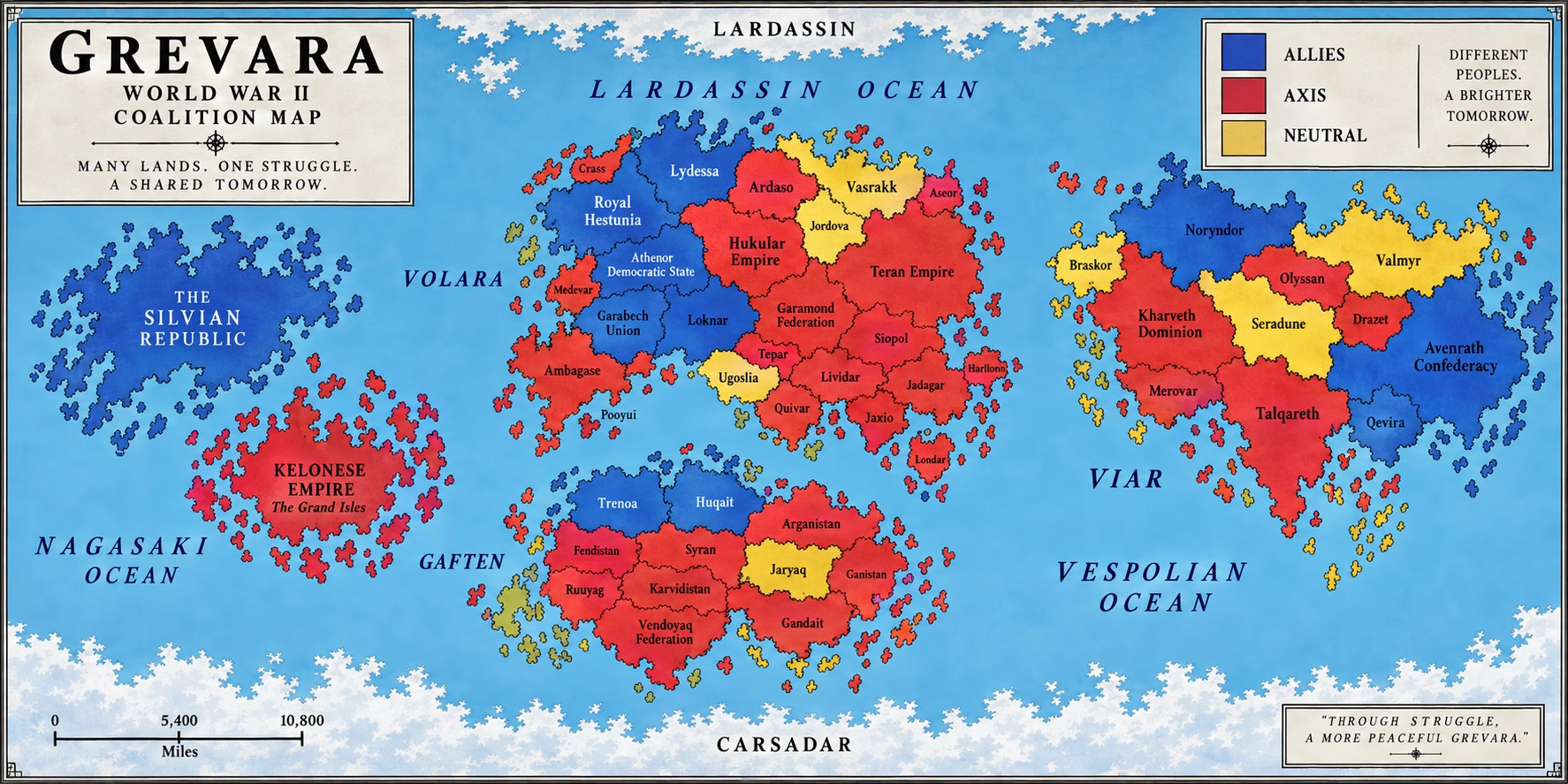
● Axis ● Allied ● Neutral · Zoom reveals cities, engagements and local positions. Drag to pan; use +/− or Ctrl+scroll to zoom. Hold over a marker for 5 seconds; click, tap or press Enter for immediate details.
Battle reference table
| Reference | Record |
|---|---|
| Dates | 1213-07-01 — 1214-04-16 |
| Participants | Arganistan; Huqait |
| Scale | Colossal |
| Status | Proposed canon |
Commands & participating forces
Named operational commanders and supporting force groupings below are proposed additions unless explicitly marked creator-established. They are not a recovered order of battle or a claim of precise unit strength.
| Nation | Commander | Status | Forces |
|---|---|---|---|
| Arganistan | Arman Qadir | Proposed operational commander | Highland infantry and carrying columns operate from fortified staging depots, with limited artillery movement over difficult roads. |
| Huqait | Harun Vaqir | Proposed operational commander | Mountain infantry, pack artillery, demolition teams and local carrying services defend pass systems and secondary tracks. |
Fighting, tactics & logistics
Arganistani forces first secure forward staging areas and begin improving tracks behind them. Huqaiti commanders avoid treating every occupied ridge as equally important. They concentrate on approaches that connect to populated valleys and functioning supply roads, while maintaining observation over less useful ground.
The middle phase is shaped by engineering rather than a single summit assault. Forward positions consume food, water and repair effort even when they are not advancing. A temporary gain becomes a liability if vehicles cannot reach it or damaged equipment cannot return. Huqaiti pressure on the usable approaches forces the Axis command to divide its engineering and security resources.
As the campaign continues, the two sides compete for the ability to hold ground through weather and interruption. Huqaiti local knowledge helps with route selection but does not remove shortages or the need for trained staff. The proposed settlement of the fighting is a restricted Arganistani forward zone that falls short of the larger transport objective.
Civilian consequences
Highland communities lose grazing access and face requisition along the few usable roads. Neutral Jaryaq’s border pressures belong to a separate diplomatic and civilian history, not to an invented Jaryaq field campaign.
Outcome & wider significance
Arganistan gains some local positions but does not establish an unrestricted highland military connection. Huqait preserves the principal routes needed for its defense.