Proposed canon. Dates, tactical sequences and local positions are newly developed unless the text explicitly identifies a creator or source anchor. Related images document the wider war; they are not photographs of this proposed battle.
Strategic objective
Syran intends to break Huqaiti resistance by reaching the roads behind the northern defenses. Huqait needs to keep the Trenoan assistance route open.
Ground & operational constraints
High roads have little room for passing vehicles. Snowmelt damages culverts while steep shoulders deny armored formations easy deployment.
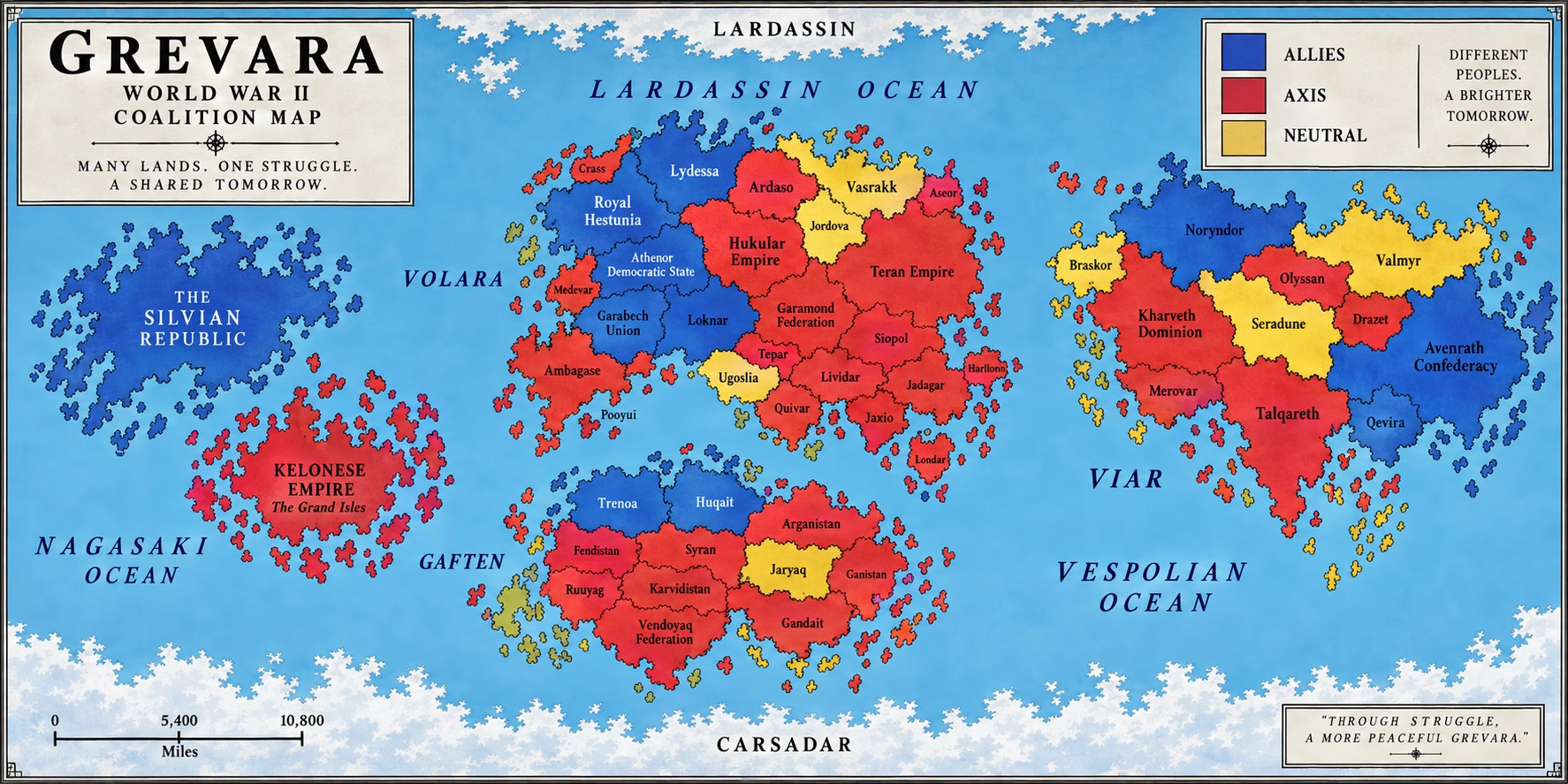
● Axis ● Allied ● Neutral · Zoom reveals cities, engagements and local positions. Drag to pan; use +/− or Ctrl+scroll to zoom. Hold over a marker for 5 seconds; click, tap or press Enter for immediate details.
Battle reference table
| Reference | Record |
|---|---|
| Dates | 1208-11-19 — 1209-07-16 |
| Participants | Syran; Huqait; Trenoa |
| Scale | Colossal |
| Status | Proposed canon |
Commands & participating forces
Named operational commanders and supporting force groupings below are proposed additions unless explicitly marked creator-established. They are not a recovered order of battle or a claim of precise unit strength.
| Nation | Commander | Status | Forces |
|---|---|---|---|
| Syran | Rashad Kassem | Proposed operational commander | Mobile infantry columns operate with towed artillery, reconnaissance patrols, tankers and recovery detachments; water and workshop capacity govern their reach. |
| Huqait | Harun Vaqir | Proposed operational commander | Mountain infantry, pack artillery, demolition teams and local carrying services defend pass systems and secondary tracks. |
| Trenoa | Samir Naref | Proposed operational commander | Sultanate infantry, mobile patrols, water columns and road-repair units sustain desert operations and the Huqait assistance service. |
Fighting, tactics & logistics
Syran infantry seizes lower staging areas and pushes guns uphill in sections. Huqaiti detachments abandon exposed summits to hold reverse slopes. Trenoan carriers bring ammunition and medical stores along the documented aid route. A summer Syran attack reaches the upper road but exhausts its ammunition before reserve infantry can exploit the penetration.
Civilian consequences
Mountain villages become carrying stations and casualty shelters. Local herds are dispersed because concentrating pack animals near the road attracts shelling.
Outcome & wider significance
Huqait retains the North Pass. The documented June 1209 hold anchors the outcome; the opening-to-July operational arc is proposed. Syran shifts attention toward the southern approaches.
Developed battle history
The battle in detail
Expanded Grevara lore: new events, characters and in-world accounts developed for this archive. Supplied historical quotations retain their source links.
The road Syran wanted
Syran’s offensive began on 19 November 1208 with an ambition larger than the capture of a mountain summit. The northern approaches of Huqait contained the roads by which defenders could move between the upland districts and the routes toward Trenoa. If Syran could reach the junctions behind the first defensive positions, Huqaiti formations might be compelled to retreat from ground they still held. The invaders therefore treated the North Pass as an operational doorway rather than an isolated trophy.
General Harven Suyr commanded the Syran advance. His plan called for the lower staging areas to be secured before the heavier supporting equipment moved uphill. Infantry would then occupy the approaches to the pass and force the defenders either to accept battle in exposed forward positions or to withdraw toward the upper road. The plan assumed that pressure could be maintained during each transition. The mountains made that assumption difficult to fulfill.
Huqaiti General Neral Havad expected an attack on the obvious heights and chose not to make those heights the center of his defense. He placed observation detachments forward while keeping stronger positions on reverse slopes, where troops could shelter from direct observation and engage an enemy as it crossed the crest. The decision seemed to concede the most impressive ground on a map. In practice it denied the attackers an easy way to bring their full supporting fire onto the principal defenses.
The first weeks tested these competing ideas. Syran could take ground without necessarily forcing the decisive battle it wanted. Huqait could preserve troops by withdrawing from exposed positions, but every withdrawal risked allowing the enemy to establish observation over another stretch of the road. Neither commander could solve the campaign simply by choosing to advance or hold.
The lower terraces
The first sustained engagement developed around the lower terraces, where cultivated slopes met the rising road. Local walls divided the ground into small compartments. They offered infantry cover but made it difficult for an advancing formation to maintain a common pace. A company moving along a terrace could disappear from the view of the unit beside it while remaining only a short distance away.
Captain Marev Hal commanded the Huqaiti detachment defending the principal approach. He placed his strongest group near a bend from which the road could be observed and kept a smaller group on the terraces above. The arrangement allowed one position to warn the other of movement, but it depended on messengers crossing exposed gaps when the telephone connection failed.
The Syran infantry attacked after preliminary fire struck the road position. Its leading group advanced against Hal’s main defense while another climbed through the terraces. The upper Huqaiti group resisted, then withdrew when Syran troops appeared beyond its flank. Hal received the warning in time to begin moving his main group uphill, but the withdrawal became disordered when a damaged cart blocked the narrow road behind the position.
The defenders cleared the obstruction under fire and recovered part of their equipment. Some stores had to be abandoned. Syran occupied the lower position by evening and claimed an important opening success. Havad’s headquarters accepted the loss of the ground while questioning whether the detachment had remained too long. Hal answered that an earlier withdrawal would have left the road open before the upper defense was ready. That disagreement introduced a recurring tension in the campaign: a delay useful to one formation could endanger the unit ordered to create it.
The summit that was not the defense
Suyr directed the next attack toward a prominent summit above the road. From below, the height appeared to dominate the pass. Its capture would provide observation, deny the defenders a conspicuous position and give the offensive a visible achievement. Syran’s leading battalion climbed toward it expecting a substantial fight near the crest.
The Huqaiti observation detachment withdrew after a brief exchange. Its commander left behind signs of recent occupation but removed the equipment needed for continued observation. The Syran troops reached the summit and reported success. Their difficulties began when they tried to move beyond it. The reverse slope fell toward broken ground that could not be observed clearly from the crest, and the main Huqaiti positions were placed where they could fire on troops descending into it.
A Syran company advancing down the far slope came under concentrated fire and sought shelter in shallow folds. Supporting troops on the summit could see the company’s predicament without being able to identify every defending position. Fire directed from above struck some useful targets but also passed over positions concealed closer to the slope. The attack stalled before the company reached the road connection it had been assigned to seize.
Havad did not immediately counterattack the summit. Holding the reverse slope gave him much of the defensive benefit without requiring troops to occupy the exposed height. He instead reinforced the positions covering the descent and watched for an attempt to turn them. The Syran command had gained observation and a forward position, but it had not broken the defense. The difference between possessing the highest ground and controlling the useful ground became one of the North Pass campaign’s defining lessons.
The guns carried in pieces
Syran’s supporting artillery could not move uphill as though the road were an open plain. Some equipment required dismantling or careful handling at the narrowest sections. Movement had to be scheduled around ammunition, food and the return of wounded personnel. A stalled load did not merely delay itself; it interrupted everything behind it until the road could be cleared.
Major Varin Tes, responsible for one supporting group, established a receiving area below the steepest climb. There, crews checked equipment before sending it farther uphill. The arrangement reduced the chance that a missing component would be discovered only after a difficult ascent, but it also created a concentration vulnerable to observation and attack. Tes dispersed what he could, accepting longer carrying distances in exchange for reducing the effect of a single strike.
When the first guns were brought into action near the summit, their crews faced limited space and awkward angles. Positions with a useful field of fire did not always provide a safe route for ammunition. Positions easier to supply sometimes offered less effective support. Tes repeatedly moved his observers rather than the guns, trying to improve the information on which fire was directed without undertaking another exhausting displacement.
The Huqaiti defense exploited interruptions in this process. Local attacks against observation parties or exposed road movement could delay support without destroying a gun. Syran officers complained that the defenders avoided decisive combat while striking at the offensive’s machinery. That complaint described Havad’s method accurately. He could not match every concentration of enemy force, so he sought to make each concentration harder to assemble and sustain.
The Trenoan connection opens
Trenoan assistance began to matter in December, after the documented opening of the support route to Huqait. The first movements did not transform the defense overnight. Cargo had to cross administrative boundaries, reach receiving points and then be divided among formations whose needs were changing faster than the requests could be updated. A shipment useful when ordered could arrive after the unit had moved or after another requirement had become more urgent.
Trenoan liaison officer Lera Tamin worked with Huqaiti quartermaster Adren Suv to establish a common receiving ledger. Tamin wanted proof that consignments reached their intended destination. Suv warned that insisting on the original destination after a retreat could prevent cargo from reaching the troops now doing the fighting. Their solution recorded both the original allocation and any authorized change, preserving accountability without assuming the front remained still.
The route carried ammunition and medical stores that the defenders could not readily replace locally. It also carried expectations. Trenoan officials wanted evidence that assistance was sustaining a coherent defense rather than disappearing into an uncontrolled retreat. Huqaiti commanders resented questions that seemed to imply distrust while their troops were under attack. Tamin’s work therefore involved explaining battlefield changes as well as checking receipts.
The military effect became visible gradually. Positions that had rationed ammunition severely could answer renewed attacks more reliably. Medical units received supplies that improved their ability to treat casualties before evacuation. None of this removed the constraints of the mountain road. It gave Havad more room to choose when to stand, when to withdraw and when a limited counterattack was worth the resources it would consume.
The ridge patrol
Havad’s observation system depended on patrols moving across ridges that did not appear important on a broad theater map. One such patrol, led by Lieutenant Seran Vel, was sent to determine whether Syran troops were preparing a route around the principal reverse-slope positions. Reports from shepherds suggested movement near an abandoned carrying path, but the reports disagreed about its size and direction.
Vel’s patrol found signs that equipment had been dragged across the path and followed them toward a shallow saddle. There it encountered a Syran reconnaissance party. The exchange was brief and confused, with both groups seeking cover among rocks that broke visibility into small fragments. Vel withdrew his forward men before the patrol could become fixed in place, then moved to a second observation point from which the saddle could be watched.
The patrol returned with a limited but useful conclusion: the route was being examined, not yet used by a large formation. Havad reinforced the nearest defensive position and ordered further observation rather than diverting a major reserve immediately. The distinction prevented a small enemy reconnaissance effort from producing a disproportionate reaction.
Syran subsequently attempted to improve the path, but progress was slow. The route could support small groups more readily than the equipment required for a sustained attack. Its existence nevertheless forced the Huqaitis to extend their observation network and keep troops available against a threat that might never fully develop. Mountain warfare repeatedly imposed that burden. A route did not have to carry an army to influence the army’s dispositions; it only had to remain a credible possibility that commanders could not safely ignore.
The first winter counterattack
The Huqaiti counterattack in the winter period aimed to recover a road bend below the reverse-slope defense. Syran observers near the bend had begun identifying movements along the upper approach, forcing the defenders to change their schedules and carry supplies by less direct routes. Havad authorized a limited attack to remove that observation advantage, while forbidding pursuit beyond the next terrace line.
Major Kesrin Vah led the assault. His troops approached through ground screened from the principal Syran positions, but the final movement crossed an exposed strip above the road. The first group reached the bend and engaged the observation post. A second group, intended to secure the flank, encountered resistance from a building thought to be empty. Its delay left the first group exposed to fire from farther down the road.
Vah committed his reserve to the building rather than sending it directly to the bend. That decision temporarily left the leading troops with little immediate reinforcement, but clearing the building restored the route they would need either to receive support or to withdraw. Once the flank was secured, the Huqaitis consolidated the bend and removed the enemy’s observation equipment.
Syran counterattacked later in the day. The defenders held long enough to damage the position’s usefulness and then withdrew under Havad’s original limits. They did not retain all the ground they had taken. They did force Syran to rebuild its observation arrangements and temporarily eased pressure on the upper approach. The result was modest in territorial terms and meaningful in operational terms, a distinction easily lost in later accounts that judged the action only by the line held at its end.
Villages between the routes
The upland villages were drawn into the campaign because they stood near the paths that remained usable when the principal road was blocked. Houses became temporary receiving points, barns held stores, and local knowledge determined whether a carrying party could reach a position without losing hours on a damaged route. These functions brought attention from both armies and exposed settlements that had initially seemed peripheral to the battle.
Village headwoman Sera Namin organized the dispersal of pack animals after shelling struck a concentration near the road. Keeping the animals together made allocation easier, but also made one interruption capable of disabling much of the carrying system. Dispersal reduced that risk while complicating feeding, supervision and the assembly of parties. Namin insisted that military requests include a return arrangement, having seen too many animals taken uphill without anyone assigned to bring them back.
The demands on local people were unequal. Families with animals or storage space were called upon repeatedly; families without them still faced food shortages and the loss of workers to carrying duties. Disputes developed over compensation, especially when equipment was damaged or supplies consumed before receipts could be completed. Tamin and Suv’s receiving system helped with some military cargo but did not automatically settle civilian claims.
Havad’s headquarters eventually appointed liaison personnel to the principal villages. Their presence improved communication, although it could not make the army’s needs harmless. The campaign’s endurance depended in part on civilian participation that was not always voluntary and was rarely costless. Recognizing that fact gives the defense a fuller history than a simple account of heroic troops sustained by an invisible countryside.
Snowmelt and the broken culverts
The thaw introduced problems that neither side could solve with additional infantry alone. Water undermined sections of the road and damaged culverts that had survived earlier traffic. A route inspected in the morning could become unsafe later in the day as runoff increased. Loads accumulated below the damaged sections, creating new concentrations at places never intended to serve as depots.
Huqaiti engineer Captain Daren Hu placed inspection parties along the most vulnerable stretch. Their task was to report not merely whether a route was open, but what kind of movement it could sustain. A path usable by a carrying party might not support a loaded vehicle. A crossing safe for one passage might need repair before another. Commanders who reduced these distinctions to a single word—open—received an incomplete answer to the question they actually needed to ask.
Syran experienced similar failures on the lower approaches. Tes’s artillery group lost time moving ammunition around a damaged section, and a proposed displacement had to be postponed because the alternate route could not carry the required loads. The delay interrupted plans for renewed pressure on the reverse-slope positions.
Both sides used the interruptions to reorganize, but neither could assume the pause would last equally long for the enemy. Havad kept forward observation active while rotating exhausted troops from positions that could be relieved. Suyr concentrated repair effort on the route supporting his intended main attack, accepting slower movement elsewhere. The thaw therefore did more than reduce mobility. It forced each command to reveal, through the allocation of engineers and transport, which part of the front it considered most important.
The false concentration
Huqaiti observers reported a growing Syran concentration west of the main road during the spring. Fires, movement and repeated visits by staff personnel suggested preparations for an attack. Havad considered shifting his reserve toward the threatened sector, but the reports contained an inconsistency: the observed activity exceeded the apparent improvement in the routes needed to sustain a major force there.
Vel’s patrol was sent to examine the supporting approaches. It found evidence of deliberate activity but little sign that the heavier requirements of a sustained attack were being assembled. The conclusion did not prove that the concentration was false. It suggested that the visible preparation might be intended to draw attention away from the main road.
Havad reinforced the sector modestly and retained his larger reserve near the upper junction. Suyr’s deception therefore achieved some effect without producing the wholesale redeployment he wanted. The Huqaitis spent time and resources watching a threat that did not develop into the main assault, but they did not abandon the position that would soon come under the greatest pressure.
The episode illustrates the limits of intelligence on both sides. Havad did not possess a complete enemy plan; he made a choice from reports of varying reliability. Suyr could create misleading indications, but he could not fully control how the defenders interpreted them. The contest was not between perfect knowledge and foolishness. It was between commanders trying to distinguish what the enemy wanted them to see from what the enemy needed to do.
The upper road attacked
The renewed Syran assault concentrated on the upper road rather than the summit alone. Suyr intended to break through the reverse-slope defense and reach the junction behind it before Huqaiti reserves could restore the line. Supporting fire was directed against known positions and the routes by which reinforcements were expected to move. The attack’s success depended on the infantry advancing while that disruption still limited the defense’s response.
The leading Syran formations gained more ground than in the earlier attacks. One group penetrated between two Huqaiti positions whose connection had been weakened by shelling and the loss of a messenger party. The defenders on either side continued fighting without immediately realizing that the ground between them was no longer secure. Reports reaching Havad described separate local pressures rather than a single breach.
Captain Hal, now commanding a reorganized detachment near the upper road, encountered Syran troops approaching from a direction he had expected to remain protected. He pulled his men into positions covering the junction and sent a warning directly to the reserve command. His action prevented the attackers from reaching an undefended road, but it also left the position he had abandoned exposed to further movement.
The Syran penetration was real and dangerous. It had carried the attack beyond the pattern of isolated gains that characterized the winter fighting. Yet the leading troops had reached the upper road with their supporting system still struggling to follow. They could threaten the junction immediately; they could not yet guarantee the ammunition, communications and reinforcement needed to hold it against a determined response.
The ammunition gap
Suyr’s staff expected reserve infantry to pass through the penetration and widen it. That movement arrived later than planned. The leading formations were still fighting for the ground needed to protect the route, and the reserve encountered congestion at several points below the breach. Officers attempted to move groups forward independently, improving the immediate flow while weakening control over how they would assemble at the upper road.
Ammunition expenditure in the leading units exceeded the assumptions used to prepare the first deliveries. Fighting at close range around the road positions consumed stocks quickly, while carrying parties faced exposed sections that had not yet been secured. Some reached the wrong receiving point after their intended unit moved. Others waited for escorts whose personnel had been committed to the fighting.
The resulting shortage did not make the attackers stop firing at once. It forced choices about which positions could be supported and which threats required ammunition to be conserved for an expected counterattack. A company that had advanced aggressively earlier in the day became less able to exploit another opening by evening. Its commander’s caution reflected a material constraint, not a sudden loss of willingness to fight.
Havad’s observers detected the change imperfectly. Reports of reduced fire might indicate shortage, reorganization or preparation for another attack. He could not know the exact condition of the opposing units. He nevertheless judged that the moment for a counterattack had arrived before the penetration could be reinforced fully. The decision rested on the timing of the enemy’s advance and the state of his own reserve as much as on any direct knowledge of Syran ammunition levels.
The junction held
Major Vah’s reserve entered the battle through a protected approach that Hu’s engineers had kept usable during the thaw. The route’s importance now became immediate. Without it, the reserve would have reached the junction in smaller groups after a longer movement, reducing the force available at the moment of contact. Its earlier maintenance had preserved an option that the command could now exercise.
Vah did not attack directly along the road occupied by the Syran leading troops. He moved one group against their exposed side while another reinforced Hal’s defense near the junction. The two actions aimed to prevent the attackers from choosing freely between holding their penetration and continuing forward. The Syrans resisted strongly and briefly pushed back part of the flanking group, but their difficulty sustaining fire became increasingly consequential.
The reserve infantry intended to support the Syran advance arrived in fragments. Some joined the fighting effectively; others were redirected toward positions already under pressure, losing the chance to act as a coherent exploiting force. By the time enough men had assembled near the upper road, the Huqaiti counterattack had restored a more continuous defense around the junction.
Suyr ordered the forward units to consolidate on ground they could supply rather than continue toward an objective they might capture only temporarily. The withdrawal from the most exposed positions took place under pressure and left wounded personnel and equipment behind. Havad prohibited an uncontrolled pursuit. His own reserve had spent much of its strength, and the enemy still held positions from which a rash advance could be punished. The junction remained Huqaiti, but the battle had come close enough to success for Syran that neither side treated the outcome lightly.
A pass is held by a system
The documented Huqaiti hold in June 1209 anchors the outcome of the campaign. The defense did not survive because every forward position remained intact. Several had been lost, recaptured or abandoned deliberately. It survived because the remaining positions, routes and reserves continued to support one another at the moments when the enemy threatened to separate them.
Hal’s retreat from the lower terraces, Havad’s choice of reverse slopes, the Trenoan deliveries and Hu’s road work all belong to that explanation, but none is sufficient alone. A reserve without a usable route would have arrived too late. A route without troops available to move along it would have solved little. Ammunition delivered to the region still needed to reach the unit fighting at the junction. The campaign repeatedly turned on the links between those functions.
Syran’s failure was similarly cumulative. Its infantry demonstrated that the defense could be penetrated. Its supporting system could not consistently convert those penetrations into a durable operational result. Terrain, resistance, damaged routes and the timing of reserve movement compounded one another. Reducing the outcome to a single commander’s mistake would conceal the difficulties that made even competent local decisions insufficient.
“The road did not defend us. We kept it working long enough to defend each other.”
— Captain Daren Hu, newly written in-world account of the North Pass campaign.
The quotation expresses the defense’s practical character. The pass was neither an impregnable wall nor an inevitable trap for an attacker. It was a position whose value depended on sustained organization under pressure. Huqait retained it by preserving enough of that organization through successive crises.
The July disengagement
Fighting continued after the decisive check at the upper road. Patrols tested positions, artillery answered identified targets and local commanders sought small improvements before the front settled. These actions mattered to the units involved even when they did not change the campaign’s outcome. A safer observation point or a shorter carrying route could determine how a formation endured the weeks that followed.
By the proposed close of the North Pass campaign on 16 July, Syran was shifting attention toward the southern approaches. The change did not require the immediate abandonment of every northern position. Holding forward ground kept pressure on Huqait and forced Havad to maintain forces there while preparing for threats elsewhere. The northern front therefore remained part of the wider war after the initial offensive had failed to secure its main objective.
Havad rotated exhausted formations as conditions permitted and ordered a review of the positions that had nearly been separated during the upper-road attack. The review produced changes in liaison, reserve warning procedures and the reporting of route capacity. It also exposed disagreements that wartime summaries tended to smooth over. Some officers believed the forward defense had withdrawn too readily; others argued that it had remained exposed too long. Their different judgments reflected the different information available from each position.
The campaign ended with Huqait retaining the pass and the Trenoan connection continuing to support its resistance. The immediate outcome was defensive. Its wider significance lay in denying Syran the rapid disruption of Huqait’s northern system and compelling the invader to seek another approach. For the villages, carrying parties and surviving units, the end of this battle meant a change in pressure rather than a return to peace.